

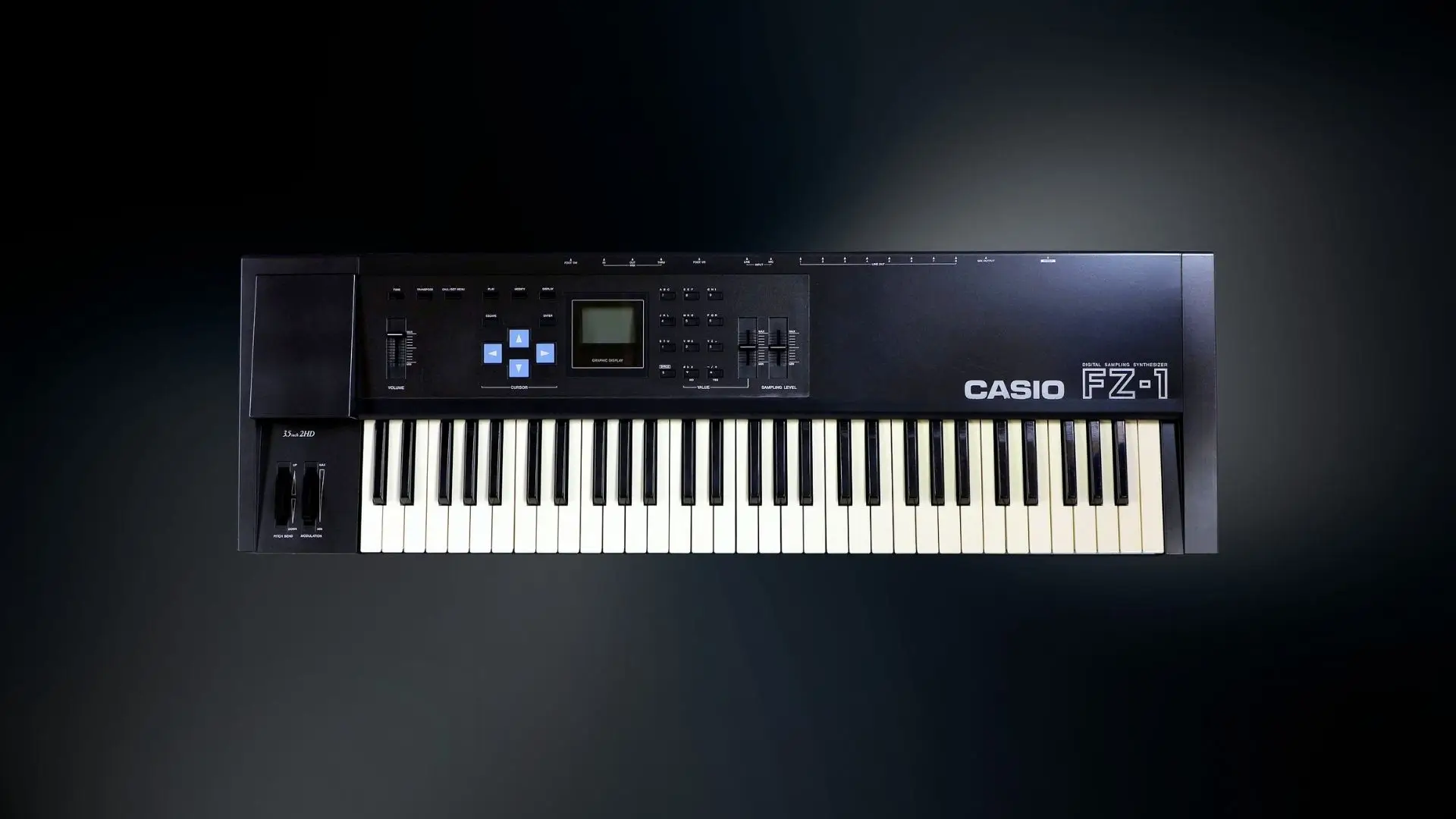
The Casio FZ-1 is a 61-key digital sampling synthesizer introduced in 1987, built around 16-bit sampling, graphic waveform editing, eight-voice polyphony, and a surprisingly deep sound-design system for its period. It was not simply a consumer keyboard with a sampling feature attached; it was Casio’s serious attempt to enter the professional sampler market at a moment when digital sampling was moving from elite studio equipment into the working musician’s reach.
Table of Contents
Casio FZ-1 sound and character
The Casio FZ-1 sounds cleaner and more extended than many earlier 12-bit samplers, but it is not sterile in the modern software sense. Its character comes from the combination of 16-bit sampling, selectable sample rates, resonant digitally controlled filtering, eight-stage envelopes, and unusually flexible looping. At higher sample rates, it can sound crisp, immediate, and surprisingly polished for a mid-1980s keyboard sampler. At lower rates, especially 9 kHz, it moves into a more grainy, narrow-band, lo-fi territory that can be used creatively rather than merely tolerated as a limitation.
Its strongest musical territory is not just “realistic instrument reproduction,” although that was part of the original appeal. The Casio FZ-1 is especially interesting when it treats samples as raw material: percussion with clean decays, vocal fragments, synthetic tones, short waveforms, layered attacks, reversed sounds, and evolving loops. The graphic editing system matters here because the player is not working blindly through numbers alone; waveforms, envelopes, and harmonic information become visible. For 1987, that made the act of shaping a sample feel closer to editing sound as material, not merely loading a preset from disk.
The filter and modulation architecture give the instrument a more synthesizer-like personality than many samplers of its era. The DCF and DCA envelopes, velocity modulation, LFO routing, and multi-loop sample handling allow a static recording to become animated. This is why the Casio FZ-1 sits awkwardly but interestingly between sampler and synthesizer: it can capture sound from the outside world, but it can also redraw, merge, reverse, loop, filter, and reorganize that sound until it behaves like a programmed instrument.
Features and architecture
- Manufacturer: Casio.
- Year introduced: 1987.
- Production years: commonly listed in market databases as 1986–1987, although Casio’s own historical page identifies the model with 1987.
- Synthesis type: 16-bit digital sampling with additional digital wave synthesis, including sine synthesis and hand-drawn waveform creation.
- Category: keyboard sampler / digital sampling synthesizer.
- Polyphony: 8 voices.
- Original price: £1,899 in contemporary UK reviews.
- Current market price: Reverb’s current used-value guide places the Casio FZ-1 roughly in the few-hundred-dollar to sub-thousand-dollar range, with condition and working storage system being decisive.
- Oscillators / sound sources: sample playback, internally generated preset waveforms, sine-based additive-style wave creation, and hand-drawn waveforms rather than traditional analog oscillators.
- Sampling rates: 36 kHz, 18 kHz, and 9 kHz.
- Sampling resolution: 16-bit linear sampling.
- Sampling time: approximately 14.56 seconds at 36 kHz, 29.12 seconds at 18 kHz, and 58.25 seconds at 9 kHz; optional RAM expansion doubles those times.
- Filter: DCF with resonant filtering and eight-stage envelope control.
- Envelopes: eight-stage DCA and DCF envelopes, with graphical editing.
- LFOs: six LFO waveforms, with rate, delay, sync options, and routings to oscillator pitch, DCA, and DCF.
- Modulation system: velocity modulation, aftertouch assignments, modulation wheel control, foot controller options, DCA/DCF modulation, and programmable performance-controller behavior.
- Sequencer / arpeggiator: no conventional onboard sequencer or arpeggiator documented as a core feature; musical organization is handled through banks, voices, areas, splits, velocity zones, and MIDI.
- Effects: no dedicated onboard reverb, chorus, or delay processor; sound manipulation is handled through filtering, reverse playback, Mix Write, Cross-Mix, detuning, delay offsets between merged sounds, envelopes, and looping.
- Memory: 1 MB standard, expandable to 2 MB with the optional MB-10 RAM board.
- Voice organization: up to 64 internal voice areas, assignable across eight banks.
- Storage: built-in 3.5-inch floppy disk drive.
- Keyboard: 61 full-size keys with initial touch and aftertouch.
- Inputs / outputs: microphone input, line input, mix output, eight individual line outputs, foot volume jack, footswitch jack, and external 25-pin port.
- MIDI / USB: MIDI In, Out, and Thru; no USB.
- Display: 96 x 64 dot backlit graphic LCD.
- Dimensions: approximately 1036 mm wide, 315 mm deep, and 120 mm high.
- Weight: approximately 17.5 kg.
- Power: internal AC mains power supply, with voltage configuration depending on region.
Strengths
- The Casio FZ-1 brought 16-bit sampling into a more attainable price range at a time when professional sampling was still expensive and often associated with studio-level systems.
- Its sound is not merely historically interesting; the combination of 16-bit sampling, variable sample rates, resonant filtering, and deep envelopes still gives it a distinct texture compared with both software samplers and more famous Akai or E-mu machines.
- The graphic LCD made waveform editing, loop editing, envelope shaping, and harmonic work more intelligible than menu-only systems that forced users to edit by numbers.
- The eight individual outputs made it practical in studio and live setups, especially for routing drums, layered sounds, or multitimbral parts to separate mixer channels.
- The keyboard itself was serious for the time, with 61 full-size keys, velocity, and aftertouch, making the Casio FZ-1 more than a rack sampler with keys attached.
- Its ability to assign areas by key range, velocity range, MIDI channel, and output made it unusually flexible as a multitimbral performance instrument.
- The hand-drawn waveform and sine synthesis functions gave it a genuine synthesizer dimension, allowing users to create sounds from scratch rather than only replay recorded audio.
- Its multi-loop capability made it possible to design less obviously repetitive sustained sounds, which was a real musical advantage in an era when looping artifacts could easily expose the machinery behind a sample.
Limitations
- Eight-voice polyphony is a real constraint, especially when using layered sounds, multitimbral setups, or complex keyboard splits.
- The workflow is powerful but menu-dependent, so the Casio FZ-1 rewards patient programming more than fast, tactile improvisation.
- The display was advanced for its time, but it is small by modern standards and can be awkward compared with computer-based waveform editing.
- The built-in floppy drive is a practical vulnerability today; buyers need to check whether the original drive works or whether a reliable floppy emulator has been installed.
- The memory ceiling is historically generous but tiny by modern sampling standards, so long multisampled instruments require careful planning.
- It lacks built-in modern conveniences such as USB storage, onboard effects, DAW-style editing, large visual displays, and immediate drag-and-drop sample transfer.
- Its size and weight make it less convenient than rack samplers, compact modern samplers, or software instruments.
- The instrument’s market value depends heavily on condition, disk system health, display condition, keybed condition, and whether RAM expansion or accessories are included.
Historical context
The Casio FZ-1 arrived when sampling was one of the most important frontiers in electronic music. Earlier samplers had already changed pop, hip-hop, film scoring, and experimental music, but many professional systems remained expensive and technically intimidating. Casio entered this space from an unusual position. The company was widely known for affordable electronic keyboards, calculators, and consumer electronics, and its CZ phase-distortion synthesizers had already shown that Casio could disrupt expectations in digital synthesis. But the Casio FZ-1 was a different kind of statement: it was Casio moving upward, not downward.
Contemporary coverage treated the instrument as a serious event because it offered 16-bit sampling at a price that challenged the assumptions of the market. Its introduction mattered not only because of resolution, but because of integration. A player received a full keyboard, graphic editing, sampling, wave synthesis, velocity and aftertouch, multi-output routing, and disk storage in a single instrument. That combination placed the Casio FZ-1 between different worlds: the workstation-like keyboard, the studio sampler, the digital synthesizer, and the performance controller.
It also arrived at a time when musicians were learning that sampling was not just a way to imitate acoustic instruments. By the late 1980s, sampling had become a compositional method: a way to reorganize recorded reality, construct rhythm from fragments, and turn accidents into hooks. The Casio FZ-1’s editing system, multi-looping, sample merging, and filtering made it especially suited to that broader idea of sampling as design rather than documentation.