

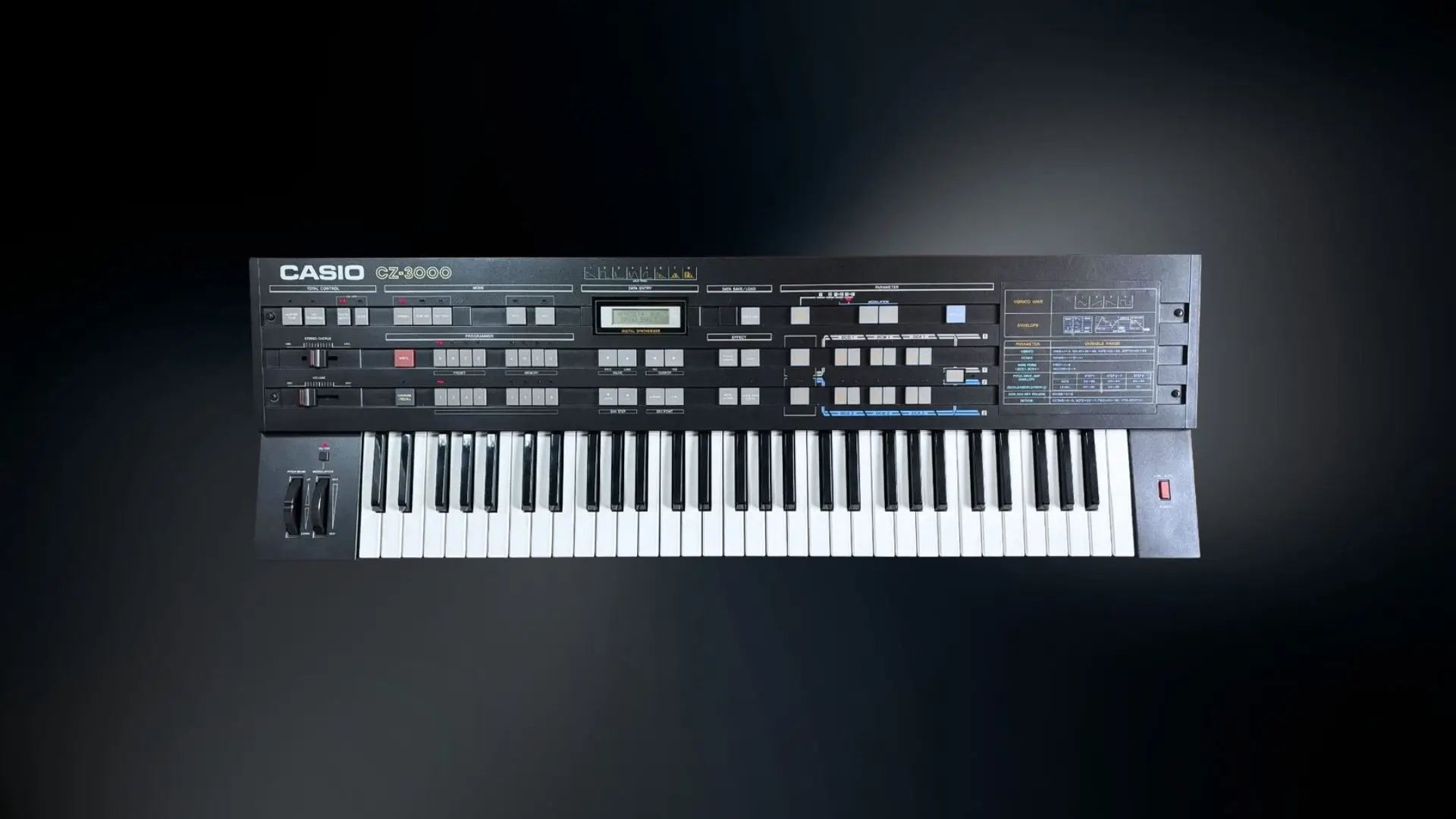
The Casio CZ-3000 is a 61-key digital polyphonic synthesizer from Casio’s CZ series, documented as a 1986 model and built around Casio’s phase distortion synthesis. It took the CZ concept into a larger stage-and-studio format, with 16-voice operation for single-DCO sounds, 8-voice operation for two-DCO sounds, split and layer modes, MIDI In/Out/Thru, programmable memory, and onboard chorus. Its importance is not that it displaced Yamaha’s FM instruments in prestige, but that it offered a different route into digital synthesis: less cryptic than FM, more visibly connected to analog-style signal flow, and still capable of sharply digital tones.
Table of Contents
Casio CZ-3000 sound and character
The Casio CZ-3000 has a sound that sits between familiar analog vocabulary and unmistakably mid-1980s digital behavior. It does not use a conventional analog filter. Instead, its phase distortion engine changes harmonic content through digitally controlled wave shaping, with the DCW section functioning as the main timbral shaper. That makes the Casio CZ-3000 feel conceptually close to subtractive synthesis while sounding cleaner, glassier, and more synthetic than a true analog polysynth.
Its best sounds often come from motion rather than thickness alone. The multi-stage envelopes can animate pitch, wave shape, and amplitude in ways that go beyond a simple ADSR contour, giving the CZ-3000 a talent for evolving attacks, hollow brass, metallic percussion, synthetic basses, bright keys, and strange transitional textures. It can suggest analog brass and strings, but it does so with a harder digital edge rather than the unstable weight of VCO-based instruments.
The Casio CZ-3000 is also capable of brittle, nasal, percussive, and bell-like sounds that place it closer to the broader 1980s digital vocabulary. Ring modulation and noise modulation extend that character into metallic, clangorous, and sound-effect territory. The onboard chorus can widen and soften the tone, but it does not turn the Casio CZ-3000 into a lush analog polysynth. Its personality remains precise, slightly austere, and more interesting when treated as a programmable digital instrument rather than as an analog substitute.
Features and architecture
- Manufacturer: Casio.
- Year: 1986 model, documented in contemporary reviews and modern synth references.
- Production years: the exact full production span is not confidently verified, so it is safer to describe the Casio CZ-3000 as a 1986-era instrument rather than assign unsupported start and end dates.
- Synthesis type: digital phase distortion synthesis.
- Category: 61-key digital polyphonic keyboard synthesizer.
- Polyphony: 16 voices when using one DCO line, 8 voices when using two DCO lines, and reduced polyphony in Tone Mix and Key Split configurations.
- Original price: £675 in the United Kingdom according to contemporary 1986 reviews.
- Current market price: used-only vintage market; prices vary widely by condition, location, accessories, and service history.
- Oscillators: two digitally controlled oscillator lines, each associated with its own digitally controlled wave and amplifier stages.
- Filter: no conventional filter; timbral shaping is handled through the DCW phase distortion system and resonant waveform options.
- LFO / vibrato: programmable vibrato with selectable waveforms, delay, rate, and depth.
- Envelopes: multi-stage envelopes for pitch, wave shape, and amplitude, with up to eight steps.
- Modulation system: detune, line selection, ring modulation, noise modulation, portamento, glide, pitch bend, modulation wheel, master tune, and key transpose.
- Sequencer / arpeggiator: no onboard sequencer or arpeggiator; the related CZ-5000 included a sequencer, while the Casio CZ-3000 did not.
- Effects: onboard stereo chorus with depth control.
- Memory: 32 fixed preset voices, 32 internal programmable memory voices, and optional RA-3 cartridge storage.
- Keyboard: 61 keys across five octaves.
- Performance response: no keyboard aftertouch; contemporary reviews and MIDI documentation indicate limited dynamic keyboard expression compared with later or higher-end instruments.
- Inputs / outputs: left and right line outputs, stereo headphone output, sustain pedal input, and foot volume input.
- MIDI / USB: MIDI In, Out, and Thru; no USB.
- Display: 32-character dot-matrix LCD.
- Dimensions / weight: approximately 1025 mm wide, 341 mm deep, and 125 mm high; approximately 11.7 kg including batteries.
- Power: AC mains operation with 100, 120, 220, and 240 V settings depending on region; memory backup uses three AA batteries.
Strengths
- The CZ-3000 gives the CZ engine a more serious playing format than the smaller CZ-101 and CZ-1000, mainly because the 61-key layout makes splits, bass-and-lead combinations, and broad performance parts more natural.
- Its phase distortion architecture is easier to conceptualize than classic FM programming because it retains the visible logic of oscillator, timbre, and amplifier stages, even though the sound generation is fully digital.
- The multi-stage envelopes are a major creative strength. They allow attacks, decays, spectral changes, and level movement to become part of the patch identity rather than simple supporting parameters.
- The Casio CZ-3000 can move convincingly between analog-like brass and string gestures, sharp digital basses, metallic percussion, artificial bells, and unusual effects, making it more flexible than its modest reputation suggests.
- Tone Mix and Key Split modes give the Casio CZ-3000 a practical performance dimension, especially for players who want layered digital timbres or separate upper/lower keyboard sounds.
- MIDI In/Out/Thru and SysEx support make it more useful today than many similarly priced vintage keyboards, because modern editors and librarians can reduce the friction of programming and patch management.
Limitations
- It has no conventional filter, so players expecting analog-style cutoff sweeps, resonance behavior, and hands-on subtractive immediacy may find it conceptually familiar but sonically different.
- Its keyboard expression is limited by the absence of aftertouch and by the lack of the kind of dynamic response associated with more performance-oriented instruments.
- Tone Mix and Key Split are musically useful but reduce available polyphony, which matters when playing sustained layered pads or two-handed arrangements.
- The multitimbral MIDI implementation is historically interesting but practically constrained by a single stereo output pair, which limits independent external processing of parts.
- It lacks the onboard sequencer found on the CZ-5000, so it is less self-contained for pattern-based composition.
- The chorus can enhance width, but it is not a deep programmable effects section and should not be treated like a modern onboard multi-effects engine.
- As a vintage digital instrument, condition matters. Buttons, display readability, memory backup, key contacts, MIDI behavior, outputs, chorus noise, and correct power configuration should all be checked before purchase.
Historical context
The Casio CZ-3000 appeared during the period when digital synthesis was becoming the central technological story of the keyboard market. Yamaha’s DX line had made FM synthesis culturally and commercially visible, while Casio’s CZ series offered a different digital language. Instead of asking players to think in operator algorithms, ratios, and FM depth, Casio presented phase distortion through a structure that resembled the familiar oscillator-filter-amplifier logic of analog synthesizers.
That distinction mattered. Casio was widely associated with calculators, watches, and consumer keyboards, so the CZ line had to fight against brand expectations as much as technical competition. The CZ-101 helped establish that Casio could make serious programmable synthesizers, and the CZ-3000 extended that idea into a larger professional-looking format. Contemporary reviewers explicitly treated it as part of Casio’s move into more serious keyboard territory.
The Casio CZ-3000 also sits in a specific relationship to the CZ-5000. It is often understood as a close relative that removes the CZ-5000’s onboard sequencer while retaining the phase distortion voice architecture and expanding practical MIDI connectivity with MIDI Thru. In that sense, it was not the most feature-loaded CZ, but it was one of the clearest attempts to make the CZ concept function as a conventional full-size performance synthesizer.