
Casio CZ-101: The compact phase distortion synth that made digital synthesis affordable
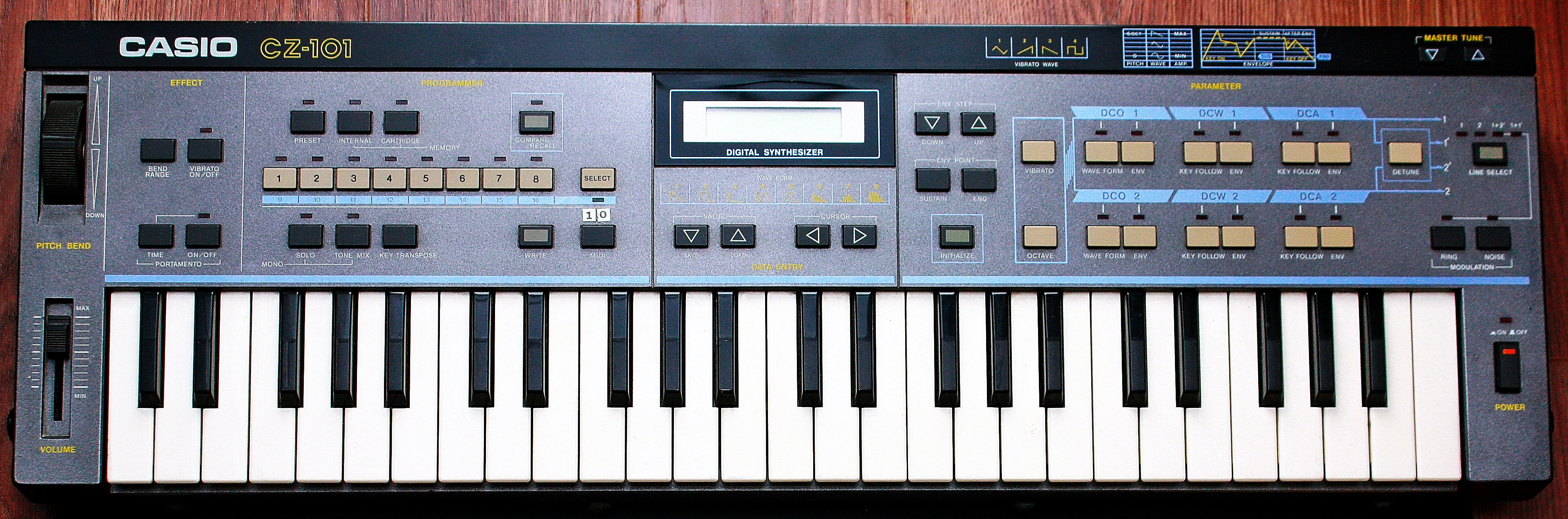
The Casio CZ-101 is a compact digital synthesizer introduced in November 1984 as Casio’s first full-fledged entry into the professional synth market. Built around the company’s original phase distortion sound engine, it offered programmable polyphony, MIDI, and unusually deep sound design in a battery-powered 49-key format that looked almost toy-like at first glance. That contrast is central to its identity: the CZ-101 mattered because it put serious digital synthesis into a cheaper, smaller, and less intimidating instrument at a moment when digital keyboards still felt technically and financially out of reach for many musicians.
Sound and character
In practice, the CZ-101 sounds unmistakably digital, but not in the same way as Yamaha’s better-known FM instruments from the same era. Its voice tends toward glassy plucks, hollow metallic tones, pointed basses, bright synthetic brass, crystalline bells, and animated pseudo-resonant sweeps. The important distinction is that it does not derive its personality from a conventional analog-style filter path. Instead, the instrument shapes timbre through Casio’s DCW stage, which changes the harmonic profile of the waveform itself over time. That gives the CZ-101 a different kind of motion: less liquid than an analog polysynth, less mathematically opaque than FM, and often more immediate in the way brightness and attack can be sculpted.
Continue Reading
The synth is especially strong when its two-line structure is used for detuned stacks, clangorous ring-modulated tones, or envelope-heavy patches in which pitch, timbre, and amplitude all move independently. In single-oscillator mode it can feel lean and sharply outlined, which is part of why some players hear it as slightly thin on its own. But in layered four-voice operation, or when pushed toward its resonant waveforms, it becomes more muscular and theatrical. That is where the instrument stops sounding merely affordable and starts sounding idiosyncratic.
The CZ-101 also has a practical sonic advantage that is easy to miss in retrospect: its architecture encourages deliberate programming. Because pitch, waveform behavior, and amplitude all have their own multi-stage envelopes, even simple sounds can develop in unusually shaped ways. The result is a synthesizer that excels not because it imitates analog warmth perfectly, but because it offers a distinct digital vocabulary of clean transients, unusual harmonic movement, and sharp-edged expressiveness.
Features and architecture
- Manufacturer: Casio
- Year introduced: November 1984
- Production years: 1985 to 1988
- Synthesis type: Phase Distortion (PD) digital synthesis
- Category: Digital keyboard synthesizer / portable programmable synthesizer
- Polyphony: 8 voices with one DCO per voice, or 4 voices when using two DCOs
- Original price: Advertised at US$499 in the United States; contemporary UK press listed £395 inc. VAT
- Current market price: Typically a used-market instrument; recent Reverb price-guide estimates place it around the mid-hundreds rather than true collector-tier pricing
- Oscillators: Two DCO lines with 8 basic waveforms, detune, selectable line structures, ring modulation, and noise modulation
- Filter: No conventional analog filter; timbre is shaped by the DCW stage, which performs the harmonic role that a filter would play in a subtractive synth
- LFOs: One vibrato section with 4 waveforms, plus rate, depth, and delay
- Envelopes: 8-stage envelopes for pitch (DCO), timbre/waveform (DCW), and amplitude (DCA) in each line
- Modulation system: Detune, key follow for DCW and DCA, ring modulation, noise modulation, pitch bend, bend range, portamento, tone mix, and MIDI-based multitimbral operation
- Sequencer / arpeggiator: None
- Effects: No onboard chorus, delay, or reverb; only performance functions such as vibrato and portamento
- Memory: 16 preset tones, 16 internal programmable tones, optional 16-tone cartridge memory, and 1 compare/recall area
- Keyboard: 49 mini keys / 4 octaves
- Inputs / outputs: Line out, headphones, DC 9V power input
- MIDI / USB: MIDI In and MIDI Out; no USB
- Display: 16×2 dot-matrix LCD
- Dimensions / weight: 676 × 208 × 70 mm; 3.2 kg including batteries
- Power: AC adapter, car adapter, or 6 D-size batteries; power consumption 5.4 W
Strengths
- It made complex digital synthesis more approachable. Contemporary reviewers already noted that Casio’s phase distortion concept was easier to grasp than FM, and that difference still matters when programming from the front panel.
- Its sound is distinct rather than generic. The CZ-101 does not simply imitate analog subtractive synths or DX-style FM. It occupies its own zone of sharp basses, metallic tones, glassy attacks, and pseudo-resonant digital movement.
- The envelope architecture is unusually deep for the price and size. Separate 8-stage envelopes for pitch, timbre, and amplitude let even small patches evolve in intricate ways.
- It is genuinely portable in a way most mid-1980s synths were not. Mini keys, battery operation, and strap buttons made it practical for mobile or stage use, even if that portability came with compromises.
- MIDI and multitimbral features gave it real sequencing value. For a compact synth in the mid-1980s, four-part multitimbral capability made it more useful in hardware-based setups than its size suggested.
- It remains one of the more affordable entries into vintage digital hardware. The market has clearly recognized its importance, but it still tends to cost less than many equally significant 1980s synths.
Limitations
- The mini keyboard is the most obvious compromise. It helped Casio hit a low price, but it also made the instrument feel less conventional for serious players.
- Patch storage is limited. With 16 user memories onboard, the CZ-101 is not generous by modern standards, and external cartridge memory is now a niche extra rather than a practical default.
- There is no conventional filter. The DCW stage is powerful, but players expecting the tactile sweep of an analog low-pass filter may find the response more angular and synthetic.
- There is no sequencer or arpeggiator. Its strengths lie in synthesis and MIDI use, not all-in-one workstation convenience.
- Single-line patches can sound comparatively lean. The synth often becomes more convincing when layered, detuned, or otherwise pushed beyond its simplest voice mode.
- Its editing depth is real, but the interface still belongs to early digital design. It is more approachable than FM, not effortless.
Historical context
The CZ-101 arrived at a crucial moment. By late 1984, digital synthesis had become one of the defining stories of the keyboard market, but that world was still dominated by instruments that either looked expensive, felt intimidating, or both. Casio entered from an unexpected angle. Known largely for calculators, watches, and consumer keyboards, the company used the CZ-101 to announce that it wanted a place in the serious synthesizer conversation.
Its strategy was clear. Casio did not try to out-luxury the established brands. Instead, it used a full-digital architecture, mini keys, and a compact casing to drive the price down while preserving programmability, MIDI, and polyphony. The result was a machine that challenged assumptions about what a professional-capable synthesizer had to look like. It was small, affordable, and slightly odd, but it was not shallow.
The timing also mattered inside Casio’s own catalog. The CZ-101 established the language of the CZ line, and later models such as the CZ-1000, CZ-3000, CZ-5000, and eventually the CZ-1 expanded the same phase distortion concept into more conventional or more fully featured formats. In that sense, the CZ-101 was not a side note. It was the foundational statement.
Legacy and significance
The CZ-101 matters because it broadened the social and aesthetic territory of the synthesizer. It helped prove that serious sound design did not have to arrive in a large, expensive chassis, and that digital synthesis did not have to be framed only as a premium, technically forbidding domain. Its importance lies less in absolute power than in access.
That access worked on several levels at once. Financially, it lowered the barrier to entry. Ergonomically, it presented a programming system that many musicians found easier to understand than FM. Culturally, it disrupted the visual code of the “professional” synthesizer: beneath the mini keys and portable shell was a machine with enough depth to reward patient users for years.
Its legacy is also sonic. The CZ-101 did not become valuable because it approximated analog gear perfectly. It endured because phase distortion has its own accent, and because that accent still cuts through modern production environments. The instrument’s attack shapes, bright timbral edges, and strange resonant-like gestures remain recognizably CZ. That is why it still appears in discussions not just about affordable vintage synths, but about genuinely distinctive ones.
Artists, users, and curiosities
The CZ-101’s user list reflects both its affordability and its usefulness. Vintage Synth Explorer associates it with artists including Vince Clarke, Moby, They Might Be Giants, Jimi Tenor, Jimmy Edgar, and Cirrus. That spread is revealing: the instrument was not tied to one genre or one prestige scene. It travelled well because it was small, cheap enough to be obtainable, and sonically unlike the standard analog options.
Vince Clarke is one of the most telling associations. Sound On Sound notes that the CZ-101’s four-part multitimbrality made it especially effective in sequenced pop workflows, and Clarke used multiple units in ways that turned a modest little Casio into part of a larger, highly organized electronic rig. That says a great deal about the instrument’s real-world value: it was not only a beginner’s synth, but also a serious tool when used strategically.
One of the enduring curiosities of the CZ-101 is visual. It looked almost like a consumer keyboard, yet it was Casio’s first full-fledged synthesizer and quickly became a major sensation. The battery power and strap buttons only sharpened that contradiction. It could be worn on stage and played like a portable oddity, but under the hood it was one of the mid-1980s instruments that helped normalize affordable programmable digital synthesis.
Market value
- Current market position: The CZ-101 sits in a strong middle ground: historically important, musically useful, and still accessible enough that it has not become a purely collector-driven object.
- New price signal: There is no meaningful new-retail market because the instrument is long discontinued.
- Used market signal: Reverb’s recent price-guide range places it roughly between $275 and $471, depending on condition and market timing.
- Availability: It is usually easier to find than rarer 1980s digital synths, especially through used-gear platforms.
- Buyer notes: Condition matters. Original power arrangements, LCD readability, button reliability, and battery-compartment health are more important than cosmetic perfection alone.
- Support ecosystem: Manufacturer support is long gone, but the instrument remains well served by community documentation and modern editor/librarian tools such as Patch Base and Midi Quest.
- Ease of finding one: Reasonably easy, especially compared with scarcer cult classics.
- Long-term position: Its value looks stable and slightly upward-facing, but it still reads more as an important working vintage synth than as a fully inflated museum piece.
Conclusion
The Casio CZ-101 was never just a cheap alternative. It was a compact, clever, historically timed instrument that used phase distortion to open a new path into programmable digital sound. Its mini keys, battery power, and modest price were compromises, but they were also the reason it mattered. The CZ-101 deserves attention not because it imitates bigger synths, but because it changed expectations about who digital synthesis was for, how portable it could be, and how distinctive an affordable instrument could sound.

His connection with music began at age 6, in the 1980s, when his father introduced him to Jean-Michel Jarre's Rendez-Vous on vinyl. He works professionally in the legal field, while synthesizers became his space for abstraction and creative exploration. He enjoys composing synthwave and cinematic ambient music. Founder of The Synth Source.