

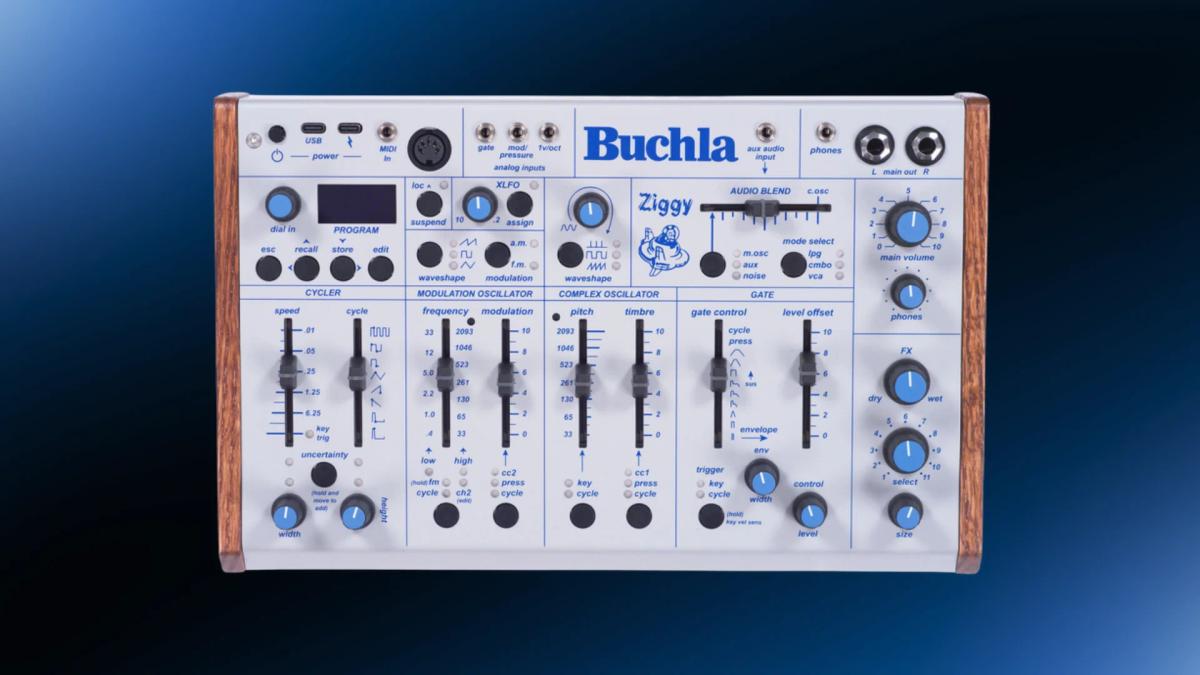
The Buchla Ziggy is a monophonic desktop synthesizer from Buchla USA, announced on May 5, 2026, just before Superbooth in Berlin. It takes the core of the West Coast approach that Buchla instruments are known for, a complex oscillator shaped by a modulation oscillator and a wavefolder, followed by a low pass gate, and puts it in a compact oak and steel box with no patch cables. The audio path is analog, while digital control adds preset memory, a modulation assignment system, scale quantization, a WebMIDI editor and a stereo digital effects section. Its US list price is $999, with £915 and €1,039 quoted in the UK and Europe, which makes it the most affordable complete instrument Buchla USA has offered. Shipping was first expected in late summer 2026, but in late September the company moved its estimate to December 2026 after redesigning the circuit.
Table of Contents
Buchla Ziggy sound and character
The sound of the Buchla Ziggy starts with its Complex Oscillator, which Buchla describes as a sine wave that can be reshaped in several ways. The Modulation Oscillator can apply frequency or amplitude modulation to it, a Timbre control drives the sine through a wavefolder, and a blend control moves the waveform toward spike, square or sawtooth shapes. Perfect Circuit describes the result as a continuously variable timbre and calls the Complex Oscillator the source of the Buchla sound in this instrument.
The Modulation Oscillator is the second analog oscillator and has a double role. It runs at low frequencies as a modulator or at audio rates, with sawtooth, square or triangle shapes, and it can be tuned and quantized. At audio rate it produces FM and AM tones that Perfect Circuit places anywhere from slow fluctuation to inharmonic, clangorous sounds. An Audio Blend control also lets it, an external signal or noise sit alongside the Complex Oscillator before the gate, so the second oscillator can serve as a voice of its own.
There is no conventional filter. Instead the Buchla Ziggy uses an analog low pass gate based on a Sallen-Key filter design, which Buchla says can act as a VCA, a filter or both. Its integrated envelope does not use ADSR stages. Buchla offers blended envelope shapes instead, set with a Gate Control slider and an Env Width control for duration, and its launch text frames the choice as favoring discovery over precision. Gate Control can also hand the gate level to the Cycler or to key pressure, which links the envelope behavior directly to playing and modulation.
On the Buchla Ziggy, movement comes from the Cycler, a multipurpose source that works as a clock, envelope, LFO or random generator, with speed, shape, width and height parameters. It can run cyclically or fire a single pass from MIDI or CV, and an Uncertainty control adds randomness to its parameters. A separate triangle XLFO can be assigned to most destinations. Modulation is routed by holding an Assign switch and moving the target slider, and LEDs in the sliders show values and assignments. Nick Kwas of Buchla told Sonicstate at Superbooth that the design suits both conventional playing and generative performance.
The digital effects sit at the very end of the chain, after the analog voice. Buchla lists reverb, delay, chorus, pitch shift and flanger variations, and other coverage adds panners, filters and distortion. A wet/dry control and a single Size macro, mapped to a different parameter for each effect, keep the section simple. Perfect Circuit summarized the early demos as Easel-style bongos and plonks, animated tones, rich leads and bass lines, and Buchla’s own page names strings, drums, plucks, leads and basses as targets.
Independent assessments of the sound remain limited, because no production units had shipped as of October 2026. The reports so far come from Superbooth demonstrations and from Buchla’s own videos. The company has also said the September redesign improved noise performance and reworked the modulation system, so the final Buchla Ziggy may differ in detail from the prototype heard in May.
Features and architecture
- Manufacturer: Buchla USA (United States)
- Year introduced: 2026 (announced May 5, 2026, shown at Superbooth 2026)
- Production years: Not yet in production as of October 2026; first shipments expected in December 2026
- Synthesis type: West Coast style analog synthesis (complex oscillator into a low pass gate) with digital control and digital effects
- Category: Monophonic desktop synthesizer without patch points
- Polyphony: Monophonic
- Multitimbrality: None
- Original price: $999 (Buchla US list); £915 (UK) and €1,039 (EU) as reported at launch; $1,999 bundled with the LEM218 V3 touch controller
- Current market price: Pre-order only; $999 at Sweetwater and Perfect Circuit, £888 at Thomann UK
- Oscillators: Two analog oscillators; Complex Oscillator (sine core with FM and AM, Timbre wavefolder, blend to spike, square or sawtooth); Modulation Oscillator (low or audio rate, sawtooth, square or triangle, usable as a second sound source)
- Filter: Analog low pass gate based on a Sallen-Key filter, usable as a VCA, a filter or both
- LFO: XLFO with triangle wave; the Cycler and the Modulation Oscillator can also run at LFO rates
- Envelopes: Integrated low pass gate envelope with blended shapes instead of ADSR, set by Gate Control and Env Width; the Cycler can also act as an envelope
- Modulation system: Cycler (clock, envelope, LFO, random) with Uncertainty control; assignment by Assign switch and sliders; LED feedback; dedicated switches for common routings, MIDI mappings and triggers
- Sequencer / arpeggiator: No dedicated step sequencer or arpeggiator documented; the Cycler provides pattern generation; pitch quantization to Western and non-Western scales
- Effects: Stereo digital effects including reverb, delay, chorus, pitch shift and flanger variations, with wet/dry and Size controls
- Memory: Over 100 factory and user presets
- Keyboard: None; designed to pair with the Buchla LEM218 touch controller or any MIDI or CV controller
- Inputs / outputs: Two 1/4 inch outputs, 3.5 mm headphone output, 3.5 mm mono audio input into the low pass gate, 3.5 mm CV inputs for 1V/oct pitch, gate and modulation; connections on the top surface
- MIDI / USB: MIDI over USB-C, 5-pin DIN and 3.5 mm TRS (Type A); USB for the WebMIDI editor and firmware updates; Buchla says the redesign adds USB audio on the USB-C connection
- Display: LED-lit sliders and LEDs showing modulation links; Thomann and Gearnews also list a display
- Dimensions / weight: 307 × 196 × 71 mm (12.1 × 7.7 × 2.8 in); 2.31 kg (5.1 lb), per retailer listings
- Power: USB-C bus power from a power bank, computer or wall adapter (adapter not included); second USB-C input for lower-power sources in the launch specification
Strengths
- It is the most affordable complete Buchla. At $999 it costs a fraction of the company’s Easel instruments and modular systems, which MusicRadar placed at around $5,000 and $15,000.
- The core Buchla voice is intact. A complex oscillator with FM, AM and wavefolding feeding a low pass gate is the signal path that defines West Coast synthesis.
- No patching is needed. Modulation is assigned with switches and sliders, so sounds can be built quickly without a patch field or cables.
- Sounds can be saved and recalled. Preset memory for more than 100 programs and a browser editor solve a long-standing problem with analog West Coast systems.
- It connects to other setups. MIDI on three connector types, CV inputs for pitch, gate and modulation, and an external audio input make it usable with Eurorack, DAWs and the LEM218.
- Power is simple and portable. USB-C operation from a power bank or computer suits a compact desktop instrument.
Limitations
- It has not shipped yet. Buchla moved the expected delivery from late summer to December 2026, and some retailers only promise shipments in the fourth quarter.
- There are no independent reviews. Impressions so far come from trade show demonstrations and Buchla’s own videos, not from production units.
- The final specification may change. Buchla redesigned the circuit, controls and modulation system over the summer, so prototype descriptions may not match shipping units exactly.
- It is monophonic and costly for one voice. Gearnews noted that the price is low for a Buchla but still high for a monosynth.
- It is not a modular. There is no patch bay beyond a few CV inputs, so it lacks the open routing of the Easel or a Buchla system.
- It has no keyboard or step sequencer. A separate controller is needed to play it, and the LEM218 bundle doubles the cost.
Historical context
Don Buchla founded Buchla & Associates in Berkeley, California in 1963. His first system, the Buchla 100, was commissioned that year by Ramon Sender and Morton Subotnick for the San Francisco Tape Music Center, installed in 1965 and moved to Mills College in 1966. Press coverage of the Buchla Ziggy treats this lineage as the root of West Coast synthesis, and Synthtopia presents the new instrument as a distillation of its key elements in a desktop form.