

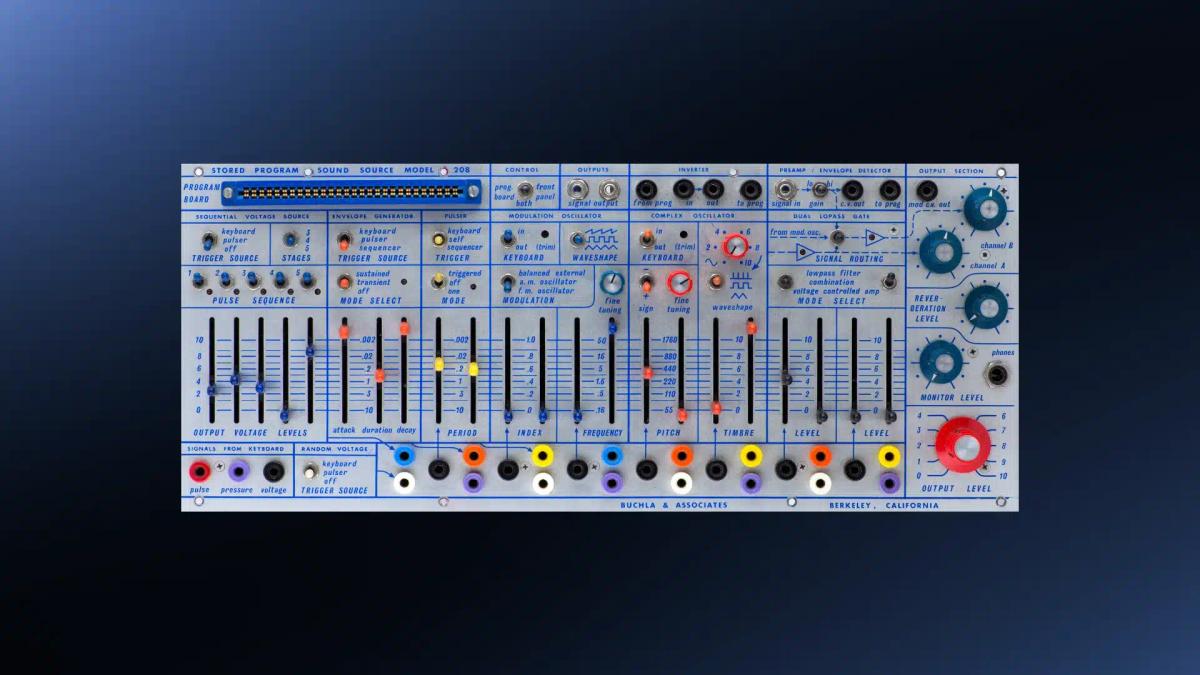
The Buchla Music Easel is a portable, semi-modular analog instrument that Don Buchla’s Berkeley company introduced in 1973 (some sources give 1972). It combines two modules from his 200 Series Electric Music Box, the Model 208 Stored Program Sound Source and the Model 218 Touch Activated Voltage Source, a capacitive touch keyboard with no moving keys, in a briefcase-like case with a removable lid. The 208 packs a complex oscillator with timbre control, a modulation oscillator, a five-step sequencer, a pulser, an envelope, a random source, two low pass gates and spring reverb, all patched with banana cables. Only a few dozen originals were made, yet the Buchla Music Easel became the most compact statement of West Coast synthesis and has been reissued three times, most recently in 2023.
Table of Contents
Buchla Music Easel sound and character
The Music Easel does not sound like a Moog with a different filter. Its voice starts in the complex oscillator, which generates a fundamental and then reshapes it with a timbre control that folds and cross-modulates the waveform, so harmonics are added rather than carved away. Sound On Sound’s Paul Nagle, reviewing the 2023 Modern and Retro editions, singled out the wavefolding, audio-rate modulation and low pass gates as a real alternative to conventional subtractive synthesis. The second oscillator can run as an LFO or in the audio range, where it frequency- or amplitude-modulates the first and produces bell tones, clangorous metallic spectra and shifting vocal formants.
The two low pass gates give the Buchla Music Easel its characteristic articulation. Built around vactrols, they act as filter and amplifier at once, so a pulse produces a short, plucked, slightly woody note that darkens as it decays, a sound often compared to struck wood, mallets or water drops. Driven by the pulser and the five-step sequencer, with the random source nudging pitch or timbre, the Buchla Music Easel quickly produces self-generating patterns that feel organic rather than mechanical.
Its limits are part of its identity. With one complex oscillator as the main voice, it is essentially monophonic; pads, thick detuned leads and the kind of subby bass a Minimoog delivers are not its strengths. The touch keyboard responds to pressure, encouraging gesture over conventional fingering, and the original 218 was not especially precise, something Nagle says the newer 218e improves on greatly. It sits firmly at the experimental, timbral end of analog synthesis: warm and vivid, but closer to an acoustic percussion instrument in behavior than to a keyboard synth.
Features and architecture
- Manufacturer: Buchla and Associates, Berkeley, California (original); reissues by Buchla Electronic Musical Instruments (2013) and Buchla USA (2023)
- Year introduced: 1973 according to Buchla’s own archive and most references; some sources, including Sound On Sound and Wikipedia, give 1972
- Production years: original run in the early 1970s (only a few dozen made, per Buchla); reissued in 2013 and from 2023, with the current editions in production in 2026
- Synthesis type: analog, West Coast style complex oscillator with timbre (wavefolding) control, frequency and amplitude modulation, and low pass gates
- Category: portable semi-modular analog synthesizer with touch keyboard controller
- Polyphony: monophonic voice; the modern 218e can also send polyphonic MIDI to external instruments
- Original price: not consistently documented for the 1973 instrument; the 2013 reissue was announced at about $4,000, and the 2023 editions list at $4,999 (50th Anniversary edition $9,999)
- Current market price: $4,999 new; Reverb’s price guide suggests about $3,056 for a 2010s reissue
- Oscillators: complex oscillator (roughly 38 Hz to 3.5 kHz on the original panel range) with switchable waveforms and timbre control; modulation oscillator usable as LFO (from about 0.13 Hz) or audio source, with FM, AM and balanced modulation
- Filter: two low pass gates (vactrol-based combined filter and amplifier)
- LFOs: modulation oscillator in its low range; the Modern edition’s EMBIO module adds a second slow LFO
- Envelopes: one voltage-controlled envelope generator with sustain and cycle options, plus an envelope detector for external audio
- Modulation system: banana-jack patchfield for control voltages (0 to 10V), random voltage source, pulser, and program card interface for storing patch routings
- Sequencer / arpeggiator: five-step voltage sequencer on the 208; arpeggiator with sync options on the modern 218e
- Effects: built-in spring reverb
- Memory: plug-in Stored Program Cards on the original; Program Interface slot and optional Program Manager (with computer software) on the modern editions
- Keyboard: Model 218 capacitive touch keyboard with no moving parts (29 keys on the current 218e, just under two and a half octaves), plus portamento, preset voltage pads and a pitch or vibrato strip; the 218e v3 adds velocity and pressure outputs
- Inputs / outputs: banana jacks for control voltages and TiniJax mini jacks for most audio; quarter-inch audio outputs and sustain input on the modern editions, whose Modern version adds 3.5 mm CV and gate inputs at 1V per octave
- MIDI / USB: none on the original; TRS MIDI and USB-C on the 2023 editions
- Display: none
- Dimensions / weight: Retro edition about 55 by 42 by 15 cm in an aluminum briefcase; Modern edition about 58 by 39 by 16 cm in an ABS case with one spare module slot; published weights are not consistently given
- Power: mains or external batteries on the original (an early battery pack gave about three hours); 12V DC with battery terminals on the modern editions
Strengths
- It is a complete West Coast instrument in one portable case. Complex oscillator, modulation oscillator, low pass gates, sequencer, envelope and reverb cover the whole Buchla approach without a full 200 Series system.
- The timbre and modulation controls produce sounds that subtractive synths struggle to imitate. Wavefolding and audio-rate FM generate bright, shifting harmonic spectra from very few controls.
- The low pass gates give notes a natural, percussive envelope. Plucked, struck and dripping tones come almost for free, and they respond musically to dynamic control.
- It rewards improvisation. The pulser, five-step sequencer and random source let the Buchla Music Easel generate patterns that a player can steer rather than program note by note.
- It is genuinely portable. Battery terminals and a monitor output strong enough for small speakers made the original usable away from mains power, and the reissues keep that briefcase format.
- The modern editions bridge old and new. MIDI, USB-C, patch storage and, on the Modern, CV and gate inputs connect it to current studios without changing the core circuit design.
Limitations
- It is monophonic in practice. Chords and layered parts require multitracking, sampling or additional instruments, as Charles Cohen and Kaitlyn Aurelia Smith have both described.
- It is expensive. At $4,999 for a single-voice instrument, new Easels cost more than many polyphonic synthesizers, and Sound On Sound listed the price as its main drawback.
- The connector formats are confusing. Banana jacks, TiniJax and 3.5 mm sockets coexist, and the EMBIO’s 1V per octave inputs differ from the 1.2V per octave standard used elsewhere in Buchla gear.
- The touch keyboard requires adaptation. It has no moving keys, the original 218 was not very precise, and players trained on conventional keyboards need time to control pressure and position.
- MIDI implementation on the reissues is complex. Nagle found the Buchla Music Easel occupying many MIDI channels, with only channels 11 to 16 reliably free.
- Original 1970s units are rare and fragile, and early owners reported failures; Cohen’s first Buchla Music Easel had to go back to Buchla within two months for replacement chips.
- There is no printed manual with the 2023 editions, and the Buchla Music Easel’s unconventional logic makes the learning curve steeper than its small size suggests.
Historical context
Don Buchla came to synthesizers through the San Francisco Tape Music Center, where he designed the modules that became the 100 Series, sold commercially from 1966. Unlike Robert Moog, he avoided the black-and-white keyboard and the subtractive model, preferring touch plates, sequencers and waveshaping oscillators, and he called his systems Electric Music Boxes. The 200 Series followed from 1970. Buchla’s archive places the Music Easel in development by the summer of 1973, with marketing photos taken in August at his shop at 1750 Arch Street in Berkeley, and credits close collaboration with composer and educator Allen Strange. Strange wrote its operating manual, Programming and Meta-Programming the Electro-Organism, published by Buchla and Associates in 1974.
The Buchla Music Easel was a portable encapsulation of 200 Series ideas: the 208 module concentrated a whole patch’s worth of sound sources and modifiers, while the 218 touch keyboard provided control, and plug-in program cards stored routings. Early units included a battery pack good for about three hours. Production was small, and Buchla describes only a few dozen originals, which explains why most musicians knew the Buchla Music Easel by reputation for decades.
Revival began after an Australian holding company acquired Buchla’s intellectual property in 2012 and launched Buchla Electronic Musical Instruments. Its engineering director Jeffrey Vallier presented a recreation at NAMM in January 2013, announced at around $4,000, and units began shipping that October. After Don Buchla’s death in September 2016 and changes of ownership, Buchla USA showed a new Buchla Music Easel at Superbooth 2023 alongside a 50th Anniversary edition with a powder blue case and gold keys. Modern and Retro versions followed at $4,999, using the updated 208C (Easel Command) and 218e v3 keyboard. It is the Buchla Music Easel’s third production run in 50 years.