

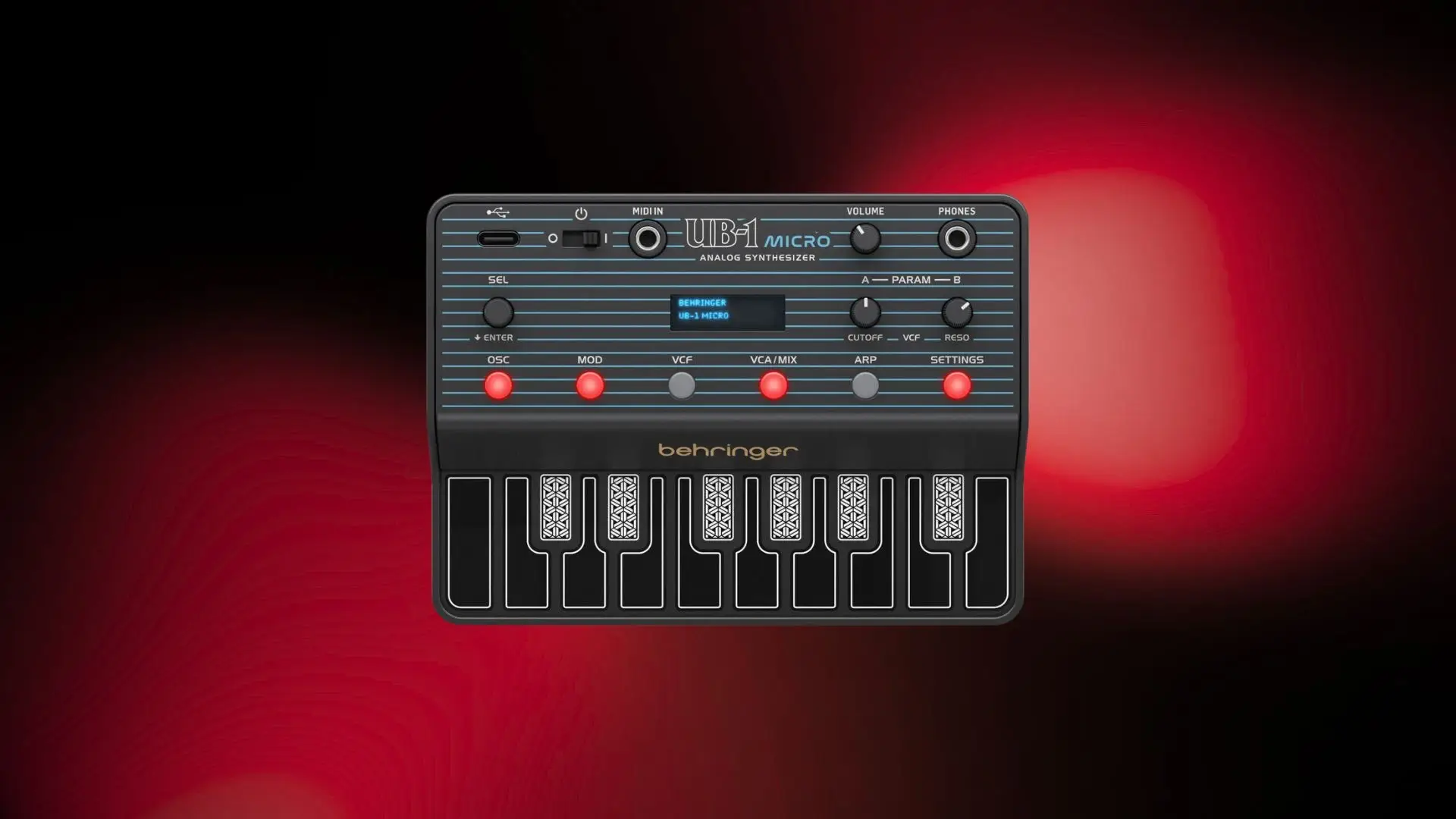
The Behringer UB-1 Micro is a portable analog monophonic synthesizer introduced in late 2025 as part of Behringer’s small-format synth line. Built around two DCO oscillators, a sub-oscillator, noise generator, classic 4-pole low-pass filter, two LFOs, two ADSR envelopes, preset memory, USB-C power, MIDI control, and a 16-key capacitive touch playing surface, it aims to compress an Oberheim Matrix-inspired analog voice into an unusually small and inexpensive instrument. Its importance is not that it recreates the full experience of a vintage Matrix-6 or Matrix-1000, but that it turns that late-1980s DCO-and-filter vocabulary into a pocket-sized sketching, sequencing, and MIDI-controlled sound source.
Table of Contents
Behringer UB-1 Micro sound and character
The Behringer UB-1 Micro’s character is defined by a specific kind of late-analog discipline: two digitally controlled oscillators feeding a 4-pole analog low-pass filter, with sub and noise available for density and edge. That architecture does not behave like a loose early-1970s VCO monosynth. Its likely musical identity is tighter, more stable, more rhythmically usable, and closer to the cleaner DCO-based side of 1980s analog synthesis.
The Behringer UB-1 Micro is best understood as a small bass, lead, arp, and synthetic effects machine rather than as a miniature workstation. The two DCOs give it enough harmonic mass for detuned lines, sync-like bite, and harmonically focused leads. The sub-oscillator pushes it toward compact bass duties, while the noise source gives it a way into percussive attacks, synthetic wind, and harder-edged transitional effects. The 4-pole low-pass filter supplies the recognizably rounded, subtractive behavior that keeps the sound from becoming merely digital or toy-like.
Its size matters sonically because it changes how the voice will probably be used. A full-size analog synth invites sustained playing, broad modulation, and hand performance across a keyboard. The Behringer UB-1 Micro, by contrast, encourages small loops, arpeggiated figures, external MIDI control, preset recall, and quick sound design. Its sound is therefore less about grand keyboard expression and more about concentrated analog gestures: a short bass figure, a one-bar arpeggio, a lead hook, a noise accent, or an 80s-style synth line that can sit inside a DAW arrangement without occupying much physical space.
It is also important not to overstate the Oberheim connection. The Behringer UB-1 Micro draws from the Matrix vocabulary, especially the DCO/analog-filter concept associated with the Matrix-6 and Matrix-1000 era, but it is not a six-voice polyphonic Matrix instrument and does not replicate the broader modulation depth, keyboard format, or rack-module role of those machines. Its character is better described as an Oberheim-inspired micro-voice: compact, programmable, historically referential, and intentionally reduced.
Features and architecture
- Manufacturer: Behringer.
- Year introduced: 2025.
- Production years: 2025–present.
- Synthesis type: Analog subtractive synthesis with digitally controlled oscillators.
- Category: Ultra-compact portable analog monophonic synthesizer.
- Polyphony: Monophonic sound engine.
- Original price and current market price: Official and retailer pricing signals place it in the very low-cost micro-synth range, with prices around $55.90 outside the US, about $69.90 in the US, around $57 at Thomann, and around £50 at Andertons, depending on region and availability.
- Oscillators: Two DCOs, plus sub-oscillator and noise generator.
- Filter: Analog low-pass filter with cutoff and resonance; described in several sources as a classic 4-pole / 24 dB-per-octave low-pass filter.
- LFOs: Two LFOs, used for oscillator and filter movement.
- Envelopes: Two ADSR envelopes, one for VCF and one for VCA.
- Modulation system: Compact parameter-editing system with MIDI CC control for most or all parameters, depending on source wording; not a full Matrix-style modulation interface.
- Sequencer / arpeggiator: Arpeggiator with three modes or patterns and hold function; no verified onboard step sequencer.
- Effects: No onboard effects listed by retailer specifications.
- Memory: 32 preset slots, expandable or manageable through Behringer’s SynthTribe app.
- Keyboard: 16-key capacitive touch playing surface; not a full mechanical keyboard and not listed as velocity- or aftertouch-sensitive in retailer metadata.
- Inputs / outputs: 3.5 mm headphone or line/headphone output, 3.5 mm MIDI input, and USB-C.
- MIDI / USB: USB-C for power and USB MIDI; 3.5 mm MIDI input; retailer listings mention an included 3.5 mm TRS-to-5-pin DIN MIDI cable.
- Display: OLED display.
- Dimensions / weight: Approximately 130 x 93 x 36 mm and around 150 g, with US retailer data listing roughly 5.09 x 3.65 x 1.42 inches and 5.29 oz.
- Power: USB-C powered; usable from a computer, power bank, smartphone, or compatible USB power source.
Strengths
- The UB-1 Micro offers genuine analog subtractive architecture in a size and price class usually associated with toys, controllers, or digital pocket instruments.
- Its two-DCO layout gives it more harmonic flexibility than a one-oscillator novelty synth, especially for basses, detuned leads, and arpeggiated figures.
- The 4-pole low-pass filter gives the Behringer UB-1 Micro a clear subtractive center of gravity, making it useful for traditional analog bass and lead programming rather than merely preset playback.
- Preset memory is unusually important at this scale: 32 slots turn the Behringer UB-1 Micro from a throwaway sound gadget into a small programmable instrument that can be prepared for a set or a DAW session.
- USB-C power and USB MIDI make it practical for modern desktop production, mobile setups, and laptop-based writing sessions.
- The 3.5 mm MIDI input gives it a more serious role than the built-in touch keys alone would suggest, because it can be driven from a full-size keyboard, sequencer, or DAW.
- The arpeggiator suits the Behringer UB-1 Micro’s scale: a micro analog synth becomes more useful when it can generate repeating musical motion without requiring full keyboard performance.
- Its Oberheim Matrix association gives the Behringer UB-1 Micro a historically recognizable sonic reference without requiring the space, maintenance, or cost of a vintage Matrix unit.
- The collaboration with Ultimate Patches gives the preset bank a more deliberate identity than many inexpensive synths receive out of the box.
Limitations
- The Behringer UB-1 Micro is monophonic, so it should not be mistaken for a miniature replacement for an Oberheim Matrix-6, Matrix-1000, UB-Xa, or any full polyphonic analog instrument.
- The capacitive touch keyboard is useful for immediacy, but it is not a substitute for a full keyboard with velocity, aftertouch, proper key travel, or expressive performance control.
- The interface necessarily relies on function buttons, a small display, and compact controls, so deep editing is less immediate than on a knob-per-function analog synth.
- There are no onboard effects listed in the retailer specifications, meaning the Behringer UB-1 Micro will often depend on external delay, chorus, reverb, or DAW processing for finished 80s-style production.
- The output and MIDI connections are mini-jack based, which is practical for size but less robust than full-size studio connectors.
- Its low price makes it attractive, but also places it close to other small Behringer instruments, including models with different feature balances; buyers should not assume it is automatically the best micro-synth for every use.
- Early market availability appears uneven, with some retailers showing pre-order, sold-out, or delayed stock status rather than mature, stable inventory.
- Because it is new, there is not yet a meaningful long-term used-market history, reliability pattern, or established artist discography attached to it.
- The historical reference is powerful, but selective: it borrows from the Matrix-era tone concept more than from the full Matrix modulation philosophy.
Historical context
The Behringer UB-1 Micro sits at the intersection of three histories: Oberheim’s late-analog Matrix era, Behringer’s modern strategy of affordable reinterpretations, and the 2020s market for ultra-small hardware synths.
The Oberheim Matrix-6 and Matrix-1000 mattered because they represented a later stage of analog synthesis. They were not early, knob-heavy VCO machines from the 1970s. They belonged to a period when analog tone was increasingly mediated by digital control, patch memory, MIDI, compact voice chips, and more economical manufacturing. The Matrix-1000 in particular compressed Matrix-6 circuitry into a rack format with a large preset library, making the Oberheim sound more accessible in a studio environment.
The Behringer UB-1 Micro takes that logic further. Instead of reducing a keyboard synth into a rack unit, it reduces the idea of a Matrix-flavored analog voice into a palm-sized mono instrument. That is historically interesting because it mirrors a broader shift in synth culture: vintage tone is no longer accessed only through large keyboards, expensive collectors’ pieces, or software emulation. It can now appear in small, low-cost hardware devices intended for mobile writing, casual experimentation, and DAW integration.
The instrument also reflects Behringer’s post-2010s identity. The company has repeatedly built products around famous analog circuits, recognizable vintage design languages, and unusually aggressive pricing. The Behringer UB-1 Micro continues that pattern, but in a more compressed form. It is not a flagship statement like a large polysynth; it is a budget expansion of a sound family. Its role is to make the Oberheim-inspired analog voice available at the level of an impulse-buy instrument.
Timing matters. The UB-1 idea was discussed years before the product reached retailers, and the name changed from UB-1 Spirit to Behringer UB-1 Micro before release. By the time it appeared, Behringer had already placed larger Oberheim-inspired instruments into the market, including the UB-Xa and UB-Xa Mini. The Behringer UB-1 Micro therefore arrived not as an isolated product, but as the smallest member of a broader Oberheim-facing Behringer ecosystem.