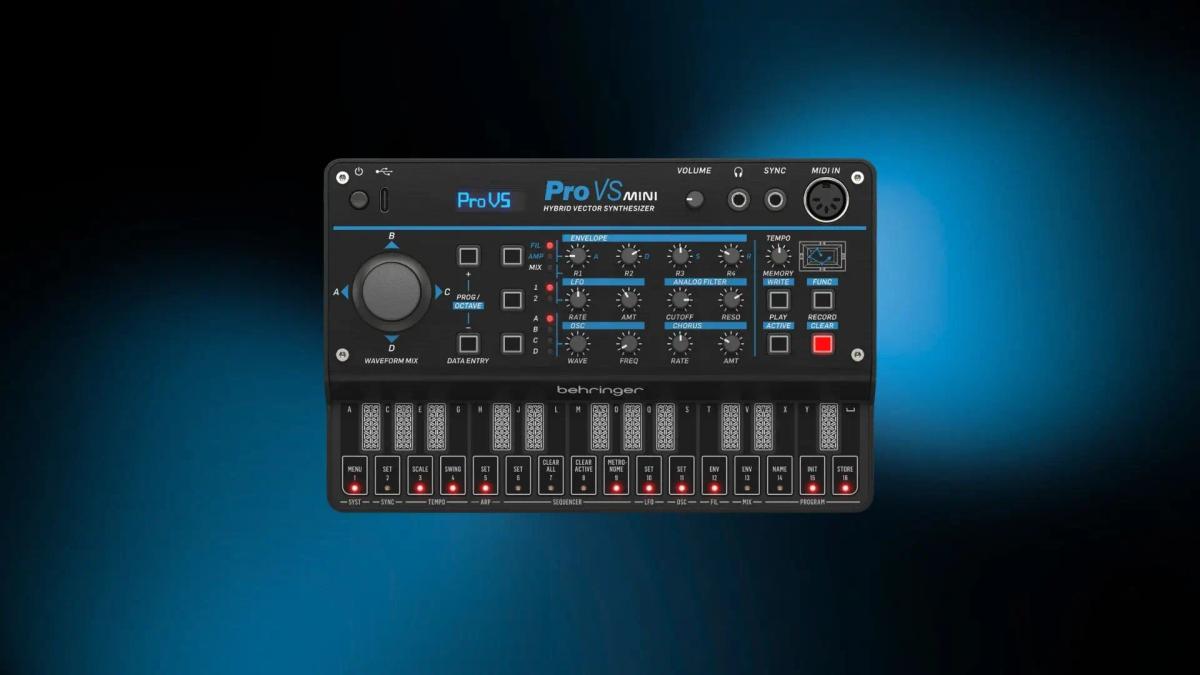
Behringer’s PRO VS Mini is therefore not merely another small clone. It belongs to a different cultural moment: the 2020s market for inexpensive reinterpretations, desktop modules, miniature synths, firmware-expanded instruments, and historically referential gear. Behringer did not rebuild the Prophet VS as a full-size luxury instrument. Instead, it reduced the idea to a small, low-cost form that favors immediacy and access over historical completeness.
The Behringer PRO VS Mini matters because it changes the social position of vector synthesis. For decades, the Prophet VS was either a vintage object, a historical reference, or a concept encountered through later workstations and software. Behringer’s miniature version turns that concept into something casual, affordable, and physically approachable. That shift is culturally significant even if the Behringer PRO VS Mini itself is small.
Its significance also lies in the way it exposes a recurring tension in modern synthesizer culture. Some musicians want faithful recreations. Others want affordable approximations that invite use rather than reverence. The Behringer PRO VS Mini sits firmly in the second category. It does not ask to be treated like a museum piece. It asks to be touched, sequenced, overdriven through effects, controlled by MIDI, and used as a compact source of moving digital-hybrid timbres.
The firmware updates are part of that legacy. Version 2.0 did not simply fix bugs; it changed the Behringer PRO VS Mini’s functional identity by expanding polyphony and effects. That makes the Behringer PRO VS Mini a good example of the modern hardware synth as an evolving platform. In the 1980s, a synth’s identity was mostly frozen at manufacture. In the 2020s, even an inexpensive mini synth can grow after release.
The Behringer PRO VS Mini does not yet have the kind of documented artist lineage that surrounds older instruments such as the Prophet-5, DX7, or original Prophet VS. Its public identity has been shaped more by demonstrators, tutorial creators, firmware coverage, and user sound banks than by a famous album credit. That is appropriate for the Behringer PRO VS Mini. It is less a prestige studio object than a widely accessible sound-design tool.
A notable curiosity is that the instrument became more capable after release. Early coverage and early specifications described a four-voice unit, while firmware 2.0 expanded it to five voices and added ensemble, reverb, portamento, chord mode, arpeggiator hold, an improved DCA model, and updated factory presets. For a low-cost miniature synthesizer, that is not a minor footnote. It means the Behringer PRO VS Mini’s identity is partly post-launch: the Behringer PRO VS Mini people can buy now is more capable than the Behringer PRO VS Mini first described during the early announcement cycle.
The deeper historical curiosity is that the Behringer PRO VS Mini revives not just a sound engine but a way of thinking. The Prophet VS made timbre spatial: four corners, one joystick, and sound as movement. The Mini keeps that metaphor alive in a form small enough to sit beside a laptop or a larger keyboard. That contrast between a historically ambitious concept and a toy-like physical footprint is what makes it memorable.
- Current market position: an affordable mini hybrid vector synthesizer aimed at entry-level buyers, collectors of compact synths, and experienced users who want a small source of vector textures.
- New price signal: current new pricing appears low, with retailer signals around the $85 to $119 range depending on market and seller.
- Used market signal: the used market is constrained by the low new price, so it is not yet a strong collectible market.
- Availability: generally available through major music retailers, though specific stock timing varies by region.
- Buyer notes: firmware version matters; buyers should update to the latest firmware to get the five-voice architecture and expanded effects.
- Support ecosystem: Behringer’s SynthTribe app supports firmware updating, while third-party preset packs and community tutorials expand the practical sound library.
- Ease of finding: easy to find compared with vintage vector synthesizers and far easier to acquire than an original Prophet VS.
- Long-term position: still forming; it is more likely to remain valued as a useful budget vector synth than as a rare collectible.
- Best buyer profile: musicians who want evolving pads, digital-hybrid textures, portable sequencing, and joystick-based sound design at low cost.
- Weakest buyer profile: players who want a full-size keyboard, professional audio outputs, deep hands-on editing, or a historically complete Prophet VS recreation.
The Behringer PRO VS Mini represents a small instrument carrying a large historical idea. It does not reproduce the full experience of the Prophet VS, and judging it by that standard would miss its real achievement. Its value is that it makes vector synthesis immediate, inexpensive, portable, and open to casual experimentation. In a market often divided between expensive nostalgia and disposable novelty, the Behringer PRO VS Mini occupies a more interesting middle ground: a miniature synth that treats a serious 1980s concept as something people can actually use, explore, and reshape today.