Home›Synths›Behringer JT-4000M Micro: The pocket-sized JP-8000-insp…
Synths

Behringer JT-4000M Micro: The pocket-sized JP-8000-inspired synth with MIDI

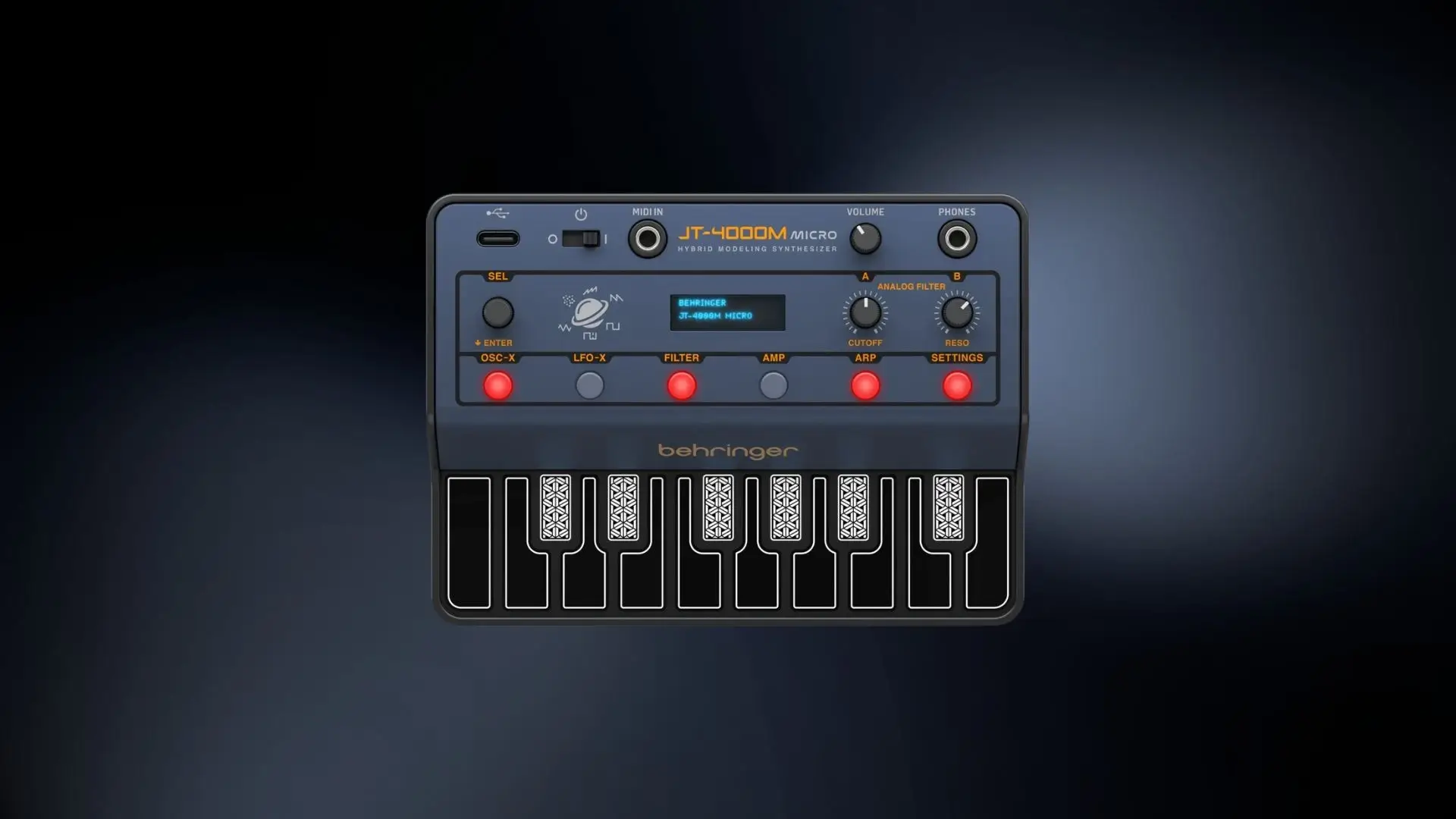
The Behringer JT-4000M Micro is a compact 4-voice paraphonic hybrid synthesizer announced in 2024 as an updated version of the JT-4000 Micro, with the crucial addition of a 3.5 mm TRS MIDI input and an included DIN adapter.

Bernardo de Azevedo
Bernardo de Azevedo
· Updated
Behringer JT-4000M Micro: The pocket-sized JP-8000-inspired synth with MIDI

The Behringer JT-4000M Micro is a compact 4-voice paraphonic hybrid synthesizer announced in 2024 as an updated version of the JT-4000 Micro, with the crucial addition of a 3.5 mm TRS MIDI input and an included DIN adapter.

Its sound engine is built around a JP-8k-inspired architecture with two analog-modeling oscillators per voice, a Supersaw waveform, an analog filter, a 12-bit DAC, two LFOs, filter and amplifier envelopes, 32 memory presets, an arpeggiator, and a 16-key capacitive touch keyboard. At a glance, it matters less as a miniature replacement for a full-size Roland JP-8000 than as a sign of how far the economics of hardware synthesis have shifted: a late-1990s dance-music vocabulary compressed into an extremely inexpensive, pocket-scale format.

Behringer JT-4000M Micro sound and character

The Behringer JT-4000M Micro lives in the sonic shadow of the Roland JP-8000, but it does not reproduce the experience of playing or programming that instrument in full. Its identity is narrower, smaller, and more pragmatic. The most obvious part of its character is the Supersaw-oriented voice structure: stacked, detuned, bright, and immediately suggestive of trance leads, synthetic pads, and compact rave-era gestures. It is an instrument designed around a recognizable electronic-music dialect rather than a neutral synthesis laboratory.

Because the oscillators are analog-modeling while the filter is analog, the JT-4000M sits in a hybrid position. The front of the sound is digital and deliberately referential, while the filter gives the tone a more rounded response than a purely software-style miniature synth might suggest. The 12-bit DAC also contributes to the Behringer JT-4000M Micro’s identity, giving the output a deliberately less pristine edge. That does not make it “vintage” in the sense of a large old analog polysynth; it makes it small, slightly grainy, and direct.

Its best territory is obvious: detuned leads, compact pads, simple basses, arpeggiated figures, and quick melodic sketches. The two-operator FM engine widens the palette beyond basic virtual analog tones, but the JT-4000M is still fundamentally a focused micro-synth. It is not trying to be a workstation, a deep modulation machine, or a studio centerpiece. Its appeal is that it can produce a very specific family of electronic sounds quickly, cheaply, and in a form factor that almost refuses to be taken too seriously.

Features and architecture

  • Manufacturer: Behringer.
  • Year: Announced in 2024 as the MIDI-equipped JT-4000M Micro revision.
  • Production years: Behringer has not published a formal production-period statement; retailer listings show availability from 2025 and current new-unit availability.
  • Synthesis type: Hybrid synthesis, combining analog-modeling oscillators with an analog filter.
  • Category: Portable micro synthesizer / desktop pocket synth.
  • Polyphony: 4-voice paraphonic operation.
  • Original price and current market price: The original JT-4000 line was promoted around the low-cost $49 / €49 range; the Behringer JT-4000M Micro has appeared around €59 in Europe, $48 on Thomann’s US-facing listing, and $70.90 at major US retailers.
  • Oscillators: Two analog-modeling oscillators per voice.
  • Waveforms: Six waveform options, including Supersaw.
  • Filter: Analog low-pass filter with cutoff and resonance.
  • LFOs: Two LFOs.
  • Envelopes: Two ADSR envelopes, assigned to filter and amplifier.
  • Modulation system: Compact menu-based editing with oscillator, LFO, filter, amplifier, arpeggiator, and settings functions; MIDI CC implementation is listed by retailers.
  • Sequencer / arpeggiator: Arpeggiator with three patterns and hold function; no full onboard sequencer is specified in the verified sources.
  • Effects: No onboard effects are listed in retailer specifications.
  • Memory: 32 memory presets, expandable via Behringer’s SynthTribe app.
  • Keyboard: 16-key capacitive touch keyboard.
  • Inputs / outputs: 3.5 mm headphone/audio output and 3.5 mm TRS MIDI input.
  • MIDI / USB: TRS MIDI input with included DIN adapter, USB-C, and USB/MIDI support.
  • Display: OLED display.
  • Dimensions / weight: 130 mm × 93 mm × 36 mm; Sweetwater lists the weight as 5.29 oz.
  • Power: USB-C power, including power from a computer, power bank, smartphone, or compatible USB source.

Strengths

  • The addition of hardware MIDI is the defining improvement over the earlier JT-4000 Micro because it makes the Behringer JT-4000M Micro far easier to use with external keyboards, sequencers, and DAWless setups without relying solely on USB hosting.
  • The Supersaw-centered architecture gives the Behringer JT-4000M Micro an immediately identifiable musical role: compact trance leads, bright pads, and detuned electronic textures rather than generic entry-level tones.
  • The hybrid design gives the JT-4000M more character than its size suggests, especially because the analog filter and 12-bit DAC keep the sound from feeling completely sterile.
  • The price-to-feature ratio is unusually aggressive: four paraphonic voices, two modeled oscillators per voice, an analog filter, an arpeggiator, patch memory, USB, MIDI, and an OLED display in a very inexpensive unit.
  • The extremely small form factor makes it useful as a sketching device, a travel synth, a secondary MIDI-controlled sound module, or a low-risk way to add JP-8k-inspired tones to a compact rig.
  • The 32-preset memory and SynthTribe expansion support make it more practical than a toy-like one-patch novelty instrument.

Limitations

  • The four voices are paraphonic, not equivalent to a full four-voice polysynth with independent complete voice architecture in the classic sense.
  • The touch keyboard is useful for quick input but is too small to replace a proper keyboard for expressive playing; the MIDI input is almost essential for serious performance.
  • The interface necessarily relies on menus, function buttons, and a small display, so editing is more constrained than on a full-size synth with dedicated controls.
  • There are no onboard effects listed in the verified specifications, which matters because Supersaw leads and pads often depend heavily on chorus, delay, and reverb in finished productions.
  • The Behringer JT-4000M Micro’s sound identity is deliberately narrow. It is strongest when used for JP-8k-inspired colors, not as a general-purpose synthesis platform.
  • The 3.5 mm output and tiny enclosure make it feel more like a compact sound module than a physically substantial studio instrument.
  • Its low price reduces the used-market advantage: buyers may prefer a new unit with warranty rather than hunt for a used one with only a small discount.

Historical context

The Behringer JT-4000M Micro belongs to Behringer’s broader strategy of compressing historically recognizable synthesizer ideas into inexpensive hardware. The earlier JT-4000 Micro already translated the JP-8000/Supersaw idea into an extremely small and affordable format, but it had a practical weakness: without a dedicated hardware MIDI input, external control depended on USB/MIDI arrangements that were less convenient for hardware-centered musicians.

The JT-4000M is therefore best understood as a correction rather than a reinvention. It keeps the same basic concept but adds the missing connection that many hardware users expected. That small change matters because MIDI is not just a technical port; it is the connective tissue of electronic-music hardware. A pocket synth without easy hardware MIDI remains partly trapped in computer-centered use. A pocket synth with MIDI becomes a module that can sit beside drum machines, sequencers, grooveboxes, and full-size keyboards.

The historical reference point is the Roland JP-8000, a discontinued analog-modeling synthesizer whose Super Saw oscillator became one of the defining synthetic gestures of late-1990s and early-2000s dance music. Roland presented the JP-8000 as a digital instrument capable of combining analog-style sound with digital flexibility and real-time control. Behringer’s JT-4000M does not carry over that large interface, 49-key format, or full performance identity. Instead, it extracts one culturally powerful idea—the JP-8k-style Supersaw vocabulary—and turns it into an affordable micro-instrument.

Legacy and significance

The Behringer JT-4000M Micro is not significant because it is the most sophisticated synthesizer in Behringer’s catalog. It is significant because it shows how far recognizable synthesis histories can now be miniaturized, commodified, and redistributed. A sound that once belonged to a full-size virtual analog keyboard associated with a major era of electronic music now exists as a pocket module costing less than many pedals, plug-ins, or boutique sample packs.

That shift has cultural consequences. Hardware synthesis used to imply expense, space, and commitment. The JT-4000M belongs to a newer category in which hardware can be casual, disposable in price but still musically functional. This does not automatically make it deep or professional in every respect. It does, however, change the entry point. A beginner can touch a Supersaw-style architecture without buying a vintage JP-8000, a modern flagship, or even a mid-priced desktop module.

Its importance is therefore democratic rather than aristocratic. It broadens access to a historically charged sound while accepting the compromises of miniaturization. The result is a synth that is easy to underestimate because of its size and price, but harder to dismiss once viewed as part of the larger movement toward low-cost, highly specific hardware instruments.

Artists, users, and curiosities

There is no reliable public evidence that the Behringer JT-4000M Micro has become associated with a named artist, producer, album, or canonical recording. That absence should not be covered up with speculative artist lists. The Behringer JT-4000M Micro is too recent, too inexpensive, and too utilitarian to have acquired a documented artistic mythology of its own.

The more relevant association is indirect: the JT-4000M points back to the Roland JP-8000 and the Supersaw lineage, a sound world deeply connected to late-1990s and early-2000s dance music. In that sense, the Behringer is not famous because of who used it, but because of the older sound it miniaturizes.

The most memorable curiosity is the reason the “M” version exists at all. The JT-4000 Micro was already notable for its tiny size and low cost, but the lack of a hardware MIDI input limited its role in hardware rigs. The JT-4000M answers that criticism directly by squeezing a 3.5 mm TRS MIDI input onto a very small front panel and including a DIN adapter. It is a small design change, but it changes the meaning of the Behringer JT-4000M Micro: from a pocket gadget with USB control to a tiny synth module that can speak the older hardware language of MIDI more fluently.

Market value

  • Current market position: Entry-level micro synth with unusually strong feature density for its price.
  • New price signal: Current listings show prices around $48 on Thomann’s US-facing page, $70.90 at Sweetwater and B&H, and around the €50–€60 range at European retailers.
  • Used market signal: The used market is not yet mature because the Behringer JT-4000M Micro is recent and inexpensive new; buyers should not treat it as collectible at this stage.
  • Availability: New units are listed by major retailers, though stock status varies; Thomann lists delayed availability, while Sweetwater lists it in stock.
  • Buyer notes: The “M” version is preferable to the earlier JT-4000 Micro for hardware setups because of its dedicated TRS MIDI input and included DIN adapter.
  • Support ecosystem: Behringer’s SynthTribe app expands preset management and patch storage beyond the 32 onboard memory slots.
  • Ease of finding: Easy to find new through large retailers; used units are less important because new pricing remains low.
  • Long-term position: Still forming. It is more likely to be remembered as a clever budget micro-synth than as a collectible flagship.

Conclusion

The Behringer JT-4000M Micro represents a very modern kind of synthesizer: historically referential, aggressively affordable, physically tiny, and more useful than its scale suggests. It does not replace the Roland JP-8000, nor does it pretend to offer the authority of a full-size performance synth. Its value lies elsewhere. It takes a culturally loaded electronic sound, adds the missing MIDI connection that the original micro version needed, and makes the Supersaw idea available as a pocket-sized hardware module. That is why it matters: not because it is grand, but because it makes a once-iconic sonic language almost absurdly accessible.


Bernardo de Azevedo
Written by
Bernardo de AzevedoFounder & Editor

His connection with music began at age 6, in the 1980s, when his father introduced him to Jean-Michel Jarre's Rendez-Vous on vinyl. He works professionally in the legal field, while synthesizers became his space for abstraction and creative exploration. Founder of The Synth Source.