

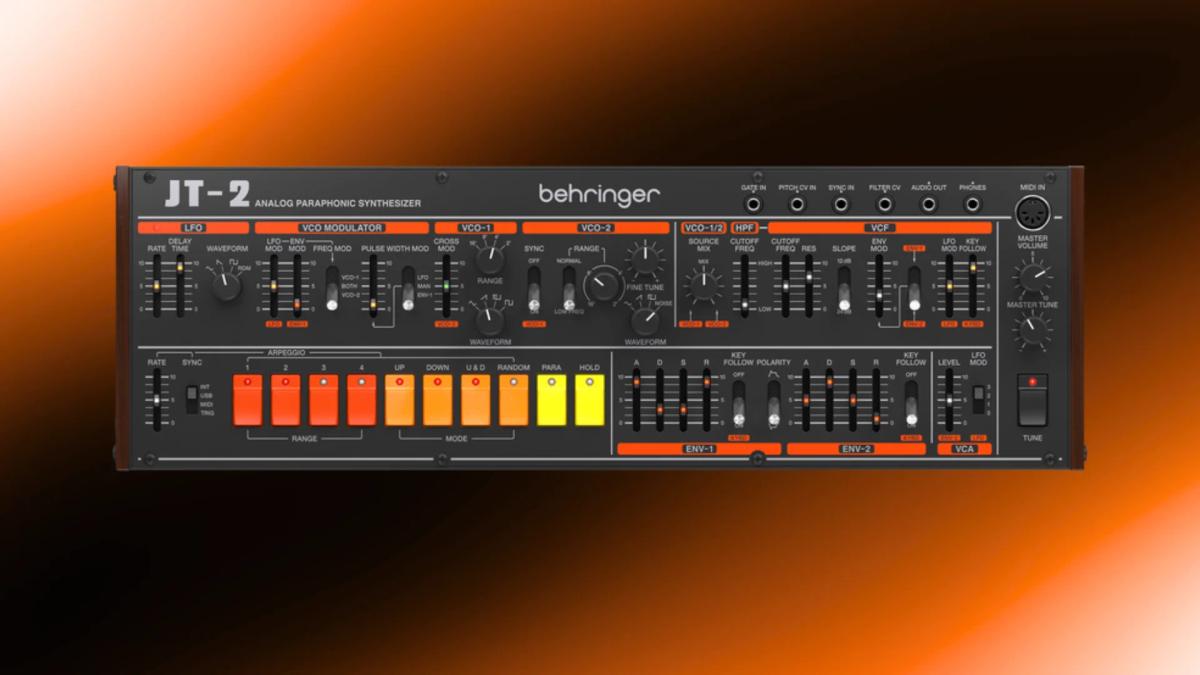
The Behringer JT-2 is a compact analog synthesizer that reproduces the voice circuitry of the Roland Jupiter-8 in an 80 HP Eurorack-compatible desktop case. Behringer first teased it as a prototype in February 2023, showed a finished unit at the NAMM Show in January 2026 and opened orders in mid-April 2026. The design pairs two analog VCOs with a switchable 12/24 dB resonant low-pass filter, a separate high-pass filter, two ADSR envelopes, an LFO and a four-octave arpeggiator. It plays monophonically by default, offers a paraphonic mode for two notes, and can be chained with other units for larger voice counts. There is no patch memory, so the 53 front-panel controls always show the sound. Launch pricing was $189, €189 and £159, well below the $299 Behringer suggested in 2023, although major US retailers list it at $259 in October 2026. Its appeal is direct: the core of a famous 1981 polysynth voice for a small fraction of a vintage unit’s cost.
Table of Contents
Behringer JT-2 sound and character
Behringer presents the Behringer JT-2 as an authentic reproduction of the original Jupiter-8 circuitry, and when it first showed the prototype in 2023 it said the voice was built on the same VCOs and VCFs as the Roland design. The oscillator section follows the Jupiter-8 pattern of two analog VCOs with cross-modulation, sync and pulse-width modulation. Each VCO offers sawtooth, triangle/sine, square and noise, and the LFO and envelope can be sent to VCO 1, VCO 2 or both. That routing is what makes the classic Jupiter sync sweeps and clangorous cross-mod tones possible, since a moving envelope on the synced oscillator produces the tearing, vocal lead sound the original is known for.
The filter stage copies the original’s two-part layout. A resonant low-pass filter can be switched between 12 dB and 24 dB slopes, which gives a brighter, more open two-pole character or a rounder four-pole one, and a separate high-pass filter thins out the low end. MusicTech and Gearnews note that the high-pass section has only a cutoff control. The Jupiter-8 used Roland’s custom IR3109 chip for its filter, but Behringer’s published material does not say which components the JT-2 uses, so claims about filter chip parity remain unverified. External audio can be routed through the filters, which turns the unit into a simple analog processor for drum loops or other synths.
Two analog ADSR envelopes with key follow shape the sound. Behringer says they can modulate the VCOs, the VCF and the VCA, while MusicTech and Gearnews describe one envelope for the filter and one for the amplifier as the basic assignment. The LFO offers sine, sawtooth, square and random waves, and the random setting covers sample-and-hold style filter or pitch movement. With the two oscillators tuned apart and the low-pass slope set to 24 dB, the Behringer JT-2 can reach the thick basses and sync leads of the Jupiter tradition, while the 12 dB setting and the high-pass filter lean toward thinner, brassier sounds.
Voicing is the most discussed part of the design. Behringer describes the unit as monophonic with a paraphonic mode for two-note playing, and MIDI voice priority can be set. Because there is one filter section and one amplifier envelope, the two notes in paraphonic mode share the same filter and contour, as is usual with paraphonic instruments. For true polyphony, units can be linked through Behringer’s Poly Chain. Behringer quotes a 16-voice Poly Chain, while MusicTech wrote that 16 chained units would give 32 voices, counting two paraphonic notes per unit. One Thomann customer reported chaining four units into an eight-voice paraphonic setup.
The playing experience is shaped by what is not there. There is no keyboard, no display and no patch memory, so the instrument is played from MIDI or from CV and gate, and every sound has to be set by hand. Synthtopia’s NAMM report put it plainly: the settings on the panel are the sound. Readers of Synthtopia also pointed out that there is no dedicated glide control. The arpeggiator partly compensates, with Up, Down, Up-Down and Random patterns over as many as four octaves, selected from a row of colored buttons that MusicTech linked to the chromatic button scheme of the Jupiter-8.
We found no independent hands-on review of the Behringer JT-2 from a major outlet as of October 2026. Behringer’s own demo video focuses on pads, punchy leads and large analog tones, which is promotional material. The two customer reviews on Thomann’s UK store, from July and August 2026, are both five stars and praise the sound, the feel of the knobs and sliders, and the multicolored LEDs. These early impressions are encouraging but too few to establish how closely the unit matches a vintage Jupiter-8 voice.
Features and architecture
- Manufacturer: Behringer
- Year introduced: 2026 (prototype teased February 21, 2023; finished unit shown at NAMM in January 2026; officially launched with pre-orders in mid-April 2026)
- Production years: 2026 to present
- Synthesis type: Analog subtractive; analog VCO, VCF and VCA signal path
- Category: Desktop synthesizer that can be removed from its case and mounted as an 80 HP Eurorack voice; not designed as a patchable modular
- Polyphony: Monophonic, with a paraphonic mode for two notes; Poly Chain links several units (Behringer quotes 16 voices; MusicTech counts 32 voices from 16 units)
- Multitimbrality: None
- Original price: $189, €189 and £159 at launch (April 2026); $299 was the estimate Behringer gave for the 2023 prototype
- Current market price: $259 at Sweetwater (pre-order), $168, €179 and £149 at Thomann; Equipboard’s October 2026 price tracker shows an average of about $235 across US dealers
- Oscillators: Two analog VCOs with sawtooth, triangle/sine, square, noise and PWM; oscillator sync and FM (cross-modulation); LFO and envelope modulation of VCO 1 and/or VCO 2
- Filter: Resonant analog low-pass with 12/24 dB slope switch; separate high-pass filter with cutoff control
- LFO: One LFO with sine, sawtooth, square and random waveforms
- Envelopes: Two analog ADSR envelopes with key follow, routable to the VCOs, VCF and VCA
- Modulation system: Fixed front-panel routings for LFO and envelope to oscillators, filter and pulse width; cross-modulation and sync between the VCOs; CV inputs for pitch and filter
- Sequencer / arpeggiator: Arpeggiator with Up, Down, Up-Down and Random patterns over up to four octaves; no step sequencer
- Effects: None
- Memory: None; no patch storage
- Keyboard: None; played via MIDI, USB-MIDI or CV/gate
- Inputs / outputs: 6.3 mm line output, 3.5 mm stereo headphone output, audio input, 3.5 mm pitch CV, filter CV, gate and sync inputs (per Thomann)
- MIDI / USB: 5-pin MIDI In and Thru plus USB-MIDI according to Thomann’s feature list (its spec table lists MIDI In and Out); MIDI channel and voice priority selection
- Display: None; 53 front-panel controls with LED-lit buttons
- Dimensions / weight: 426 × 136 × 91 mm; 1.9 kg (Thomann listing); 80 HP when mounted in Eurorack
- Power: External 12 V DC power supply included (Thomann)
Strengths
- The voice architecture is close to the original. Two VCOs with sync and cross-mod, a switchable 12/24 dB low-pass and a separate high-pass follow the layout of a Jupiter-8 voice section.
- The price is very low for discrete analog hardware. At $189 at launch, and $168 or £149 at Thomann in October 2026, it costs a tiny fraction of a vintage Jupiter-8.
- Every function has a control. With 53 knobs, sliders and switches and no menus, the panel shows the whole patch at a glance.
- It works on a desk or in a rack. The same unit can sit in its own case or be moved into a Eurorack system as an 80 HP voice with CV and gate inputs.
- It can grow into a polysynth. Poly Chain lets owners add units for more voices, and early buyers have already built multi-unit setups.
- It doubles as a processor. The audio input routes external sound through the analog filters and VCA.
Limitations
- There is no patch memory. Sounds cannot be saved or recalled, which matters for live use and for chained multi-unit setups.
- One unit is not a polysynth. A single Behringer JT-2 plays one note, or two paraphonic notes that share a filter and amplifier envelope.
- Glide has no dedicated control. Synthtopia readers flagged the missing portamento knob after the launch demo.
- Availability is uneven. Thomann quotes nine to 12 weeks and Sweetwater estimates January 2027, while some other stores show stock.
- US pricing is above the launch figure. Major US dealers list $259, noticeably more than the $189 announced in April 2026.
- Independent reviews are missing. As of October 2026 we found no hands-on test from a major publication, so sound comparisons with the original rely on demos and a few user reports.
- Specifications vary between sources. Behringer’s page omits I/O details, dimensions and power, and dealer listings disagree on details such as MIDI Out versus Thru.
Historical context
Roland introduced the Jupiter-8 in early 1981 as an eight-voice analog polysynth with two VCOs per voice, cross-modulation, sync and pulse-width modulation, a resonant low-pass filter switchable between 12 and 24 dB per octave, a non-resonant high-pass filter, two envelopes and an arpeggiator. It sold for $5,295 in the US and £3,995 in the UK, and about 3,300 units were made before production ended in 1985. Its users ranged from Duran Duran and Vince Clarke to Michael Jackson and Giorgio Moroder. MusicTech noted in 2026 that an original sells for close to $30,000 on Reverb.