

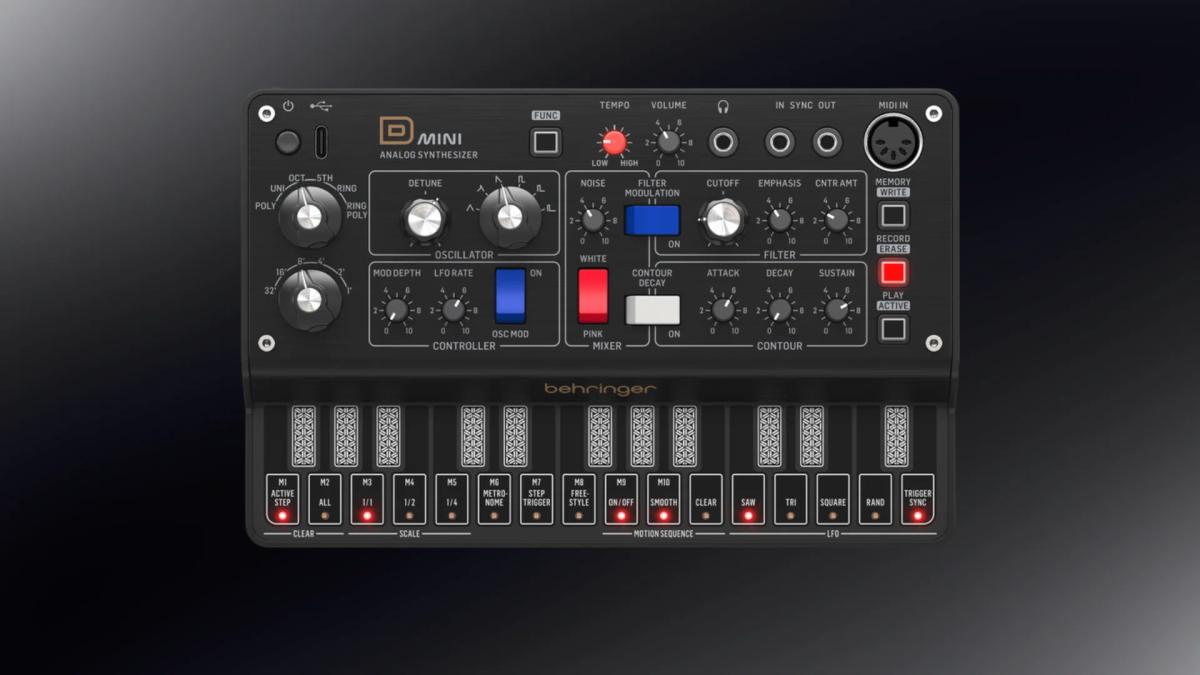
The Behringer D Mini is a compact analog synthesizer modeled on the 1970s Minimoog Model D, made by Behringer as part of its growing line of small, low-cost recreations. It was first announced in March 2022 under the name Model D Soul, then shown in finished form and renamed at NAMM in January 2026. European pre-orders opened in June 2026, and the first small batches reached buyers over the summer. Behringer specifies three VCOs, a classic lowpass filter, one LFO and one envelope, played from 27 touch keys and 18 controls, with a 16-step motion sequencer, paraphonic voice modes and USB-C bus power. The price is €99 in Europe, £82 at Thomann’s UK store and about $119 on US pre-order. What gives the Behringer D Mini its weight is reach rather than novelty: it places a Minimoog-style voice path in a 370 g box at roughly half the European price of Behringer’s own Model D.
Table of Contents
Behringer D Mini sound and character
The Behringer D Mini follows the classic subtractive order of the Minimoog Model D: oscillators and noise into a resonant lowpass filter, then into a VCA. Behringer lists five oscillator waveforms (saw, triangle, sharktooth, square and pulse), a white and pink noise source with its own level control, and a vintage-voiced lowpass filter with resonance. Synth Anatomy describes the filter as ladder-style, and both Musicstore and Bedroom Producers Blog give its slope as 24 dB per octave, which matches the four-pole character of the original design.
The oscillator section is where the small format departs most clearly from the Minimoog. Synth Anatomy reports that a single knob tunes all three oscillators together, and Thomann lists an octave selector and a detune control rather than separate tuning for each oscillator. In practice that means thickness comes from detuning a stack of oscillators against each other, not from setting each one to its own interval as on a Model D. One reader of Synthtopia’s launch report also took the panel to mean that the three oscillators share one waveform choice, a point Behringer’s own materials do not settle.
Intervals return through the voice modes. Thomann lists six: Poly, Unison, Octaves, Fifths, Ring Unison and Ring Poly. Poly spreads the three oscillators across three notes paraphonically, so chords share one filter and one envelope, while Unison stacks all three on a single note for a heavier mono sound. Octaves and Fifths fix the stack to those intervals, and the two Ring modes add ring modulation for metallic and bell-like tones. James Nugent of Bedroom Producers Blog singled out these modes as a large part of the instrument’s appeal, while one Thomann customer, writing as Nicolas279, found the paraphonic mode of limited use.
Modulation is deliberately lean. A single ADS envelope drives the VCA, and a variable envelope amount sends it to filter cutoff; Synth Anatomy adds that it can also be routed to the oscillators. Filter and amplitude therefore move together, unlike the separate filter and loudness contours of the original instrument. The LFO offers four waveforms, which Thomann lists as sawtooth, triangle, square and random, and it can modulate both pitch and filter. That is enough for vibrato, filter wobble and stepped random effects, but not for layered or independent modulation.
The playing surface shapes the experience as much as the circuit. The Behringer D Mini uses 27 flat touch keys and 18 direct controls, and Thomann’s specification lists no velocity, aftertouch or modulation wheel. Nugent compared the keys to those on Arturia’s MicroFreak and suggested that players used to conventional keyboards may find them less expressive, with an external MIDI controller as the obvious remedy. The 16-step motion sequencer records knob movements alongside notes, and a Thomann customer writing as Gummibär described that ability to capture several parameter changes as one of the unit’s best features, while wishing for a built-in delay.
As of October 2026, no full independent review from a major publication was found for this article, so first impressions come mostly from buyers. Thomann’s UK store shows 11 customer reviews averaging 4.5 out of 5. One German reviewer, MichaelBernd, reported that the oscillators drift fairly quickly, adding that a pause of about ten seconds sorts it out, while another, Axi_etx, praised the filter in particular. A reviewer writing as Citric Acid 303 recommended the D Mini as an instrument in its own right rather than as a Minimoog replacement, which is a fair summary of how most early buyers seem to frame it.
Features and architecture
- Manufacturer: Behringer
- Year introduced: 2026 (first announced as the Model D Soul in March 2022; shown as the D Mini at NAMM in January 2026; Thomann lists it as available since July 2026)
- Production years: 2026 to present
- Synthesis type: Analog subtractive (VCO, VCF, VCA)
- Category: Portable desktop analog synthesizer with touch keys and sequencer
- Polyphony: Monophonic, with a three-voice paraphonic Poly mode; six voice modes (Poly, Unison, Octaves, Fifths, Ring Unison, Ring Poly)
- Multitimbrality: None
- Original price: €99 in the EU; $99 was the figure given for the Model D Soul in 2022; no official US list price found for the D Mini
- Current market price: €99 at Thomann and Musicstore; £82 at Thomann UK; $119 on pre-order at Perfect Circuit (Synthtopia cited a street price of about $120)
- Oscillators: Three VCOs according to Behringer’s product headline, with five waveforms (saw, triangle, sharktooth, square, pulse), shared tuning, octave selector and detune; some Behringer copy and retailer listings describe a single VCO; white and pink noise with level control
- Filter: One analog ladder-style lowpass filter with cutoff, resonance and envelope amount; 24 dB per octave according to retailer listings
- LFO: One LFO with four waveforms (sawtooth, triangle, square, random per Thomann), routable to oscillator pitch and filter
- Envelopes: One ADS envelope for VCA and filter; the 2022 Model D Soul specification listed two envelopes
- Modulation system: Fixed routing; envelope amount to cutoff, LFO to pitch and filter, ring modulation through the Ring voice modes; all parameters addressable by MIDI CC and NRPN according to Synth Anatomy
- Sequencer / arpeggiator: 16-step motion sequencer with knob-movement recording; 10 memory slots per Thomann and Musicstore (8 in earlier specifications); built-in scaler per Synth Anatomy; Musicstore lists an arpeggiator with three patterns, while Thomann lists none
- Effects: None
- Memory: No patch memory specified by the manufacturer; sequencer patterns stored internally; MIDI bulk load and save allow external patch storage according to Synth Anatomy
- Keyboard: 27 capacitive touch keys, no velocity or aftertouch; 18 direct-access controls
- Inputs / outputs: Line output, stereo 3.5 mm headphone output, 3.5 mm sync in and out
- MIDI / USB: MIDI In (listed as 5-pin DIN by Thomann and Perfect Circuit); USB-C for power, MIDI and firmware updates
- Display: None
- Dimensions / weight: 193 x 124 x 43 mm; 370 g (Thomann; Perfect Circuit gives the same dimensions)
- Power: USB-C bus power from a computer, phone or power bank; no adapter included
Strengths
- The price is very low for a three-oscillator analog synth. At €99 or £82, the Behringer D Mini costs roughly half of what Synth Anatomy quoted for Behringer’s Model D in Europe.
- It keeps the core Minimoog signal path. Three VCOs, mixed noise and a resonant ladder-style lowpass filter give it the basic ingredients of the Model D sound in a much smaller form.
- The voice modes add range the original lacks. Paraphonic Poly, Octaves, Fifths and two ring modulation modes add playing options well beyond a plain mono synth.
- The motion sequencer makes it self-contained. Sixteen steps with recorded knob movements and stored patterns let it produce evolving lines without a computer or external sequencer.
- It is genuinely portable. At 370 g and powered from USB-C, it runs from a phone, laptop or power bank, which suits travel and small desks.
- The MIDI implementation is broad for the class. Synth Anatomy reports CC and NRPN control of every parameter plus bulk dumps, which opens the door to editors and external patch storage.
Limitations
- The oscillators cannot be tuned independently. A shared tuning control with detune rules out the per-oscillator intervals that define many classic Minimoog patches, outside the fixed Octaves and Fifths modes.
- There is only one envelope. Filter and amplitude share a single ADS contour, so plucks with a sustained body or slow filter sweeps under a fast amplitude shape are not possible.
- The touch keys limit expression. With no velocity, aftertouch or wheels, expressive playing depends on an external MIDI keyboard.
- Official specifications are inconsistent. Behringer’s own page lists three VCOs in its headline but describes a single VCO in its feature text, and retailers disagree on sequencer slots and the presence of an arpeggiator.
- Supply is thin. Synth Anatomy reported that Thomann’s first batch sold out almost immediately, and in October 2026 Thomann quotes delivery in several months while Musicstore estimates January 2027.
- Documentation and software support lag behind the hardware. Thomann customers reported that no manual was supplied and said Behringer’s SynthTribe software did not recognize the unit, which blocked changes such as the MIDI channel.
- Independent reviews are scarce. Beyond retailer ratings and news reports, no full review by a major publication was found as of October 2026.
Historical context
The instrument behind the D Mini is one of the most influential synthesizers ever made. The Minimoog Model D appeared in 1970 as a compact, more affordable alternative to Moog’s modular systems, with three oscillators, a noise generator and a 24 dB per octave lowpass filter. Production ran until 1981 and passed 12,000 units, and Moog Music later reissued the design in 2016 and again from 2022, the latter adding a spring-loaded pitch bend wheel and updated MIDI.