

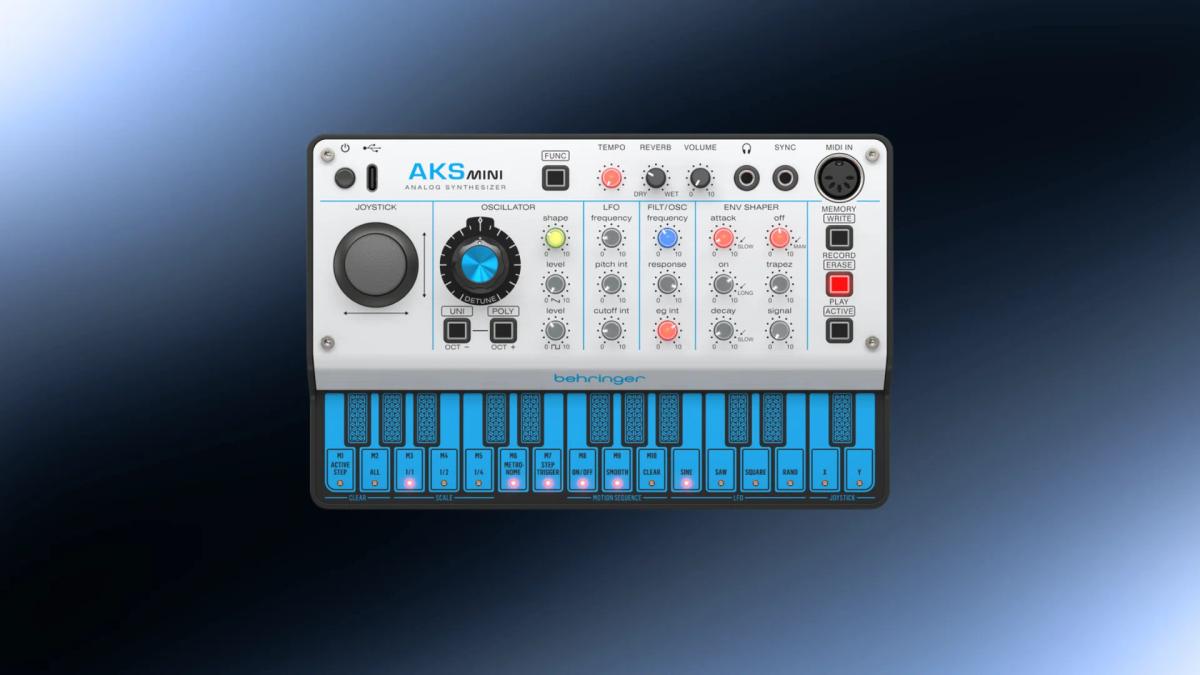
The Behringer AKS Mini is a compact analog synthesizer with three VCOs, a 27-key touch keyboard and a two-axis joystick, built as a small, modern take on the 1970s EMS Synthi AKS. Behringer first showed it as a render in 2022, presented a “final version” in January 2023 with a summer shipping target, and then went quiet until mid-July 2026, when the instrument appeared on the company’s website and opened for pre-order. The signal path pairs the three oscillators with a resonant low-pass filter that Behringer describes as based on the original AKS circuitry, plus an LFO, a trapezoid-inspired envelope, a digital spring reverb and a 16-step motion sequencer. It runs on USB-C power and weighs 360 g. Pre-order prices are €119 and £99, with US retailers listing it at $129. What makes the Behringer AKS Mini notable is less the clone question than the price: a hint of EMS character for about the cost of a budget groovebox.
Table of Contents
Behringer AKS Mini sound and character
As of October 2026, the Behringer AKS Mini has not been independently reviewed, so its sound can only be described from Behringer’s own claims, its official launch video and the reactions of the press. Behringer says the VCOs and the VCF faithfully reproduce the original circuitry and that the signal path is fully analog, apart from the digital reverb. Matt Mullen of MusicRadar took a careful line on that claim, describing the instrument as a quirky mini synth that takes playful inspiration from the AKS rather than a clone of it.
The oscillator section is the core of the design. Each of the three VCOs offers variable sawtooth and square waveforms, but Synth Anatomy pointed out that they share tuning and waveform controls rather than being programmed independently. In practice they behave as one thick oscillator bank, spread by a large blue detune knob that echoes the colored controls of the original AKS. In Poly mode the three oscillators are split across up to three notes; in Unison mode they stack on a single note for a wider, detuned mono sound.
That arrangement explains why outlets describe the voice structure differently. Behringer’s product page calls the Behringer AKS Mini a polyphonic synthesizer, and retailers such as Thomann and Alto Music list three voices. MusicRadar and Synth Anatomy describe it as paraphonic, since the three notes appear to pass through one filter and one envelope rather than three independent voice paths. Either way, it is a three-note instrument with shared shaping, closer to a paraphonic string or chord machine than to a full polysynth.
The filter is a resonant low-pass design with cutoff and resonance controls, and the envelope can be routed to it as well as to the VCA. The envelope itself takes its cue from the trapezoid generator of the EMS instruments rather than a standard ADSR. Synth Anatomy listed its stages as attack, decay, on and off, with a separate trapezoid level control, and noted that the off stage can loop the envelope so that it works as an extra modulation source. A four-waveform LFO (sine, saw, square and random) adds vibrato, filter movement or stepped random modulation.
Performance control centers on the joystick, a nod to the most recognizable feature of the original. On the AKS Mini it is a two-axis controller that can be assigned to any two parameters, so it can sweep filter and pitch at once or drive the LFO depth against resonance. The 27 capacitive keys respond to touch rather than travel, and the 16-step motion sequencer records knob movements as well as notes, with ten pattern slots. The digital spring reverb nods to the spring tank built into the original EMS designs and gives the small unit some sense of space on its own.
Early listener reactions to Behringer’s demo were mixed. Under Synthtopia’s first-look article, some commenters heard a pleasant analog subtractive synth, while others felt it did not sound much like a Synthi and noted that the video avoided classic EMS effects. Those comments reflect a demo, not a hands-on assessment, and since the launch materials list no pin matrix, noise source or ring modulator, the AKS Mini cannot reproduce the more unusual EMS patches directly in any case.
Features and architecture
- Manufacturer: Behringer (Music Tribe)
- Year introduced: 2026 (official launch and pre-orders in July 2026; first shown as a render in 2022 and as a “final version” in January 2023)
- Production years: 2026 to present (pre-order stage as of October 2026)
- Synthesis type: Analog subtractive; three VCOs into a resonant low-pass VCF and VCA, with digital spring reverb
- Category: Portable analog mini synthesizer with built-in touch keyboard
- Polyphony: Three notes in Poly mode, described by Behringer as polyphonic and by MusicRadar and Synth Anatomy as paraphonic; Unison mode stacks all three oscillators on one note
- Multitimbrality: None
- Original price: $99 target announced in 2022 and 2023; at the 2026 launch, €119 and £99, with US retailers listing $129
- Current market price: Pre-order only as of October 2026; $129 at Perfect Circuit and Alto Music, €119 in Europe, $111 on Thomann’s international site
- Oscillators: Three analog VCOs with variable sawtooth and square waveforms and a shape control; shared tuning and waveform settings; dedicated detune knob
- Filter: Analog resonant low-pass VCF based on the AKS design; Alto Music lists 12/24 dB per octave, while other retailers list 24 dB
- LFO: One LFO with sine, sawtooth, square and random waveforms, routable to pitch and filter cutoff
- Envelopes: One trapezoid-inspired envelope for VCF and VCA; Synth Anatomy lists attack, decay, on and off stages with a looping option, while Thomann and Bonedo list attack, hold, decay and retrigger
- Modulation system: Two-axis joystick assignable to any two parameters; LFO and envelope routings; no patch matrix
- Sequencer / arpeggiator: 16-step motion sequencer with parameter recording and 10 pattern memories; arpeggiator listed by retailers and in Behringer’s 2023 announcement
- Effects: Digital spring reverb emulation with dry/wet control
- Memory: Programmable patches according to Behringer; 10 sequencer pattern slots; MIDI bulk load and save
- Keyboard: 27 capacitive touch keys
- Inputs / outputs: 3.5 mm stereo headphone output (also used as the main output, according to Synth Anatomy); 3.5 mm sync input
- MIDI / USB: 5-pin DIN MIDI In; USB-C for power and class-compliant MIDI; NRPN and CC control of all parameters
- Display: No screen in Behringer’s feature list; Alto Music lists a power LED
- Dimensions / weight: 193 × 124 × 40 mm (7.6 × 4.9 × 1.6 in); 360 g (0.79 lb)
- Power: 5 V over USB-C from a computer, phone or power bank; no power adapter listed
Strengths
- The price is very low for a three-VCO analog synth. At €119 or about $129, it costs a fraction of most analog instruments with three oscillators and a resonant filter.
- The joystick keeps a key piece of the EMS identity. A two-axis controller assignable to any two parameters gives the small unit a more physical, gestural way to play than a single mod knob.
- The Behringer AKS Mini is truly portable. At 360 g with USB-C power from a phone or power bank, it can run without a mains adapter or an external keyboard.
- The sequencer records movement as well as notes. Ten pattern slots of 16-step motion sequencing make it usable as a self-contained sketch or loop instrument.
- MIDI control is comprehensive. Every parameter responds to NRPN or CC messages, and bulk load and save opens the door to editors and DAW recall.
- The envelope design goes beyond a basic ADSR. A trapezoid-style generator that can loop gives the instrument a second modulation source with an EMS flavor.
Limitations
- There is no patch matrix. On the Behringer AKS Mini, the 16 × 16 pin matrix that defined the VCS3 and Synthi AKS is absent, so the signal path is fixed rather than open routing.
- Important EMS sound sources are missing. None of the launch materials list the original’s noise generator, ring modulator or external input amplifiers.
- The oscillators cannot be set independently. Shared tuning and waveform controls rule out separate intervals, cross-modulation or one oscillator acting as a modulator.
- Connectivity is minimal. Audio leaves through a 3.5 mm headphone jack, and there is no CV, gate or audio input listed.
- It is not shipping yet. Retailers were still taking pre-orders in October 2026, with estimated arrival dates in mid to late November.
- No independent reviews exist. Sound quality, build and the faithfulness of the circuit claims have not yet been tested by the press.
Historical context
The instrument behind the name comes from Electronic Music Studios, the Putney company co-founded by Peter Zinovieff, Tristram Cary and David Cockerell, which MusicTech dates to 1969 through 1979. The VCS3 arrived in 1969, with Cockerell designing the electronics and Cary its look, at a price just under £330. It replaced patch cables with a pin matrix, combined three oscillators with a 24 dB per octave low-pass filter, a trapezoid envelope, a ring modulator, a spring reverb and a joystick, and became one of the first portable synthesizers. The Synthi AKS (dated 1972 by Wikipedia and MusicRadar, and 1971 by Synth Anatomy and Synthtopia) put essentially the same electronics into a plastic briefcase, with a touch-sensitive capacitive keyboard and a 256-event sequencer in the lid.