Home›Articles›Best beginner synths in 2026: 10 hardware picks for ele…
Articles

Best beginner synths in 2026: 10 hardware picks for electronic music production

Ten beginner synths for 2026, from a $70 pocket FM box to the MiniFreak and Moog Messenger, with US prices, who each suits and what to check before buying.

Bernardo de Azevedo
Bernardo de Azevedo
· Updated
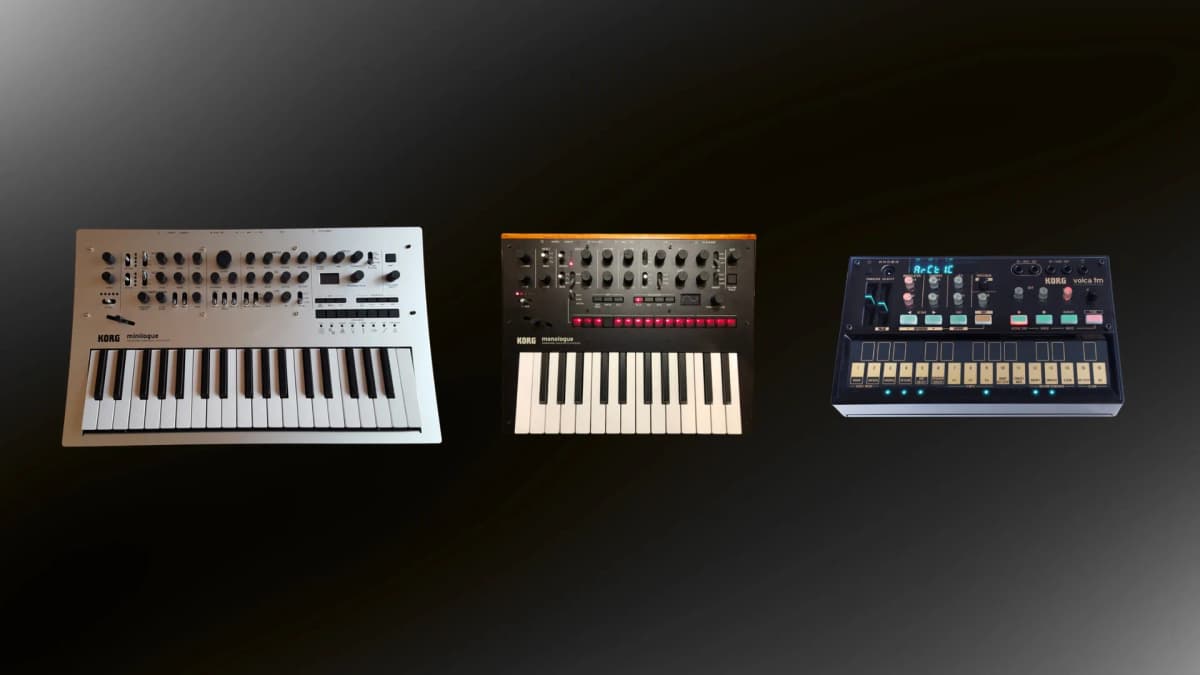
Beginner synth picks: Korg minilogue, monologue and Volca FM2

The best beginner synths in 2026 are ones that put their main controls on the front panel, ship with good presets, and include a sequencer or arpeggiator so you can make music straight away. For most new players that means the Arturia MicroFreak or Roland S-1 on a tight budget, and the Arturia MiniFreak, Korg minilogue xd or ASM Hydrasynth Explorer if you can spend $600 to $700. If you want an analog mono synth for bass and leads, the Korg monologue and Moog Messenger are the picks.

Below you will find a quick comparison table, a short guide to what actually matters in a first synth, and notes on each of the ten instruments. Prices are approximate US street prices as of October 2026 from major retailers. They move often, and European stores such as Thomann are frequently cheaper, so check before you buy.

Quick picks: the best beginner synths

Synth Type Voices Keys Approx. US price (Oct 2026) Best for
M-VAVE FM-1 6-operator FM 12 (20 with firmware v16) 27 silicone keys ~$70–100 Trying FM for almost nothing
Behringer Pro VS Mini Hybrid vector 4 Mini keys ~$119 Cheapest real synth with presets and a sequencer
Roland S-1 Virtual analog 4 None (step buttons) ~$270 Portable, battery-powered sketching
Arturia MicroFreak Digital + analog filter 4 (paraphonic) 25-key touch plate ~$349 Sound variety on a budget
Korg monologue Analog mono 1 25 slim keys ~$400 Learning subtractive synthesis
Korg microKORG 2 Virtual analog + vocoder 8 37 mini keys ~$600 Presets, vocoder, battery use
Arturia MiniFreak Digital + analog filters 6 37 slim keys ~$599 Best all-rounder for most beginners
ASM Hydrasynth Explorer Wavetable/wave morphing 8 37 mini keys, poly aftertouch ~$649 Deep sound design that grows with you
Moog Messenger Analog mono 1 32 full-size ~$699 Bass and leads with a real keyboard
Korg minilogue xd Analog poly + digital 4 37 slim keys ~$700 Analog chords, pads and sequencing

What to look for in a beginner synth

One knob per function

The fastest way to learn synthesis is to turn a labeled knob and hear what it does. Synths where the oscillator, filter and envelope controls sit on the panel teach you far more than ones that hide everything behind a screen. Menus are not a deal-breaker, but a beginner should be able to make a usable sound without opening one.

Presets and patch memory

Good factory sounds let you play music on day one and give you working examples to pull apart. Patch memory also matters more than many first-time buyers expect: if a synth cannot save sounds, every tweak you love disappears when you move on. All ten picks here store patches on board.

A sequencer or arpeggiator

Electronic music is built on loops, and a built-in step sequencer lets you write a bassline or chord pattern without a computer. Look for motion recording (sometimes called parameter or knob automation), which records filter sweeps and other moves into the pattern.

Keys or desktop

If you already play piano, or want to learn, pick something with at least 32 to 37 keys. Mini and slim keys are fine for basslines and parts but cramped for two-handed playing. A desktop or keyless synth is cheaper and smaller, and you can always pair it with a USB MIDI keyboard later.

Mono, paraphonic or polyphonic

A monophonic synth plays one note at a time, which is perfect for basses and leads but rules out chords. Paraphonic synths can play several notes that share one filter and envelope. True polyphony (four voices or more) is what you need for pads and chord progressions. If you are unsure, start polyphonic; it covers more musical ground.

USB MIDI and USB audio

Nearly every current synth offers class-compliant USB MIDI, so you can record notes into a DAW and control the synth from it. USB audio is less common and very handy, because it sends the synth’s sound into your computer over the same cable with no audio interface. The Roland S-1 has it, and so does the FM-1.

A free soft synth is a perfectly good first step

You do not need hardware to start. Free plug-ins such as Vital (wavetable) and Surge XT (a deep, open-source hybrid) cover everything in this guide and run in any DAW. Plenty of people learn the basics in software and buy hardware once they know which sounds and workflows they enjoy. Hardware earns its price through hands-on control and focus, not because it is required.

Under $200

M-VAVE FM-1: an ultra-cheap FM experiment

The M-VAVE FM-1 is a pocket six-operator FM synth with 32 algorithms and 12-voice polyphony (20 voices across eight parts since firmware v16), and it reads DX7-style patches. It typically sells for around $70 on AliExpress and closer to $100 elsewhere. For that money you get a speaker, a rechargeable battery rated around 12 hours, USB-C audio and MIDI, Bluetooth MIDI, effects, an arpeggiator and a step sequencer.

The caveats are real. The knobs feel cheap, the effects are basic, MIDI support was thin at launch (official updates have improved it), and you get neither a power supply nor a TRS MIDI adapter in the box. FM is also the least intuitive synthesis method for a beginner. Treat it as a fun, low-risk second instrument or a way to hear classic FM sounds, not as your only synth. If you get hooked, the site has more on its hardware and on the custom firmware scene.

Behringer Pro VS Mini as a beginner synth

Inspired by the Sequential Prophet VS, the Pro VS Mini is a four-voice vector synth that blends several waveforms with a joystick. It has presets, a sequencer and an arpeggiator, and it sells for around $119. The mini keys and small controls are a compromise, but as a first box for learning what oscillators, filters and envelopes do, little else at this price comes close. Behringer’s mini range also includes the JT-4000 Micro if you want something even smaller.

$200 to $500

Roland S-1 as a beginner synth

The S-1 is part of Roland’s AIRA Compact line: a four-voice synth in a palm-sized case with a 64-step sequencer, motion recording, probability, a built-in battery rated around 4.5 hours, and USB-C audio and MIDI. It sells for about $270. You play it from a row of buttons rather than a keyboard, which suits pattern-based electronic music better than melodic playing. It sounds bigger than its size suggests and is easy to carry anywhere, so it is a great choice for producers who want to sketch ideas away from the computer.

Arturia MicroFreak as a beginner synth

The MicroFreak pairs a long list of digital oscillator modes (wavetable, granular-style textures, physical modeling and more) with an analog filter. Its flat, touch-sensitive keyboard takes some getting used to but responds to pressure, and the modulation matrix teaches routing better than most budget synths. At around $349, with occasional deals well below that, it gives the widest range of sounds for the money. It is paraphonic rather than fully polyphonic, so chords are possible but limited.

Korg monologue as a beginner synth

If your goal is to understand classic subtractive synthesis, a simple analog mono synth is the best teacher, and the monologue is among the most affordable good ones. Two oscillators, a characterful filter with drive, a 16-step sequencer with motion recording, and slim keys in a small case: everything is visible and nothing is wasted. It sells for about $400 in the US. It is a bass and lead machine, so pair it with a polyphonic synth or software for chords.

$500 to $900

Arturia MiniFreak as a beginner synth

The MiniFreak is the pick we would hand most beginners. It has six voices, 37 slim keys with aftertouch, two digital engines with 22 oscillator modes between them, analog filters, three effects slots and a 64-step sequencer with modulation lanes. That gives you chords, pads, basses and odd textures from one instrument, plus a large preset library to learn from. It runs about $599 in the US, often less in Europe. If you want full-size keys, read our look at the MiniFreak 49.

Korg microKORG 2 as a beginner synth

The original microKORG was a first synth for a generation, and the microKORG 2 keeps the recipe: lots of presets, a vocoder with a microphone, 37 mini keys, and battery power from AA cells. It offers eight voices, or four per sound when you layer two. US retailers list it at about $600, though European stores have sold it for considerably less. It is menu-heavier than the analog picks here, so it suits people who want to play and perform with ready-made sounds more than those who want to learn programming from scratch.

ASM Hydrasynth Explorer as a beginner synth

The Hydrasynth Explorer is the most powerful synth in this guide. You get eight voices of wave-morphing synthesis, a deep modulation system, strong effects and a 37-note mini keybed with polyphonic aftertouch, all for about $649. The layout is clear and well labeled, but there is a lot of depth, so it rewards beginners who expect to dig in over months. Its preset library is large and broad enough for almost any genre. For the full-size model, see our review of the Hydrasynth Keyboard.

Moog Messenger as a beginner synth

The Messenger brings a classic Moog sound to a price close to the digital polys. It is a monophonic analog synth with two oscillators with wavefolding, a sub-oscillator, a ladder filter with several modes, a 64-step sequencer, an arpeggiator and 256 patch slots. Its 32 full-size keys with velocity and aftertouch make it much nicer to play than slim-key rivals. It costs about $699. Choose it if bass, leads and that Moog low end matter most to you. Novation’s Bass Station II covers similar ground for about $600.

Korg minilogue xd as a beginner synth

The minilogue xd is a four-voice analog polysynth with a digital multi-engine on top, which adds FM, noise and user-loadable oscillators. The 16-step sequencer records knob movements, the effects are good, and the oscilloscope display helps you see what the waveform is doing as you turn knobs. It sells for about $700. Four voices is enough for most chords and pads, and the panel is laid out like a textbook diagram, which makes it one of the best instruments for learning analog polyphonic synthesis. Our minilogue vs minilogue xd comparison covers the older model if you are shopping used.

Which beginner synth should you buy?

  • Tightest budget: Behringer Pro VS Mini, or the M-VAVE FM-1 if you accept its rough edges.
  • Producer who works in loops: Roland S-1 or Arturia MicroFreak.
  • Want to learn synthesis properly: Korg monologue (mono) or minilogue xd (poly).
  • One synth that does a bit of everything: Arturia MiniFreak.
  • Willing to grow into it: ASM Hydrasynth Explorer.
  • Bass and leads first: Moog Messenger.
  • Presets, vocoder and battery power: Korg microKORG 2.

Whatever you choose, the instrument you actually play every day will teach you more than a more capable one that sits under a dust cover. Pick the one whose sound and layout make you want to turn it on.

Related articles

Sources

Image credits: Korg minilogue photo by Aeternus, Wikimedia Commons, CC BY-SA 4.0; Korg monologue photo by medicalfools / David Chancey, Wikimedia Commons, CC BY-SA 4.0; Korg Volca FM2 photo by Multicherry, Wikimedia Commons, CC BY-SA 4.0. Photos were cropped, cut out and placed on a gradient background for the featured image.


Bernardo de Azevedo
Written by
Bernardo de AzevedoFounder & Editor

His connection with music began at age 6, in the 1980s, when his father introduced him to Jean-Michel Jarre's Rendez-Vous on vinyl. He works professionally in the legal field, while synthesizers became his space for abstraction and creative exploration. Founder of The Synth Source.