Home›Synths›Novation Bass Station II Swifty Edition: The modern ana…
Synths

Novation Bass Station II Swifty Edition: The modern analogue monosynth with graphic attitude

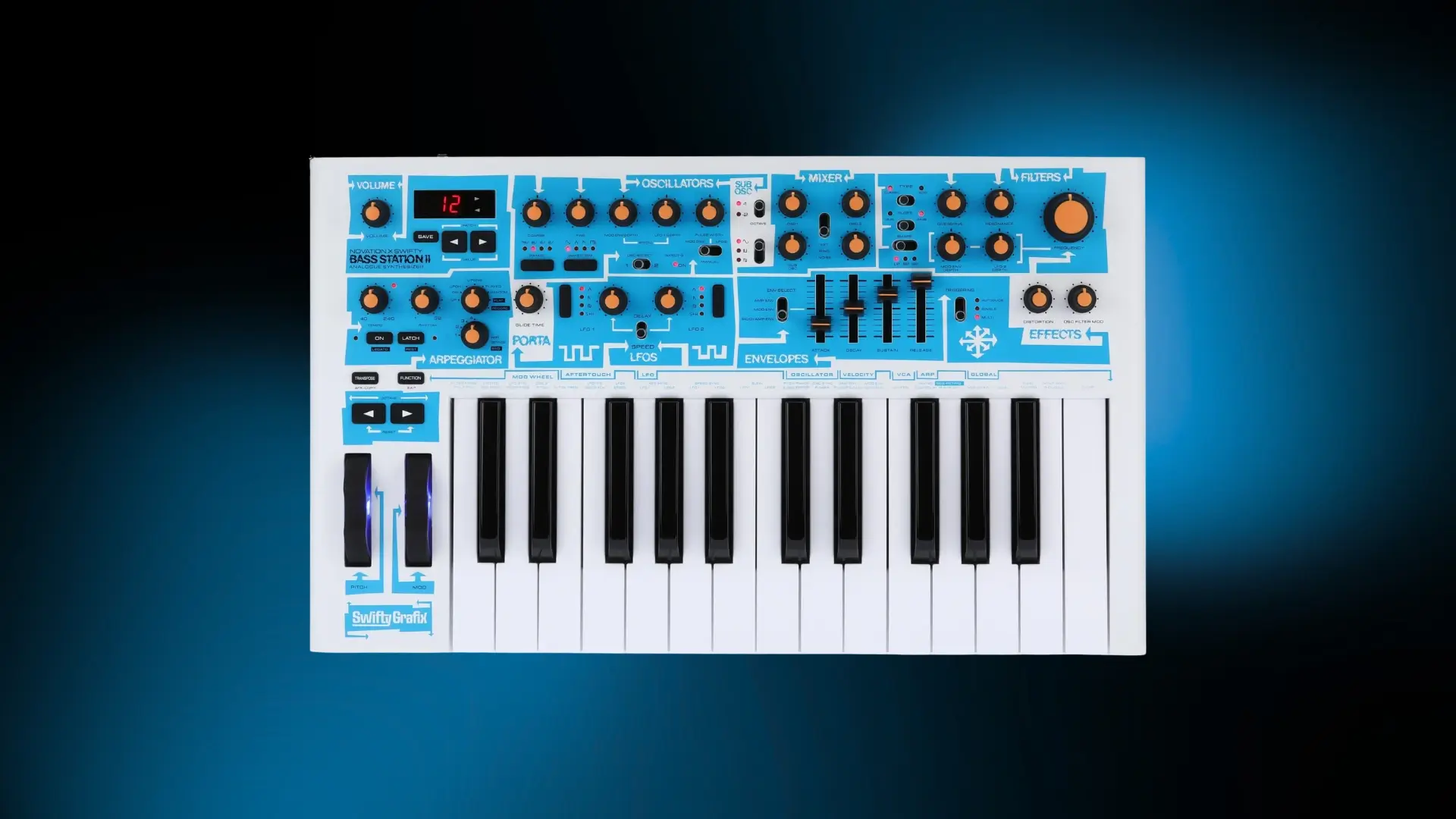
The Novation Bass Station II Swifty Edition is a limited-edition version of Novation’s Bass Station II, introduced in 2025 as a collaboration with British graphic designer Ian “Bass Station II Swifty Edition” Swift.

Bernardo de Azevedo
Bernardo de Azevedo
· Updated
Novation Bass Station II Swifty Edition: The modern analogue monosynth with graphic attitude

The Novation Bass Station II Swifty Edition is a limited-edition version of Novation’s Bass Station II, introduced in 2025 as a collaboration with British graphic designer Ian “Bass Station II Swifty Edition” Swift. It is a compact digitally controlled analogue monosynth with paraphonic capability, two analogue oscillators, a sub-oscillator, two analogue filter characters, a step sequencer, an arpeggiator, AFX Mode, and a newly designed visual identity.

Its importance does not lie in a radically new architecture, but in the way it reframes one of the most durable modern analogue monosynths as an object connected not only to bass synthesis, but also to British club graphics, underground visual culture, and the long afterlife of 1990s electronic music.

Bass Station II Swifty Edition sound and character

The Swifty Edition sounds, at its core, like the Bass Station II: direct, compact, forceful, and designed around the physical pleasure of shaping bass, lead, acid, percussion, and synthetic motion by hand. It is not a polite vintage reissue. Its analogue signal path gives it weight, but the character is more elastic and aggressive than nostalgic. The two main oscillators provide the basic vocabulary, while the sub-oscillator gives the Bass Station II Swifty Edition the low-end authority that explains why the Bass Station name has remained meaningful for dance and electronic producers.

Its two filter personalities are central to that identity. The Classic filter gives the Bass Station II Swifty Edition a broader subtractive range, with low-pass, band-pass, and high-pass behavior and variable slope. The Acid filter narrows the focus toward sharper, more liquid, more insistent low-pass movement. That second filter character matters because it ties the instrument to the long history of acid basslines without turning it into a simple TB-303 imitation. The Bass Station II does not merely copy the acid template; it places that language inside a more programmable and performance-oriented monosynth.

The Bass Station II Swifty Edition can be clean enough for precise basslines, but its more memorable territory is where drive, oscillator sync, filter modulation, distortion, and envelope movement turn the tone into something more serrated. It excels at firm electronic basses, animated arpeggios, raw leads, synthetic drum hits, tuned percussion, and abrasive effects. The Bass Station II Swifty Edition’s artist patches underline this broader range: Legowelt, Pecq, and Maria Chiara Argirò are not presented as traditional “bass synth” names only, but as users who stretch the Bass Station II Swifty Edition toward pads, glitch, percussion, evolving arps, and FM-like edge.

AFX Mode is the feature that most alters the instrument’s perceived scale. By allowing different parameter variations to be assigned per key, it lets the Bass Station II behave less like a simple one-sound-at-a-time monosynth and more like a compact sound-design system. It can become a per-key drum kit, a set of keyboard zones, or a patch whose behavior changes across the keyboard. In practice, this gives a modest-looking 25-key synth a more experimental personality than its format suggests.

Features and architecture

  • Manufacturer: Novation.
  • Year introduced: 2025 for the Bass Station II Swifty Edition; the underlying Bass Station II platform dates from 2013.
  • Production years: Bass Station II Swifty Edition, 2025 to present as a limited edition; the manufacturer has not published a clear unit count or final production end date.
  • Synthesis type: Digitally controlled analogue subtractive synthesis.
  • Category: Compact keyboard analogue monosynth with paraphonic mode.
  • Polyphony: One-voice monophonic architecture, with paraphonic mode allowing the two oscillators to play separate pitches for two-note behavior through a shared voice path.
  • Original price: Novation listed the Swifty Edition at $569.99; launch coverage also reported approximately $580 / £450.
  • Current market price: New listings observed around $579.99 in the United States, £399 in the United Kingdom, and roughly €419 to €489 in European retail contexts.
  • Oscillators: Two digitally controlled analogue oscillators, syncable and tuneable, with multiple waveforms, plus a sub-oscillator.
  • Filter: Classic state-variable filter with low-pass, band-pass, and high-pass behavior and variable slope; separate Acid low-pass filter character.
  • LFOs: Two dedicated LFOs.
  • Envelopes: Amp envelope and modulation envelope.
  • Modulation system: LFO modulation, modulation envelope routing, pitch and mod wheels, aftertouch assignment, oscillator filter modulation, oscillator sync, paraphonic behavior, microtuning support, and AFX Mode for per-key parameter variation.
  • Sequencer / arpeggiator: 32-step sequencer with four memories; arpeggiator with pattern and rhythm functions.
  • Effects: Analogue drive/distortion character, including filter overdrive and post-filter distortion; no broad onboard multi-effects section such as reverb or delay.
  • Memory: 64 factory patches and 64 user locations on the Bass Station II platform; Bass Station II Swifty Edition adds 60 new artist patches.
  • Keyboard: 25 full-size velocity-sensitive keys with assignable aftertouch, octave shift, and transpose functions.
  • Inputs / outputs: 1/4-inch mono output, 1/4-inch headphone output, 1/4-inch external input, sustain pedal input, DC power input, Kensington security slot.
  • MIDI / USB: 5-pin MIDI In, 5-pin MIDI Out, and USB-B.
  • Display: LED display for patch selection, parameter values, octave settings, and related feedback.
  • Dimensions / weight: 457 mm wide, 273 mm deep, 76 mm high; 2.48 kg.
  • Power: USB power or 9V DC power supply, with maximum consumption listed as 9V DC 300 mA.

Strengths

  • It preserves the established Bass Station II engine rather than diluting it. The Bass Station II Swifty Edition’s appeal is partly that it keeps the architecture that made the instrument durable: analogue oscillators, a sub-oscillator, two filter characters, hands-on controls, patch memory, MIDI, USB, and compact portability.
  • The sound remains unusually broad for a small monosynth. Bass is the obvious territory, but the design also supports acid lines, leads, arpeggios, percussion, effects, and stranger key-by-key constructions through AFX Mode.
  • The two-filter design gives it more personality than many simple budget monosynths. The Classic filter covers broader subtractive work, while the Acid filter gives the Bass Station II Swifty Edition a sharper and more historically loaded dance-music edge.
  • AFX Mode turns a modest monosynth into a more radical performance instrument. Per-key parameter variation can make the keyboard behave like a drum map, a split instrument, or a deliberately unstable patch field.
  • The Bass Station II Swifty Edition panel has practical value, not only visual value. By printing references to hidden and firmware-era functions on the chassis, the edition makes some of the Bass Station II’s deeper behavior easier to access.
  • Full-size keys with velocity and assignable aftertouch make it more playable than many compact desktop or mini-key synths in the same general price range.
  • The 60 artist patches give the edition a useful editorial frame. They show the instrument as a living platform rather than merely a preserved 2013 design.
  • Its size and weight make it realistic as a studio satellite, live bass synth, or performance controller for sequences and arpeggios without requiring a large keyboard footprint.

Limitations

  • The Bass Station II Swifty Edition is not a new synthesis engine. Buyers expecting a Bass Station III, a redesigned voice architecture, or expanded hardware will not find that here.
  • Its paraphony is not true polyphony. Two-note behavior comes from independent oscillator pitch control inside a shared voice path, so it does not behave like a two-voice polysynth with separate filters, VCAs, and envelopes per note.
  • The 25-key format is efficient, but it restricts wider melodic playing. It suits basslines, leads, sequences, and compact performance gestures better than full-range keyboard work.
  • The onboard effects are limited. Distortion and drive are central to its character, but users who want built-in chorus, delay, reverb, or deep spatial processing will need external hardware or software.
  • The interface is hands-on, but some deeper functions still depend on secondary operations. The Bass Station II Swifty Edition panel helps, but it does not fully remove the compact-synth tradeoff between surface simplicity and hidden depth.
  • It has MIDI and USB, but not a broad modular-style patch bay. Users looking for extensive CV/gate integration will find the connectivity more conventional than semi-modular.
  • Because it is a limited edition, its long-term parts, cosmetic replacement, and collector-market behavior are harder to predict than the standard black Bass Station II.
  • The visual design is deliberately bold. That is part of the point, but it may not suit users who prefer neutral studio equipment.

Historical context

The Bass Station line matters because it arrived at moments when analogue synthesis was being revalued. The original Novation Bass Station appeared in 1993, during a period when electronic musicians were rediscovering the value of tactile analogue control after the dominance of large digital instruments. It offered a compact way into the kind of bass and acid vocabulary that had become culturally important but increasingly expensive in vintage form.

Bass Station II, launched in 2013, was not merely a nostalgic reissue of the original. It was a modernized successor: more flexible, more programmable, more integrated with MIDI and USB workflows, and equipped with a broader synthesis architecture. Its timing also mattered. By the early 2010s, analogue hardware had returned to the mainstream conversation, but affordable, playable, memory-equipped analogue monosynths still had a particular appeal for producers moving between DAWs and hardware.

The platform’s history after launch is unusually important. Novation’s v2.5 firmware update added paraphonic mode, filter tracking, microtuning, oscillator error, envelope retriggering, and new soundpacks. Firmware v4.14 then introduced AFX Mode, fixed-duration envelopes, extended sub-oscillator control, oscillator glide divergence, and envelope retrigger count. These updates changed the Bass Station II from a good modern monosynth into a long-lived instrument whose identity expanded over time.

The Bass Station II Swifty Edition appears after that evolution, not before it. That is why it should be understood as a mature-platform edition: it benefits from years of firmware development and then adds a new visual-cultural layer. Unlike the AFX Station, which foregrounded the Aphex Twin connection, the Swifty Edition foregrounds graphic language: Mo’ Wax-era visual memory, underground typography, club-culture design, and the idea that a synthesizer can carry cultural meaning on its surface as well as in its circuitry.

Legacy and significance

The Bass Station II Swifty Edition will probably not be remembered as a turning point in synthesis architecture, because it does not introduce a new engine. Its significance is subtler. It demonstrates how a modern analogue instrument can accumulate meaning over time through firmware, artist use, design editions, and cultural reframing. The original Bass Station II was already a practical answer to a familiar problem: how to make an affordable, compact analogue monosynth that was immediate enough for performance but deep enough for serious programming. The Bass Station II Swifty Edition answers a different question: how does a long-running synth remain culturally alive after more than a decade?

Its answer is not simply “new colors.” The redesign matters because the Bass Station lineage has always been tied to dance music’s practical economy: small instruments, direct controls, acid lines, bass pressure, and the translation of underground sound into accessible tools. Swifty’s design language pushes that connection outward. It reminds the user that synthesizers are not only circuits and specifications, but also artifacts in a broader network of record sleeves, club flyers, labels, scenes, studios, and subcultures.

This is why the Bass Station II Swifty Edition is more than a cosmetic footnote, even though the engine is familiar. It treats the Bass Station II as a modern classic with enough cultural gravity to deserve reinterpretation. That is different from releasing a random color variant. The edition works because the underlying instrument has already earned its place.

Artists, users, and curiosities

For the Bass Station II Swifty Edition specifically, the verified artist associations are its patch contributors: Legowelt, Pecq, and Maria Chiara Argirò. Their inclusion is telling because none reduces the instrument to a narrow “bass only” role. Legowelt’s contribution points toward saturated analogue electronics and underground techno lineage; Pecq’s patches suggest stranger FM-like textures, percussion, and hybrid electronic songwriting; Maria Chiara Argirò’s contribution frames the Bass Station II Swifty Edition through expressive arps, glitchy rhythmic material, and deeper analogue atmosphere.

The larger Bass Station II story also includes Richard D. James, better known as Aphex Twin, through the development of AFX Mode. That feature changed the identity of the Bass Station II Swifty Edition by allowing key-by-key parameter variation, a concept that made the Bass Station II feel more like a compact experimental system than a conventional monosynth.

The central curiosity of the Swifty Edition is linguistic and cultural: “Bass Station II Swifty Edition” has nothing to do with Taylor Swift fandom. It refers to Ian “Bass Station II Swifty Edition” Swift, a British graphic designer associated with the visual language of labels and publications such as Mo’ Wax, Talkin’ Loud, and The Face. That distinction matters because the edition’s purpose is not celebrity branding in the pop sense. It is a deliberate connection between a synth associated with electronic bass culture and a designer associated with the graphic identity of British club, jazz, hip-hop, and electronic scenes.

Another useful curiosity is that the Bass Station II Swifty Edition’s panel labels help expose hidden firmware-era functions. In a practical sense, the edition acknowledges a common Bass Station II problem: the synth became deeper through updates than its original panel could fully explain. The Bass Station II Swifty Edition redesign partly turns that accumulated history into visible interface information.

Market value

  • Current market position: A current limited-edition version of a long-running and well-established analogue monosynth, rather than a discontinued vintage collectible.
  • New price signal: New retail prices observed around $569.99 to $579.99 in the United States, £399 in the United Kingdom, and roughly €419 to €489 in European listings.
  • Used market signal: The used market is still forming because the edition is recent. One observed used eBay listing showed a sold-out used unit at $458.86, while broader Bass Station II used-market data is more mature than Swifty-specific data.
  • Availability: Despite being limited, it has appeared in stock at major retailers; availability should be checked retailer by retailer because limited editions can shift quickly.
  • Buyer notes: It is most compelling for someone who wants a Bass Station II now and prefers the Bass Station II Swifty Edition visual design, the artist-patch framing, and the labeled firmware-era panel information.
  • Support ecosystem: Strong, because it belongs to the Bass Station II platform, with Novation user guides, Components support, firmware history, downloadable soundpacks, and broad community familiarity.
  • Ease of finding: Easier to find new than many older limited editions, but likely less predictable long term than the standard Bass Station II.
  • Market behavior: Too recent for a stable collector premium. Its long-term position is still forming, and its value will likely depend on production quantity, cosmetic desirability, and whether buyers treat it like the AFX Station or simply like a visually distinctive Bass Station II.
  • Practical value: High if judged as a current Bass Station II package; uncertain if judged strictly as a collectible investment.
  • Risk factor: Paying substantially above standard Bass Station II pricing only makes sense if the Swifty design and limited-edition status matter to the buyer.

Conclusion

The Novation Bass Station II Swifty Edition represents a mature instrument wearing its cultural history more openly. It does not reinvent the Bass Station II, and that is precisely the point: the engine was already strong enough to support reinterpretation. What the Bass Station II Swifty Edition adds is graphic attitude, artist-patch context, and a clearer visual bridge between analogue bass synthesis and the design language of underground British music culture.

As a synthesizer, it remains a compact, aggressive, flexible modern monosynth. As an edition, it argues that a useful instrument can become historically resonant not by changing its circuit every few years, but by accumulating stories, updates, scenes, and meanings around a sound that still works.


Bernardo de Azevedo
Written by
Bernardo de AzevedoFounder & Editor

His connection with music began at age 6, in the 1980s, when his father introduced him to Jean-Michel Jarre's Rendez-Vous on vinyl. He works professionally in the legal field, while synthesizers became his space for abstraction and creative exploration. Founder of The Synth Source.