

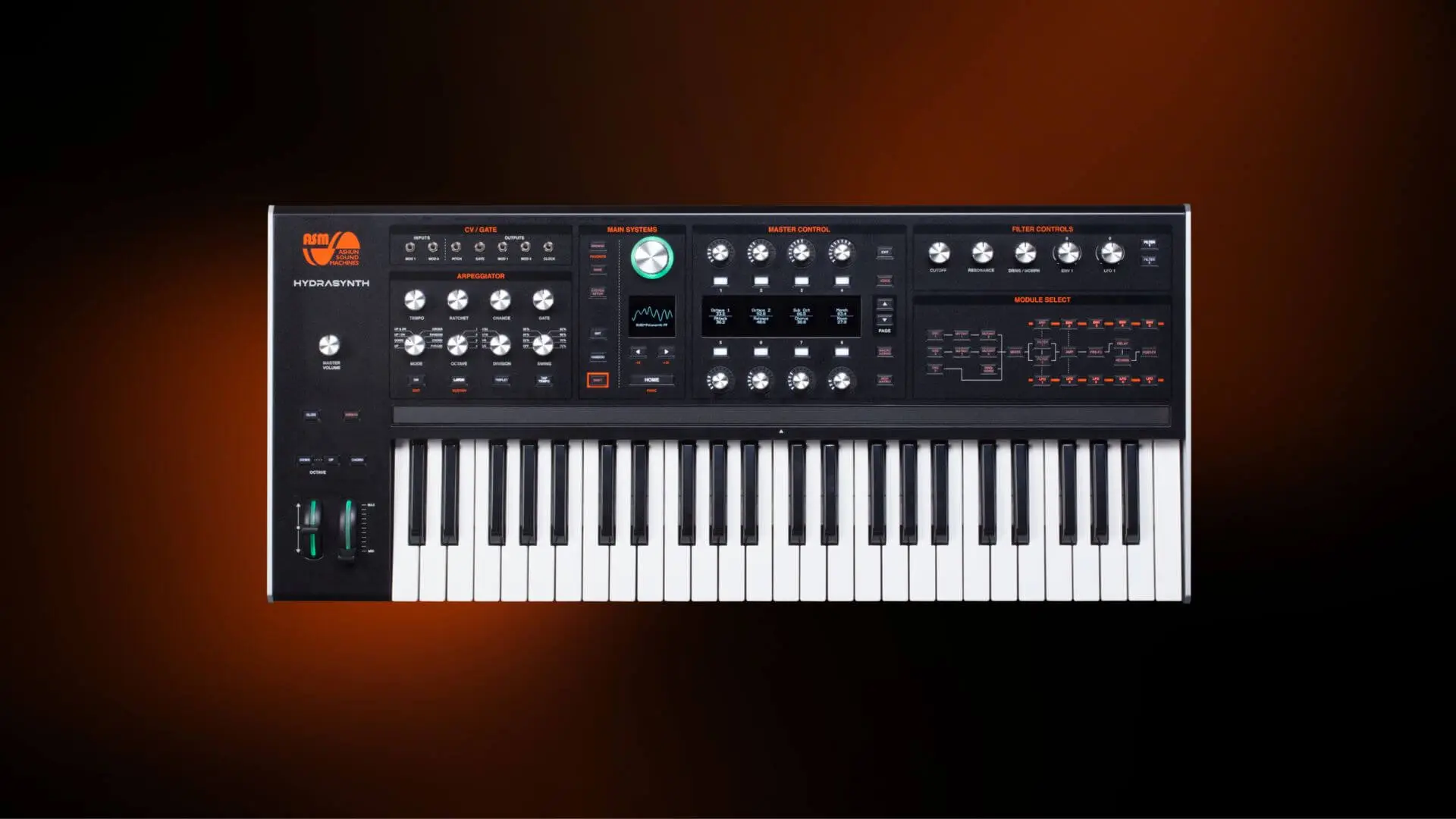
The ASM Hydrasynth Keyboard is an eight-voice digital wave-morphing synthesizer introduced in 2019 that combines three oscillators per voice, dual filters, polyphonic aftertouch, a long ribbon controller, and an unusually deep modulation system. It did not arrive as a retro remake or a nostalgic tribute to an earlier circuit. Instead, it emerged as a forward-looking instrument from a new company, one that treated expressive control, flexible digital synthesis, and serious sound design as parts of the same idea.
Table of Contents
ASM Hydrasynth Keyboard sound and character
The ASM Hydrasynth Keyboard does not have a single fixed personality, and that is one of the reasons it became so important. Its core tone can be glassy, metallic, vocal, crystalline, rubbery, abrasive, or surprisingly weighty depending on how its oscillators, Mutants, filters, and modulation are arranged. In practice, it excels at animated pads, morphing textures, digital brass, vocal-like sweeps, aggressive basses, unstable sequences, and complex evolving patches that feel composed rather than merely selected.
What gives it that identity is not just the wavetable side of the engine, but the way the ASM Hydrasynth Keyboard lets digital material be pushed, bent, stacked, and filtered. Oscillators 1 and 2 can morph through custom wavetables, while the Mutants add processes such as linear FM, sync, several forms of PWM, harmonic sweep, WavStack detuning, and phase-difference reshaping. The result is a synthesizer that can move from polished motion to deliberate violence very quickly. It can sound clean, but it is rarely flat.
The filter section is a major part of why the Hydrasynth avoids the sterile reputation that sometimes follows digital hardware. Filter 1 offers a large range of models, from ladder-style responses to MS-20-inspired options and vocal formant behavior, while Filter 2 brings a SEM-style state-variable topology with continuously variable modes. That combination matters musically. It means the ASM Hydrasynth Keyboard is not locked into a single digital sheen; it can round off edges, exaggerate motion, or turn already complicated spectra into something more organic and playable.
Even so, the ASM Hydrasynth Keyboard is not automatically flattering in the way some classic analog polysynths are. It often rewards intention more than accident. The sweet spots are there, but the ASM Hydrasynth Keyboard is at its most distinctive when the user treats synthesis as design rather than preset browsing. That makes it less instantly romantic than some analog competitors, but often more interesting over time.
Features and architecture

- Manufacturer: Ashun Sound Machines (ASM)
- Year: 2019
- Production years: 2019 to present, with ongoing official firmware, manuals, and editor support as of March 2026
- Synthesis type: Digital wave-morphing / wavetable synthesis with analog-modeling elements and extensive waveshaping
- Category: Keyboard synthesizer, digital polysynth
- Polyphony: 8 voices
- Original price: $1,299 MAP / street price at launch
- Current new price signal: about $1,399 at major U.S. retailers in March 2026
- Oscillators: 3 per voice; Oscillators 1 and 2 are wavemorphing oscillators with 219 single-cycle waveforms and user wavetables, while Oscillator 3 is a fixed-wave oscillator; dual Mutants are available for Oscillators 1 and 2
- Filter: Dual-filter design; Filter 1 offers 16 filter types including ladder, MS-20-style, low-pass gate, vocal, and other models, while Filter 2 is a SEM-style continuously variable state-variable filter
- LFOs: 5 LFOs with standard and step-wave options; the step mode supports up to 64 user-definable steps
- Envelopes: 5 loopable DAHDSR envelopes with tempo sync, variable curves, and trigger options
- Modulation system: 32-slot modulation matrix with 35 sources and 191 destinations, plus 8 macro controls
- Sequencer / arpeggiator: 8-mode arpeggiator with ratchet, chance, phrase, swing, latch, and clock functions; step-LFO behavior can also be used for sequencer-like modulation and pitch movement
- Effects: Four effect modules in series: Pre-FX, Delay, Reverb, and Post-FX; Pre/Post-FX types include chorus, flanger, rotary, phaser, lo-fi, tremolo, EQ, compressor, and distortion
- Memory: 1,024 patches across 8 banks, plus 32 favorites
- Keyboard: 49-note semi-weighted Polytouch keybed with polyphonic aftertouch
- Inputs / outputs: Balanced stereo outputs, two headphone outputs, expression pedal input, sustain pedal input, CV/Gate and clock I/O
- MIDI / USB: MIDI In/Out/Thru, USB MIDI, MPE support, and overflow mode with a second Hydrasynth
- Display: Two high-resolution OLED displays
- Dimensions / weight: 80 x 35 x 10.3 cm; 10 kg
- Power: 12V DC, at least 1.5A
Strengths
- Polyphonic aftertouch is built into the ASM Hydrasynth Keyboard rather than treated as an exotic add-on. That changes how the ASM Hydrasynth Keyboard is played, not just how it is marketed. Pads, leads, and complex textures become more sculptural because pressure can animate individual notes inside a chord.
- The interface is unusually successful for a synth this deep. The ASM Hydrasynth Keyboard does not eliminate complexity, but it organizes it well. Dedicated sections, OLED feedback, and fast modulation shortcuts make serious programming more immediate than on many equally capable digital instruments.
- Its sound design range is genuinely broad. The combination of wavemorphing oscillators, Mutants, loopable envelopes, step LFOs, and dual filters allows it to cover ambient, industrial, cinematic, electronic, experimental, and hybrid territories without feeling like it is pretending to be a vintage clone.
- The filter architecture gives the engine depth and contrast. The Hydrasynth can be sharp and futuristic, but it can also be softened, voiced, or destabilized in musically useful ways. That keeps it from collapsing into one-dimensional digital gloss.
- It is expressive in more than one direction. Polyphonic aftertouch, ribbon control, macros, CV integration, MPE support, and extensive modulation make it equally attractive to keyboard players, modular users, and sound designers.
- It was aggressively competitive for its feature set. At launch, few hardware polysynths at its price offered this combination of keybed expression, synthesis depth, and performance control.
Limitations
- Eight voices can feel tight for a synth this ambitious. Long releases, stacked chords, unison textures, and richly modulated pads can make voice limits audible sooner than some players would like.
- It has a real learning curve. The interface is good, but the engine is still dense. Players looking for immediate one-knob vintage gratification may find it less instinctive than simpler analog instruments.
- It is not the most naturally flattering synth for every style. The ASM Hydrasynth Keyboard can produce beautiful results, but it often reveals its best side when programmed deliberately. Some users will love that; others will want a sweeter default tone.
- It is a single-part instrument rather than a multitimbral performance workstation. That matters for players who want splits, layered parts, or more elaborate live setups inside one keyboard.
- There is no conventional onboard note sequencer in the usual workstation sense. The arpeggiator and step-LFO tools are powerful, but they do not replace a full dedicated sequencing environment.
- At 10 kg, it is not especially lightweight for a 49-key digital synth. It is portable enough, but it is built more like a serious instrument than an ultra-mobile controller.
Historical context
The ASM Hydrasynth Keyboard appeared in 2019 at a moment when much of the ASM Hydrasynth Keyboard market was still heavily driven by analog nostalgia, reissues, and clone culture. That does not mean digital synths had disappeared, but many of the loudest conversations in hardware were still centered on the past. In that environment, ASM did something strategically smart: instead of trying to win by reenacting a classic instrument, it introduced a new design built around expressive control, deep modulation, and a digital architecture that was proud of being digital.
That timing mattered even more because ASM was a new name. The Hydrasynth was not the comeback of an established giant. It was the debut statement of a new manufacturer entering a crowded field and doing so with unusual confidence. The keyboard and desktop versions immediately framed the product line as serious rather than tentative, and the keyboard model in particular became the public face of the launch because it tied the engine to a polyphonic aftertouch keybed and ribbon controller at a price that was notably competitive for what it offered.