

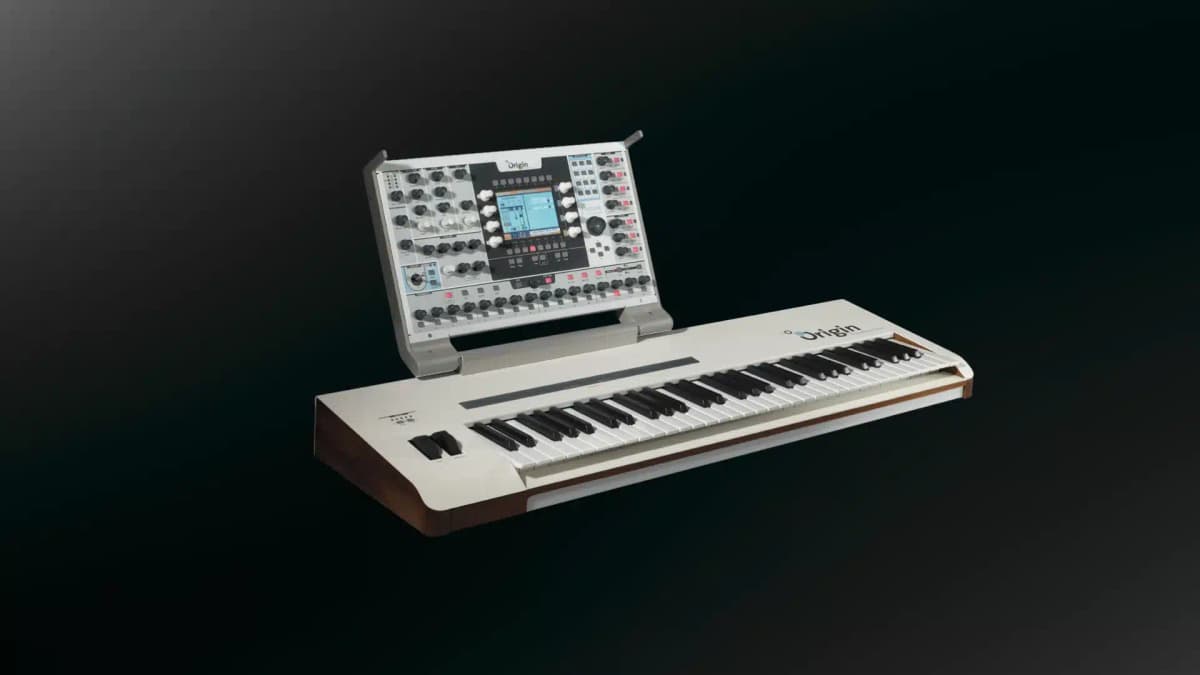
The Arturia Origin Keyboard is a 61-key, DSP-based modular synthesizer that the French company began shipping in 2010, after announcing it in Grenoble and at the January 2010 NAMM show. It took the engine of the Arturia Origin Keyboard desktop unit of 2008, a hardware box running Arturia’s TAE (True Analog Emulation) algorithms on Analog Devices TigerSHARC processors, and built it into a single cabinet with a semi-weighted keyboard, a 40 cm ribbon, a joystick and a control panel that tilts up from the keys. Inside, players could wire modules modeled on the Minimoog, ARP 2600, Yamaha CS-80, Roland Jupiter-8, Moog Modular and Prophet VS into their own patches, with up to 32 voices. It matters as Arturia’s first serious attempt to turn its software into a performing instrument.
Table of Contents
Arturia Origin Keyboard sound and character
The Arturia Origin Keyboard sounds like Arturia’s V Collection emulations of the late 2000s, because it runs the same family of algorithms on dedicated DSP rather than on a computer. That means fat, slightly soft-edged analog modeling: Minimoog-style basses and leads with a firm low end, brassy CS-80 patches, and the glassy, morphing tones of the Prophet VS wavetables. AudioTechnology’s Brad Watts found the emulations close to the original hardware while noting, reasonably, that they are not analog circuits. Each program also has a TAE control that adds deliberate instability to imitate the drift of the originals.
What makes it more than a preset player is the modular layer. A program can combine oscillators from different emulations with filters from others, drive them with up to eight envelopes and several kinds of LFO, and add Arturia’s own Galaxy module (three interlocked LFOs feeding an X and Y output) and a looping 2D envelope. Sound On Sound’s Gordon Reid, reviewing the keyboard in 2011, counted up to 15 oscillators per program (nine analog-style, four wavetable and two tonewheel), four filters and five mixers, and judged the engine more useful in keyboard form.
There are trade-offs. Polyphony is quoted as up to 32 voices for a typical patch, but it falls as patches grow more complex, and Reid’s earlier review of the desktop unit recorded a heavy multi dropping to four voices and a CS-80 build pushing the processor past its limit. That review also heard significant aliasing in the oscillators, while the German site Bonedo, testing the desktop, heard none, so impressions vary with patch and register. Effects are serviceable rather than lush, with reverb singled out as weak in more than one review. The Arturia Origin Keyboard sits firmly in the modern, digital camp: warm in intent, clean in execution, and at its best on basses, leads, brass and evolving textures.
Features and architecture
- Manufacturer: Arturia, Grenoble, France
- Year introduced: announced in December 2009 and shown at NAMM in January 2010; Arturia initially gave March 2010 as the shipping date, and its “now shipping” announcement followed in October 2010
- Production years: 2010 to the early 2010s; Arturia never published a firm end date, the last listed firmware dates from 2011, and retailers now list it as discontinued
- Synthesis type: DSP-based virtual analog modeling with modular patching (TAE engine), plus wavetable and tonewheel organ modules
- Category: 61-key modular virtual analog synthesizer and performance keyboard
- Polyphony: up to 32 voices for a typical patch, reduced as patch complexity rises; mono, poly and unison modes (poly unison stacks up to eight voices, added in firmware 1.3)
- Multitimbrality: Multi mode with four program slots routed to four mixer channels, with up to four keyboard splits
- Original price: $3,499 in the United States; €2,899 at the NAMM announcement and €2,990 at shipping; £2,499 in the UK
- Current market price: Sweetwater’s Gear Exchange guide shows used units at roughly $1,560 to $2,310
- Oscillators: up to 15 per program in later firmware (nine analog-style, four wavetable, two tonewheel), derived from the Minimoog, ARP 2600, CS-80, Jupiter-8, Prophet VS and Arturia’s own designs
- Filter: up to four per program, with types derived from the same emulated instruments
- LFOs: up to four polyphonic and two global LFOs, plus the Galaxy module (three combined LFOs driving X and Y outputs)
- Envelopes: up to eight envelope modules, a CS-80-style envelope in later firmware, and a 2D envelope with four outputs and looping points
- Modulation system: modular patching in a rack of module slots, eight CV modulators, an ARP-style sample and hold (firmware 1.3), macros and a three-mode joystick
- Sequencer / arpeggiator: three-track step sequencer of up to 32 steps with 16 step encoders, slide and accent; arpeggiator with four modes over up to five octaves
- Effects: three slots per program, from ten types including chorus, delay, reverb, distortion, phaser, ring modulator, EQ, bit crusher, compressor and rotary speaker
- Memory: 1,000 programs (400 factory, 600 user) and 256 multis (100 factory)
- Keyboard: 61 semi-weighted keys with velocity and channel aftertouch, plus a duophonic aftertouch mode that applies pressure only to a chosen note; pitch and modulation wheels, octave buttons and a 40 cm ribbon controller
- Inputs / outputs: two main outputs, eight auxiliary outputs, S/PDIF coaxial output, stereo headphone output, two audio inputs for processing external signals, expression pedal and footswitch inputs
- MIDI / USB: MIDI In, Out and Thru; USB 2.0 for the librarian, firmware updates and editing from a DAW
- Display: 5.2-inch color TFT screen (320 by 236 pixels per Sound On Sound) flanked by eight encoders
- Dimensions / weight: about 102 by 33 by 16 cm with the panel folded, per retailer listings; MusicRadar weighed it at about 23 kg
- Power: external 6.5V DC, 3.85A power supply
Strengths
- It offers several classic architectures in one instrument. Minimoog, ARP 2600, CS-80, Jupiter-8 and Prophet VS components can be mixed in a single patch.
- The performance controls are unusually rich. Velocity, channel and duophonic aftertouch, a long ribbon, wheels and a joystick give real expressive range, and the ribbon was praised in nearly every review.
- The modulation depth rewards programmers. Up to eight envelopes, the Galaxy module, the looping 2D envelope and CV modulators allow evolving patches well beyond the original templates.
- It is computer-free on stage while still integrating with one. The DSP hardware does all the processing, and USB editing and librarian software were available for studio work.
- The outputs suit serious setups. Ten analog outputs, S/PDIF and external audio inputs let it act as a multitimbral sound source and as a processor for other instruments.
- Axel Hartmann’s industrial design, with ash wood, a tilting aluminium-hinged panel and a well-organized left-hand performance section, gives it a distinctive and practical stage presence.
Limitations
- Polyphony depends on processing load. The 32-voice figure applies to typical patches, and complex modular programs or multis can reduce it sharply.
- It is heavy and awkward to move. At about 23 kg with a fold-down panel, it needs a sturdy stand and a dedicated flight case, which undercuts Arturia’s “laptop synthesizer” pitch.
- The external 6.5V DC power supply is unusual and hard to replace, a weakness reviewers criticized on a flagship instrument.
- The interface takes time to learn. Menus run through a small, non-touch color screen, Sound On Sound wanted a contrast control, and the factory presets were felt not to show the engine at its best.
- Software support stalled early. Templates such as CS-80 and Jupiter-8 arrived late, the last widely documented firmware dates from 2011, and some owners report bugs that were never fixed.
- It only does analog-style and organ sounds. There are no pianos, strings or samples, so it cannot double as a workstation despite its price.
- Its launch price put it close to genuine analog polysynths and far above the software it emulated, which limited its market.
Historical context
Arturia was founded in Grenoble in 1999 by Frédéric Brun and Gilles Pommereuil as a software company, and it built its reputation on emulations such as Modular V, developed with input from Robert Moog and launched in 2003. According to Arturia, musicians who were reluctant to take computers on stage began asking around 2004 and 2005 for hardware that ran its TAE algorithms, and Rekkerd reports that the Arturia Origin Keyboard project started in 2004. Arturia announced its move into hardware in early 2007, and by March of that year CDM was showing renderings of a 61-key Arturia Origin Keyboard projected for December 2007 at $3,499. The industrial design came from Axel Hartmann.
The plan changed along the way. Arturia shipped the desktop Arturia Origin Keyboard first, in October 2008, at $3,200, with only the Minimoog template complete; CDM and Sound On Sound praised its sound but criticized boot time, CPU limits and early bugs. The keyboard version was reintroduced in December 2009 with Arturia calling it “the first lap-top synthesizer ever,” shown as a pre-series unit at NAMM 2010 with a March 2010 ship date, and finally announced as shipping in October 2010 at $3,499. Firmware 1.3, released in December 2010, added the Jupiter-8 template, poly unison, a compressor and an ARP-style sample and hold.
No formal discontinuation was announced. The resource page for the Arturia Origin Keyboard lists firmware up to 2011, and reader comments collected by Synthtopia in 2014 already described the operating system as effectively abandoned and the project as a financial strain on the company. By then Arturia had changed course: the MiniBrute of 2012, an inexpensive analog monosynth, sold well and set the direction for the Brute, Freak and later hardware ranges. The Arturia Origin Keyboard quietly disappeared from catalogs, and retailers now list it as discontinued.