


The Arturia MiniFreak is a six-voice hybrid polyphonic synthesizer introduced in October 2022 that combines dual digital sound engines with per-voice analog multimode filters and VCAs, a 37-note aftertouch-equipped slim keyboard, a 64-step sequencer, stereo effects, and a tightly linked software counterpart. What makes it meaningful is not simply that it expands the earlier MicroFreak idea, but that it turns that offbeat concept into something more fully usable as a studio instrument, a live keyboard, and a serious sound-design tool.
Sound and character
The MiniFreak sounds like a deliberate collision between digital curiosity and analog containment. Its oscillators can be sharp, vocal, metallic, hollow, glassy, synthetic, or unstable depending on the engine pairing, but the instrument rarely feels brittle for long because the analog filter stage gives the whole machine a center of gravity. That is one of the most important things about its sound. The MiniFreak is not a sterile digital hybrid built around novelty engines for their own sake. It is a machine whose stranger timbres are usually routed back into something playable, shaped, and musically useful.
In practice, it excels at animated pads, sequenced textures, plucked digital-analog hybrids, aggressive synthetic basses, unstable arpeggios, vocal-like tones, and motion-heavy patches that evolve under modulation. It can move from bright and clipped to warm and spreading without sounding like it has changed instruments entirely. That continuity matters. Many hybrid synths are broad in capability but fragmented in identity. The MiniFreak, by contrast, tends to keep a recognizable personality even as it shifts across very different synthesis methods.
Part of that identity comes from architecture. The dual-engine structure encourages layered or interactive timbres rather than single-oscillator simplicity, while the analog state-variable filters help smooth, focus, or destabilize the result depending on how they are driven. The result is a synthesizer that can sound modern without sounding detached, experimental without becoming unusable, and compact without feeling sonically small.
Features and architecture
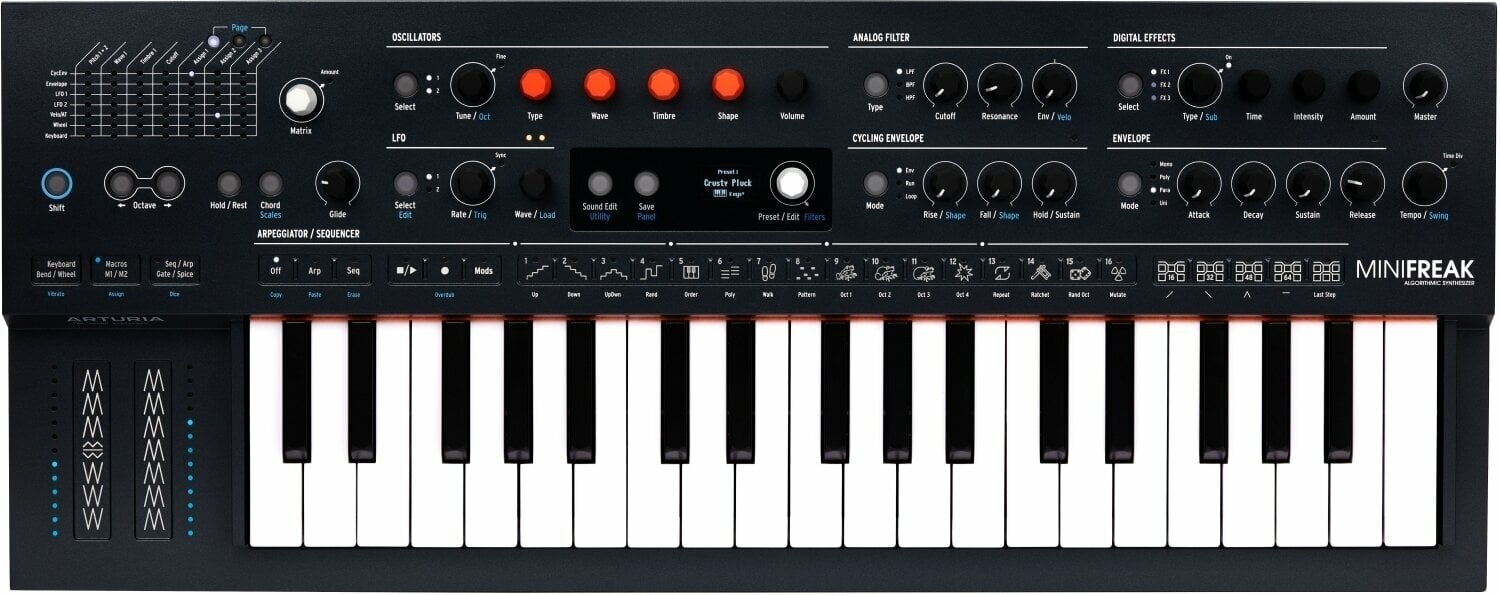
- Manufacturer: Arturia
- Year introduced: 2022
- Production years: 2022 to present
- Synthesis type: Hybrid synthesizer with dual digital sound engines and per-voice analog filters/VCAs
- Category: 37-key polyphonic keyboard synthesizer
- Polyphony: 6 voices in polyphonic mode; 12-voice paraphonic mode is also supported
- Original price: US$599 / €599 at launch
- Current market price: Common new street price remains around US$599 to US$649; used pricing typically sits well below new depending on condition and whether software transfer is included
- Oscillators: Two digital sound engines per voice, with a large and evolving set of oscillator and processing modes; engine pairing and cross-processing are central to the instrument’s design
- Filter: Polyphonic analog state-variable resonant filter per voice with low-pass, band-pass, and high-pass modes, capable of self-oscillation
- LFOs: Two LFOs per voice, with editable curves
- Envelopes: One ADSR envelope and one cycling envelope per voice
- Modulation system: Mod matrix with seven sources and thirteen main destinations, plus automation lanes in the sequencer
- Sequencer / arpeggiator: 64-step sequencer with four pages of sixteen steps, four lanes of automation, plus performance-focused arpeggiator functions
- Effects: Three digital stereo FX slots; later firmware significantly expanded the palette, including wavetable-related additions, granular expansion, and vocoder-oriented processing
- Memory: 420 factory presets and 244 user slots on Arturia’s current overview page
- Keyboard: 37-note velocity-sensitive slim-key keybed with aftertouch
- Inputs / outputs: Stereo outputs, headphone output, mono audio input, sustain pedal input, clock in/out
- MIDI / USB: MIDI in, out, and thru; USB for communication, updates, preset management, and hardware/software integration
- Display: OLED display
- Dimensions / weight: 578 x 231 x 55 mm; about 2.94 kg
- Power: External 12V DC, 1A power supply
Strengths
- It makes hybrid synthesis feel immediate rather than academic. The MiniFreak offers a genuinely broad palette, but its front panel remains inviting enough that experimentation usually produces musical results instead of dead ends.
- The analog filter stage gives the instrument coherence. Many of the engine modes can be bright, jagged, or synthetic, but the per-voice analog filtering helps the sound stay embodied and mix-ready.
- It is far more than a “bigger MicroFreak.” True polyphony, stereo effects, expanded routing, and a more traditional keyboard make it a different class of instrument in practical use.
- The software relationship is unusually strong. MiniFreak V turns the synth into part of a hardware-software ecosystem rather than a standalone keyboard with a loose plug-in companion.
- Firmware support has materially extended its value. Updates did not merely fix bugs; they expanded the instrument’s synthesis vocabulary, which has helped the MiniFreak age better than many synths in its price bracket.
- It is compact without feeling compromised in sound. The chassis is small enough for real-world desks and travel, yet the sonic results often feel larger and more layered than the footprint suggests.
Limitations
- Six voices can disappear quickly. Rich pads, long releases, layered engine designs, and unison-style thinking can make the polyphony feel tighter than the headline number suggests.
- The slim-key format is practical, not luxurious. It helps keep the instrument compact, but players who strongly prefer full-size keys may never fully love the feel.
- Not every deep function is equally immediate. The interface is good, but it is still a matrix-based hybrid with multiple layers of behavior, not a pure one-knob-per-function analog panel.
- Its strength is breadth, not one instantly iconic vintage voice. Players seeking the singular imprint of something like a Prophet-5, SH-101, or Jupiter-8 may find the MiniFreak more versatile than definitive.
- USB integration is strong for control and synchronization, not for replacing an audio interface. In a studio setup, it still expects conventional audio connections.
- The constantly expanding feature set can blur the simple “spec sheet” identity. That is good for owners, but it also means the instrument is best understood through use rather than through one static list of features.
Historical context
The MiniFreak arrived at an important moment for Arturia. By 2022, the company had already established itself through analog hardware like the MiniBrute line, more premium designs like the PolyBrute, and the improbable success of the MicroFreak, which had shown that a compact, unconventional hybrid synth could attract both beginners and experienced sound designers. The MiniFreak emerged as the logical next move, but also as a correction. It kept the Freak family’s fascination with unusual digital engines and modulation-driven play, while addressing the practical limits that kept the MicroFreak from being a complete replacement for a more conventional polysynth.
That timing mattered in the wider market as well. The affordable and mid-priced synthesizer space was already crowded with capable digital, wavetable, and virtual-analog instruments. The MiniFreak did not try to win by offering the most voices, the largest keyboard, or the most traditional panel layout. Instead, it occupied a more interesting position: a hybrid instrument that was compact and experimental, yet structured enough to function as a real centerpiece rather than a side-device for odd sounds.
This is why its release was more significant than it first appeared. It was not simply a new mid-priced synth. It was Arturia proving that the Freak concept could mature without losing its oddness.
Legacy and significance
The MiniFreak matters because it helped redefine what a modern “entry to mid-tier” polysynth could be. Historically, compact synthesizers in this range often forced a clear choice: either immediate and traditional, or deep and slightly awkward; either affordable and limited, or powerful and expensive. The MiniFreak disrupted that logic by offering genuine sonic depth, a distinct design identity, and a meaningful hardware-software workflow without moving into flagship pricing.
Its broader significance lies in translation. The MicroFreak was clever, provocative, and often brilliant, but it could still be dismissed by some players as a niche instrument or an eccentric side synth. The MiniFreak translated that same experimental DNA into a form that was harder to dismiss. It became a serious argument that modern hybrid design did not need to imitate vintage architecture in order to feel musically substantial.
It also reflects a larger cultural shift in synthesizer design. More instruments now live simultaneously as hardware, software, and update-driven ecosystems rather than fixed objects. The MiniFreak is one of the clearest examples of that model working well. Its significance is not only that it sounds good, but that it demonstrates how a synth can remain alive after release through meaningful firmware expansion and mirrored software continuity.
Artists, users, and curiosities
Arturia itself has publicly associated the MiniFreak with artists including Rone, Carl Craig, dBridge, and KMRU, which already says something about the instrument’s range. That is not a single-scene user list. It crosses electronic subcultures that value very different things: rhythmic precision, atmospheric depth, studio experimentation, and performance portability.
One especially revealing detail is how often users praise not one isolated sound, but the instrument’s ability to move between categories. Carl Craig highlighted its basses and strings in unusually concrete terms, while Rone emphasized versatility and portability. That combination is important because it explains the MiniFreak’s reputation better than a generic “sounds great” endorsement. It is an instrument that repeatedly earns praise for range plus immediacy.
A useful curiosity is that the MiniFreak’s identity did not freeze at launch. Firmware 2.0 added wavetable capabilities, firmware 3.0 pushed the instrument into granular and sample-based territory, and firmware 4.0 introduced vocoder-oriented effects and presets. That means the MiniFreak’s public image shifted over time from “polyphonic MicroFreak successor” to a more expandable hybrid platform. In other words, its story is partly a launch story, but just as much an update story.
Another memorable point is the hardware-software mirror. Plenty of instruments offer software editors, but MiniFreak’s linked VST counterpart became part of the instrument’s appeal rather than a mere utility. That gave it an unusual place in the market: not just a keyboard with companion software, but a synth whose practical identity includes moving fluidly between the desk and the DAW.
Market value
- Current market position: Strongly positioned as a compact but serious hybrid polysynth in the lower mid-priced hardware tier
- New price signal: Commonly sold new around US$599, with Arturia’s own store showing pricing around US$649 on the main overview/store pages depending on listing context and edition
- Used market signal: Used values often land roughly in the mid-US$300s to high-US$400s, depending on condition, region, edition, and software-transfer status
- Availability: Generally easy to find new through major dealers and widely visible on the used market
- Buyer notes: Confirm firmware status, cosmetic condition, power supply inclusion, and whether the software license or bundled ecosystem benefits transfer with the unit
- Support ecosystem: Strong; Arturia has continued releasing substantial firmware updates, support materials, and software-side expansion
- Ease of finding one: Easy in standard edition; special editions are less common but not truly scarce
- Long-term market behavior: Stable rather than speculative; it looks more like a modern keeper than a collector’s trophy at this stage
- Collectibility: Too current and too available to be called collectible in the vintage sense, but significant enough that well-kept units should remain desirable
Conclusion
The Arturia MiniFreak matters because it takes an eccentric design philosophy and gives it real staying power. It is compact, but not trivial; experimental, but not chaotic for its own sake; modern, but not detached from the tactile expectations that make hardware synthesis satisfying. More than anything, it shows that a hybrid polysynth can be playful, expandable, and genuinely useful at the same time. That is why it stands as one of the more important synthesizer releases in its price class of the last several years.