

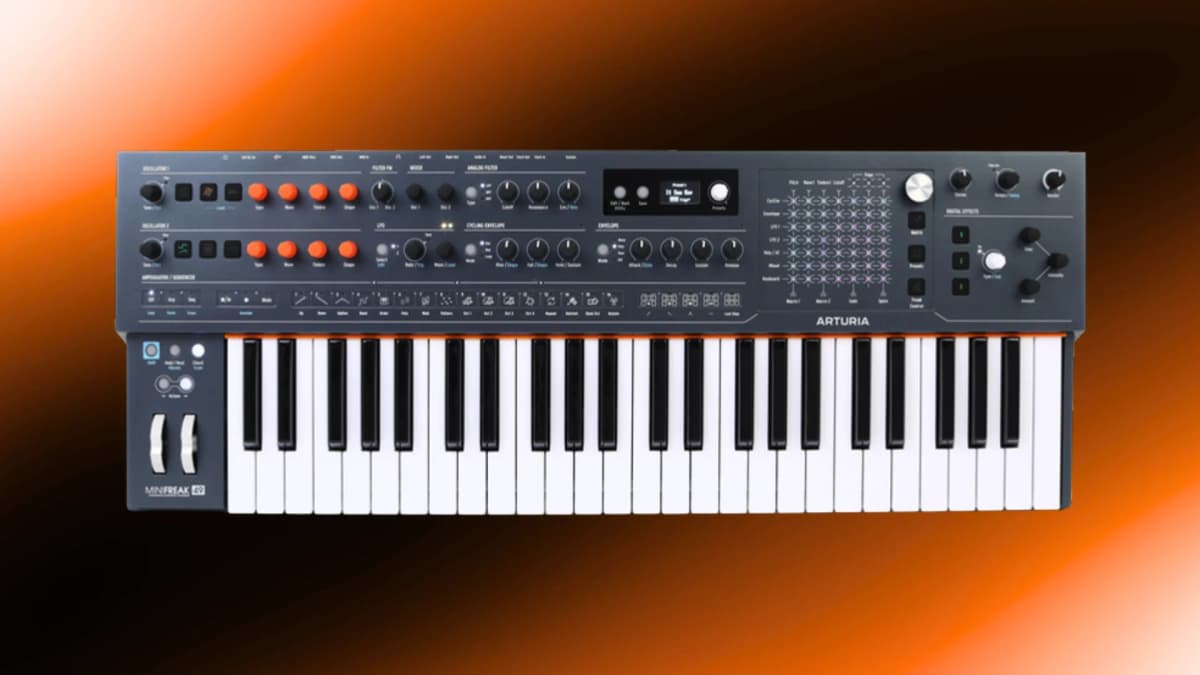
The Arturia MiniFreak 49 is a six-voice hybrid polyphonic synthesizer with 49 full-size, semi-weighted keys, announced by Arturia on October 20, 2026. It keeps the sound engine of the 2022 Arturia MiniFreak: two digital engines per voice with more than 30 oscillator modes, drawn from Arturia, Mutable Instruments and Noise Engineering algorithms, followed by an analog state-variable filter and VCA on each voice. What changes is the instrument around that engine. The slim 37-key keyboard and touch strips give way to a larger keybed with aluminum pitch and modulation wheels, each oscillator gets its own set of knobs, and a pressure-sensitive XYZ touch matrix takes over modulation routing, preset browsing and a new performance layer called Freak Control. Audio-rate filter FM, per-voice stereo panning and eight times the sample memory complete the update. At launch the Arturia MiniFreak 49 is priced at $849 in the US, €799 and £699.
Table of Contents
Arturia MiniFreak 49 sound and character
The Arturia MiniFreak 49 sounds like a MiniFreak, and every early review says so plainly. Rob Puricelli of Gearnews described the engine as unchanged apart from a few additions, and Si Truss of MusicRadar called the 49 the best version of the Freak engine so far rather than a new one. That engine pairs two digital oscillators per voice, which can run side by side or in series, with Engine 2 able to process the output of Engine 1. The palette runs from basic waveforms, wavetables and samples to FM, ring modulation, Karplus-Strong physical modeling and formant algorithms, and the more abstract textural modes that gave the Freak line its reputation.
The most audible addition is the dedicated Filter FM section. Either engine can now modulate the cutoff of the analog filter at audio rate through a bipolar control, which pushes the filter from smooth subtractive duty into grit, clangor and sideband-rich tones. Truss wrote that this made the analog stage feel essential for the first time, where he had previously seen it as a nod to analog rather than a defining feature. With resonance raised, the filter self-oscillates and becomes a sound source in its own right.
Stereo behavior has also moved forward. The original MiniFreak ran a mono signal path up to its effects, a point Sound On Sound flagged in its 2022 review. The Arturia MiniFreak 49 adds Voice Panning, which spreads the six voices across the stereo field with selectable spread algorithms, before the three stereo effect slots. Pads and arpeggios gain width without leaning entirely on chorus or reverb.
The XYZ touch matrix changes how the Arturia MiniFreak 49 is played as much as how it is programmed. The grid of pads responds to position and to contact width, and it doubles as the modulation matrix: sources run along the rows, destinations along the columns, and a Matrix encoder sets the depth of each assignment. Freak Control turns the same surface into a performance controller with bipolar and four-corner vector layouts, and Gearnews listed modes such as Time Stretch, Filter Freak, Timbre Shape and FX Mix. Custom LFO shapes can be drawn directly on the pads, and the sequencer’s steps can be edited from the matrix as well.
Sampling has become a bigger part of the sound. The Arturia MiniFreak 49 carries 256 MB of memory for samples and wavetables, eight times the figure of the original, and Sonicstate reported that user samples of up to six seconds can be loaded through the bundled MiniFreak V software, then played back directly or through granular modes. Combined with Engine 2 processing Engine 1 and the analog filter, imported material can be pushed far from its source.
The sequencer and arpeggiator shape the instrument’s musical personality as much as its oscillators. The 64-step sequencer spans four pages of 16 steps and records four lanes of parameter motion, while the arpeggiator adds octave, ratchet, repeat and mutate functions. Spice and Dice, inherited from the MicroFreak, add controlled variation and randomness to a sequence, so a simple pattern can drift and evolve over time. Chord mode stacks a stored voicing on a single key, and Scale mode, with five preset scales and a custom option, keeps playing and sequencing inside a chosen key. On the Arturia MiniFreak 49 these functions sit on 16 multifunction step keys and dedicated Hold, Chord, Scale and Octave buttons, which makes them easier to reach during a performance.
The rest of the character is familiar: a clean, detailed digital top end shaped by a warm, slightly unruly analog filter, with modulation that can turn a static patch into something restless. The larger keybed matters to the sound as much as any new circuit. Velocity and channel aftertouch are easier to control on full-size, semi-weighted keys, and MusicRadar found the mono aftertouch noticeably more expressive here than on the original slim keys.
Features and architecture
- Manufacturer: Arturia (France)
- Year introduced: 2026 (announced October 20, 2026)
- Production years: 2026 to present
- Synthesis type: Hybrid; two digital oscillator engines per voice into an analog filter and VCA
- Category: 49-key polyphonic hybrid synthesizer
- Polyphony: 6 voices; 12-voice paraphonic mode, plus mono and unison modes
- Multitimbrality: None listed in Arturia’s specifications
- Original price: $849 (Arturia US list), €799, £699
- Current market price: New only at launch; Gearnews listed launch street prices of $799 at Sweetwater and €789 at Thomann
- Oscillators: Two engines per voice; 31 oscillator modes according to Arturia’s comparison table, including Basic Waves, Wavetable, Sample, FM/RM and Multi Filter groups; Engine 2 can process Engine 1
- Filter: One analog state-variable filter per voice with low-pass, band-pass and high-pass modes; self-oscillating; audio-rate Filter FM from either engine
- LFO: Two LFOs per voice with customizable shapes, which can now be drawn on the touch matrix
- Envelopes: One ADSR envelope per voice plus one cycling envelope per voice (Rise, Fall, Hold) with Env, Run and Loop modes reaching audio rate
- Modulation system: Modulation matrix assigned through the XYZ touch matrix; two Macros; Freak Control with Gate and Spice; bipolar and four-corner vector layouts
- Sequencer / arpeggiator: 64-step sequencer (four pages of 16 steps) with four modulation lanes; arpeggiator with octave, ratchet, repeat and mutate options; Spice and Dice variation; Chord and Scale modes
- Effects: Three stereo effect slots, each with 13 algorithms, including chorus, reverb, distortion, Super Unison and vocoder modes
- Memory: 512 preset slots (350 factory, 162 user); 256 MB of sample and wavetable memory
- Keyboard: 49 full-size, semi-weighted keys with velocity and channel (mono) aftertouch; aluminum pitch and modulation wheels
- Inputs / outputs: Balanced stereo outputs, headphone output, audio input, sustain pedal input, clock in, clock out and reset out
- MIDI / USB: MIDI In, Out and Thru on 5-pin DIN; USB-C for MIDI and editor connection
- Display: Larger OLED display than the original MiniFreak, plus the XYZ touch matrix
- Dimensions / weight: 777 × 71 × 288 mm (30.59 × 2.80 × 11.34 in); 5.7 kg (12.57 lb)
- Power: External 12 V DC, 2 A universal power supply; power switch
Strengths
- The playing surface is a real upgrade. Full-size, semi-weighted keys, an extra octave and metal wheels make the Freak engine far more comfortable for two-handed and expressive playing.
- Each oscillator has its own controls. Dedicated Type, Wave, Timbre and Shape knobs for both engines remove the menu juggling of the original and make cross-modulation easy to perform.
- Filter FM gives the analog stage a new role. Audio-rate modulation of the cutoff from either engine adds a range of aggressive and metallic tones the original could not produce as directly.
- The touch matrix speeds up modulation. Routing sources to destinations, browsing presets and drawing LFO shapes happen on one surface instead of through nested pages.
- The engine is unusually deep for the price. More than 30 oscillator modes, a polyphonic cycling envelope, a 64-step sequencer and three effect slots cover a very wide sonic range.
- Software and presets carry over. MiniFreak V is included for registered owners, and presets from the original MiniFreak remain compatible.
Limitations
- It is not a new engine. Reviewers agree that owners of the original MiniFreak gain playability and control rather than a different sound.
- Polyphony stays at six voices. MusicRadar noted that more voices would have made a bigger difference for a 49-key instrument.
- Aftertouch is monophonic. The keybed responds to channel pressure only, while the earlier MicroFreak offered polyphonic pressure on its flat keyboard.
- Glide lost its own knob. Gearnews pointed out that portamento now sits on a shift function of the Attack control.
- The touch matrix is not perfect. MusicRadar found it less responsive than hoped, and Gearnews felt the larger display is only modestly bigger.
- It costs more and weighs more. At 5.7 kg and $849 list, it gives up the portability and low price that defined the 37-key model.
Historical context
The Freak line began in 2019 with the Arturia MicroFreak, a small paraphonic synth with a flat PCB keyboard and polyphonic aftertouch. It paired digital oscillator engines, several of them derived from Mutable Instruments’ Plaits Eurorack module, with an analog multimode filter. Its mix of low price and experimental sound made it one of Arturia’s most visible instruments, and later updates added wavetable and vocoder modes.