

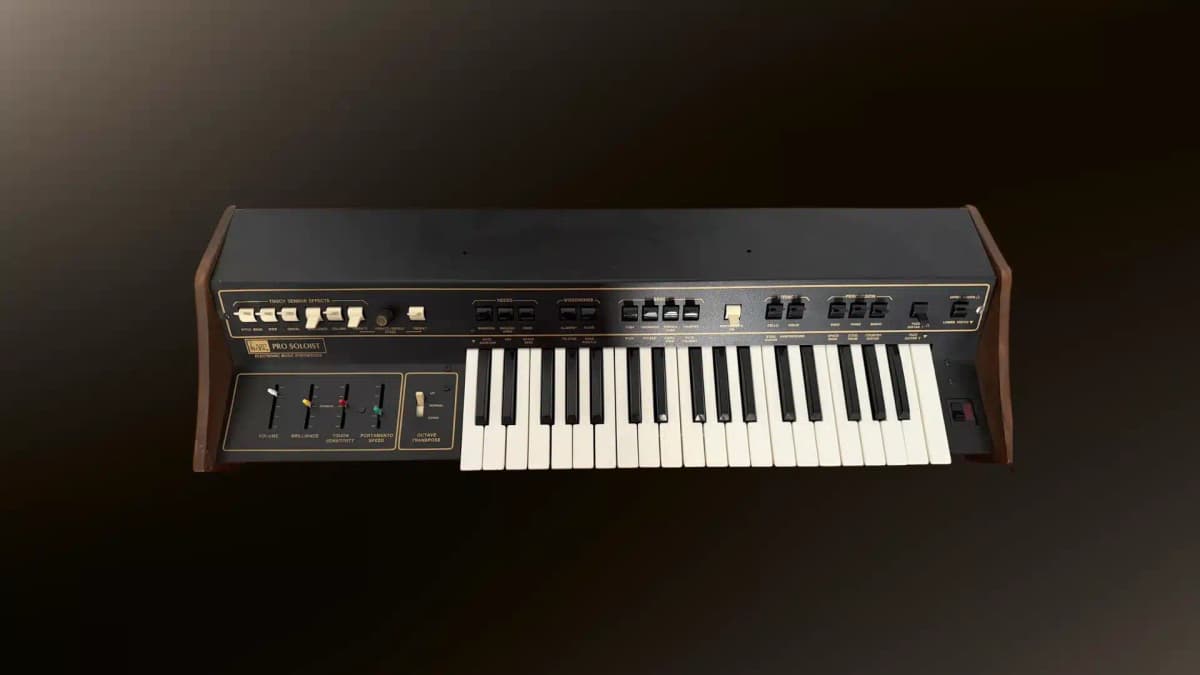
The ARP Soloist is a small monophonic preset synthesizer that ARP Instruments introduced around 1970 and 1971, only a year or two after the company’s founding. Instead of patch cords or a full front panel, it offered 18 fixed sounds selected by toggle tabs beneath the keyboard, plus a pressure-sensitive control that let the playing hand add vibrato, growl, wow, and brightness. It was designed to sit on top of an organ or electric piano and was marketed mainly to organists. The original ARP Soloist was unreliable and hard to keep in tune, and the Pro Soloist replaced it in 1972, but it established both the preset lead synth format and the expressive touch control that defined ARP’s line for the rest of the decade.
Table of Contents
ARP Soloist sound and character
The ARP Soloist was built to imitate solo instruments rather than to explore synthesis. Its 18 presets covered the kinds of lead voices an organist would want on top of the organ’s chords: brass, reeds, flutes, strings, and synthetic leads. Because the presets were fixed and could not be edited, its character comes from the voicings ARP chose at the factory and from how the player shaped each note in performance.
That shaping is the instrument’s real identity. Sources describe the touch control in slightly different ways, as a pressure-sensitive keyboard (Wikipedia) or as a pressure-sensitive bar under the keys (ARP design history published on Google Arts & Culture), but the effect was the same: pressing harder after a note was played could add vibrato, growl, wow, brilliance, or pitch bend. Combined with portamento, this let a single hand produce phrasing that on most early synths required a second hand on a wheel or knob, and it gives the ARP Soloist a more vocal, instrumental quality than a static preset suggests.
The weaknesses are equally clear. The original’s analog circuitry was prone to tuning drift, which ARP corrected in the Pro Soloist with a digitally controlled oscillator and digital preset memory. With only 18 sounds and no way to edit them, the ARP Soloist is narrower than its successor, and it sits firmly in the vintage, organ-top category rather than alongside fully programmable monosynths such as ARP’s own Odyssey.
Features and architecture
- Manufacturer: ARP Instruments, Inc., United States
- Year introduced: 1970 according to ARP design history and Cherry Audio; other references, including a photo caption in the same ARP history and the Swiss Museum for Electronic Music Instruments, date the instrument to 1971
- Production years: about 1970 or 1971 to 1972, when the Pro Soloist replaced it
- Synthesis type: analog subtractive, preset
- Category: organ-top preset monosynth
- Polyphony: monophonic
- Original price: not reliably documented in available sources
- Current market price: original units are rare, and listings often mix it with the Pro Soloist; Equipboard tracked a Reverb listing titled ARP Soloist at about $3,500 in April 2026
- Oscillators: analog, with no user control over waveform or tuning beyond the presets and performance effects; detailed published specifications for the original are scarce
- Filter: analog, preset per voice, with a brilliance control for brightness
- LFOs: internal modulation for vibrato and related effects, not user-programmable
- Envelopes: preset per voice; not user-programmable
- Modulation system: pressure-sensitive touch control for vibrato, growl, wow, brilliance, and pitch bend, plus portamento
- Sequencer / arpeggiator: none
- Effects: none beyond the performance effects listed above
- Memory: 18 factory presets selected by toggle tabs placed below the keyboard; no user memory
- Keyboard: short three-octave keyboard with pressure sensitivity; a 37-key compass is commonly given for the ARP Soloist line
- Inputs / outputs: audio output for connection to an amplifier or organ system; published connector details for the original are limited
- MIDI / USB: none; the instrument predates MIDI
- Display: none
- Dimensions / weight: compact organ-top cabinet with a built-in music rack; published dimensions and weight are not consistently documented
- Power: AC mains
- Model number: the Swiss Museum for Electronic Music Instruments catalogs it as model 2700; a dealer listing gives the Pro Soloist as model 2701
Strengths
- It made expressive control practical for one hand. The touch control let players add vibrato, growl, and brightness while playing, an idea ARP carried into the Pro Soloist and Pro/DGX.
- The preset approach removed the learning curve. Organists could get a usable synthesizer lead with a flick of a tab, at a time when most musicians had no experience with patching or programming.
- Its organ-top form suited the way keyboardists worked in the early 1970s, adding a solo voice to an organ or electric piano setup without a second large instrument.
- The built-in music rack and simple layout show how clearly ARP targeted the home and working organist market, a deliberate move beyond studios and universities.
- As ARP’s first preset instrument, it has historical value well beyond its specifications, standing at the start of a line that ran from 1970 to the company’s closure.
Limitations
- Tuning stability was poor. Multiple accounts describe the original’s analog circuitry as unreliable and hard to keep in tune, a problem fixed only in the Pro Soloist.
- The preset tabs were fragile. A history of the line notes that they broke off, and ARP moved the controls to a tilted panel above the keys on the Pro Soloist.
- Only 18 presets are available, none of them editable, which makes the sound palette narrow compared with the Pro Soloist’s 30.
- It is strictly monophonic and offers no programmable filter, envelope, or LFO controls.
- Documentation is thin. Prices, detailed specifications, and production numbers are not well recorded, which complicates restoration and valuation.
- Original units are rare and often need significant work, and parts specific to the first ARP Soloist are harder to source than those for later ARP models.
Historical context
ARP Instruments was founded in 1969 by Alan R. Pearlman, with David Friend as a co-founder. Its first products were large instruments: the 2500 modular system, released in 1970, and the semi-modular 2600, which entered production in 1971. The ARP Soloist was a very different kind of product, aimed not at studios or educators but at keyboard players who wanted a lead voice to place on top of an organ. Other companies soon pursued the same market, including Moog, Elka, and later Roland and Yamaha with their own organ-top preset monosynths.
The ARP Soloist offered 18 presets on toggle tabs under the keyboard and the pressure-sensitive control that became the line’s signature. Its problems were practical: the tabs were fragile, the analog circuitry drifted, and keeping it in tune was difficult. ARP worked on a Soloist Mk II with fewer presets and a digitally controlled oscillator, but according to ARP design histories it remained a prototype and never shipped.
The redesign that did reach the market was the Pro Soloist, usually dated to 1972 (one ARP history gives 1974). It expanded the presets to 30, moved the controls to a tilted panel above the keys, and used a digitally controlled oscillator and digital preset logic to cure the tuning problems. The Pro/DGX followed in 1977 or 1978 with pushbuttons and LED indicators, and remained in production until ARP closed in 1981. The original ARP Soloist’s own run was therefore short, ending around 1972.