
ARP 2600: Sound, history, and legacy of the synth that bridged modular and mainstream
The ARP 2600 is a semi-modular analog synthesizer introduced in 1971, created at a moment when modular synthesis was still powerful but intimidating, expensive, and often impractical outside specialist environments. By combining a pre-wired signal path with patchable flexibility, ARP turned a serious synthesis system into something that could function as both an educational instrument and a professional studio tool. That balance is the reason the 2600 still matters: it did not merely offer a set of modules in a box, but helped redefine how musicians could approach synthesis itself.
Sound and character
The ARP 2600 sounds direct, vivid, and unusually tactile. Where some classic monosynths are remembered mainly for thickness or warmth, the 2600 is often prized for articulation: it can be sharp, wiry, nasal, percussive, vocal, unstable, or beautifully controlled depending on how it is patched. It has the kind of tone that reveals structure. You hear the motion of the oscillators, the edge of the filter, the snap of the envelopes, and the physicality of the spring reverb.
Continue Reading
In practice, that makes it exceptional for leads, aggressive basses, synthetic percussion, bleeps, sweeps, sci-fi effects, and animated modular-style textures. It can sound huge, but not in a polished, homogenized way. Even when it is doing something simple, there is often a sense of circuitry at work. The three-oscillator architecture gives it weight and complexity, while the low-pass filter and ring modulator let it move quickly from musical phrasing to abstract sound design. The built-in preamp and envelope follower also give it an unusual relationship with external sound sources, which is one reason it became so important in film and effects work.
Another part of its identity is that the 2600 never locks the player into one genre of “vintage” sound. Early units with the 4012 filter are often associated with a smoother, more Moog-like response, while later 4072-filter instruments are frequently described as darker and slightly more constrained at the top end. But the deeper truth is that the 2600’s personality comes less from one flattering sweet spot than from its range: it is a synthesizer that rewards intervention.
Features and architecture
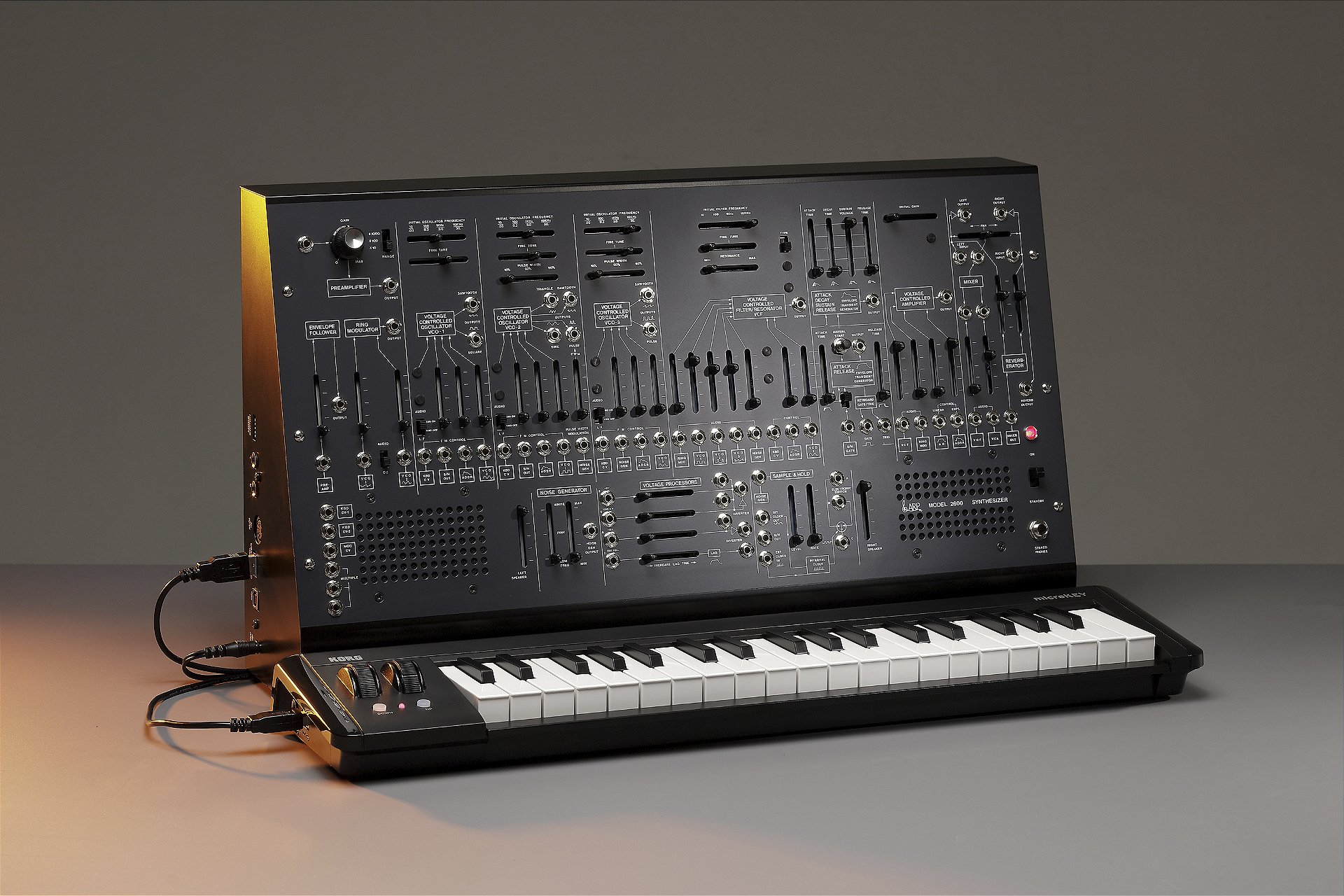
- Manufacturer: ARP Instruments, Inc.
- Year introduced: 1971
- Production years: 1971–1981
- Synthesis type: Analog subtractive, semi-modular
- Category: Semi-modular synthesizer system with separate keyboard controller
- Polyphony: Monophonic voice architecture; later 3620 keyboard enabled duophonic performance control
- Original price: Introduced at $2,600; original vintage units now occupy a much higher collector tier
- Oscillators: 3 VCOs
- Filter: 24 dB/octave resonant low-pass filter; early instruments used the 4012 filter, later versions the 4072
- LFOs: No dedicated main-panel LFO in the core synth; later 3620 keyboard added an LFO for vibrato functions
- Envelopes: 2 envelope generators, one ADSR and one AR
- Modulation system: Extensive normalled routing plus patch points, sample-and-hold, ring modulator, voltage processors, lag processor, envelope follower, and preamp
- Sequencer / arpeggiator: None
- Effects: Built-in spring reverb
- Memory: None
- Keyboard: Separate 49-key controller; early 3604 keyboard was monophonic, later 3620 added duophonic capability and more performance control
- Inputs / outputs: Extensive patching connections, audio input via preamp, audio outputs, and CV/gate-style interfacing
- MIDI / USB: None on the original instrument
- Display: None
- Dimensions / weight: These vary by revision; commonly cited figures for the main unit are roughly 21.5 × 17.5 × 5.5 inches and about 35 lb
- Power: AC mains; original documentation specifies 110V operation, with service conversion documentation for 220V use
Strengths
- It made advanced synthesis more accessible without making it shallow. The normalled signal path meant a player could get sound immediately, while the patch points preserved serious modular-style depth.
- Its sonic range is unusually wide for a single vintage mono system. The same instrument can move from thick bass and expressive leads to noise design, external processing, and cinematic effects without feeling like it is leaving its natural territory.
- The panel design is pedagogically brilliant. Sliders, printed signal flow, and logically grouped functions make the instrument readable in a way many modular systems are not.
- It excels at sound design, not just keyboard playing. The preamp, envelope follower, ring modulator, spring reverb, and sample-and-hold make it a genuine audio laboratory.
- The keyboard separation had real performance implications. For some players, especially in the early 1970s, the ability to separate controller and main unit changed how a synth could appear onstage.
- Its cultural footprint extends beyond records. The 2600 became part of film sound history, not merely synth history, which broadened its legacy far beyond keyboard circles.
Limitations
- It is still fundamentally a monophonic instrument. Even with later duophonic keyboard behavior, this is not a polyphonic synth in any modern sense.
- There is no patch memory. Every sound must be built, documented, or re-created manually.
- Its size and format are more transportable than a full modular, but not truly convenient. The 2600 solved one level of impracticality, not all of it.
- Revision differences matter. Buyers and players often care deeply about filter type, cosmetics, keyboard version, and internal changes, which can make the market confusing.
- Maintenance is a real part of ownership. Vintage examples often require restoration, calibration, or specialist service.
- Workflow can be slower than it first appears. The clear layout helps, but serious patching still demands concentration and technical fluency.
- Original units are expensive enough to be financially restrictive. For many musicians, the instrument now exists more as a collector’s object or studio luxury than a practical first choice.
Historical context
The ARP 2600 arrived just after ARP’s earlier large-scale modular work and at a time when synthesizers were still associated with specialist studios, academic environments, and technically adventurous professionals. That timing mattered. There was growing fascination with electronic sound, but the available tools were still too cumbersome for many working musicians. The 2600 addressed that gap directly.
ARP initially aimed the instrument at schools, universities, and other users who needed a serious but comprehensible synthesis platform. That helps explain several design decisions that can otherwise seem eccentric: the built-in speakers, the large and legible panel, the slider-based interface, and the now-famous manual. Yet the same features that made it useful in education also made it attractive to musicians. It could teach synthesis, but it could also survive contact with actual musical work.
In brand terms, the 2600 was not a budget compromise or a stripped-down novelty. It was a strategic reframing of what ARP could be after the ARP 2500: still sophisticated, but more immediate, more portable, and more legible. In the broader market, it helped define the semi-modular idea as a practical middle ground between fixed-architecture keyboards and full modular systems.
Legacy and significance
The ARP 2600 matters because it changed the social shape of synthesis. It helped move electronic sound away from the image of a distant laboratory machine and toward something a musician could study, play, and integrate into real work. That is a different kind of breakthrough from simply adding more modules or more sonic power. It is a breakthrough in usability without surrendering seriousness.
Its importance also lies in how many worlds it managed to inhabit at once. It was a teaching instrument, a stage instrument, a studio instrument, and a sound-design instrument. It belonged to the classroom and the rock stage, to jazz-fusion experimentation and blockbuster cinema. Many synthesizers become iconic because of one narrow lane. The 2600 became iconic because it proved unusually adaptable across several.
In historical terms, it also helped solidify the idea that interface design is not secondary to sound. The 2600’s panel is part of its achievement. It made synthesis visible. That may sound modest now, but in the early 1970s it had enormous consequences. A synthesizer that can be read invites exploration, and a synthesizer that invites exploration can change who feels entitled to use it.
Artists, users, and curiosities
Early high-profile users included Edgar Winter, Stevie Wonder, Pete Townshend, Joe Zawinul, and Herbie Hancock, which already tells you something important about the instrument: it crossed genre boundaries very quickly. It was not confined to one scene or one idea of what synthesizer music should be.
One of the most memorable stories belongs to Edgar Winter, who used a long extension cable so he could wear the keyboard and play it in a more theatrical, guitar-like way onstage. That anecdote is more than rock-show trivia. It captures what made the 2600 feel new: it was modular thinking, but no longer nailed to the floor.
Another famous curiosity is Stevie Wonder’s Braille-labeled ARP 2600, which has become one of the most enduring visual symbols of the instrument’s accessibility and adaptability.
The 2600 also entered popular culture through sound design. Ben Burtt used it, along with his own voice, to create the voice of R2-D2 in Star Wars. That single fact may have done as much as any album credit to make the 2600 memorable to people who never touched a synthesizer.
There is also a subtler curiosity in the instrument’s reputation: many vintage synthesizers are remembered mainly as “great sounding,” but the 2600 is often remembered as a system people learned from. Its manual remains part of its legend because it taught users not just how to operate the machine, but how to think in synthesis.
Market value
- Current market position: Firmly established as a blue-chip vintage synthesizer rather than a merely nostalgic collectible.
- New price signal: There is no true “new original” market, only reissues and inspired recreations.
- Used market signal: Original vintage examples commonly surface at five-figure asking prices; restored or clean listings in the current market often appear around $12,000 to $16,800, with wide variation by revision, originality, service history, and keyboard inclusion.
- Availability: Limited. Original units do appear, but not with the regularity or price transparency of more common vintage monosynths.
- Buyer notes: Revision matters. Early and later filters, keyboard version, restoration quality, cosmetic condition, and originality all materially affect desirability.
- Support ecosystem: Better than many vintage instruments because of enduring demand, specialist technicians, clone projects, reissues, replacement parts knowledge, and a large enthusiast community.
- How hard it is to find: Not impossible, but meaningfully scarce in fully sorted, trustworthy condition.
- Long-term position: Stable to rising as a collectible icon, with value supported by historical importance as much as by pure utility.
Conclusion
The ARP 2600 endures because it was more than a famous sound machine. It was a design argument: that synthesis could be deep without being obscure, teachable without being simplistic, and experimental without leaving music behind. Many instruments are influential because they sound distinctive. The 2600 is influential because it also changed how people learned, imagined, and used the synthesizer itself.

His connection with music began at age 6, in the 1980s, when his father introduced him to Jean-Michel Jarre's Rendez-Vous on vinyl. He works professionally in the legal field, while synthesizers became his space for abstraction and creative exploration. He enjoys composing synthwave and cinematic ambient music. Founder of The Synth Source.