

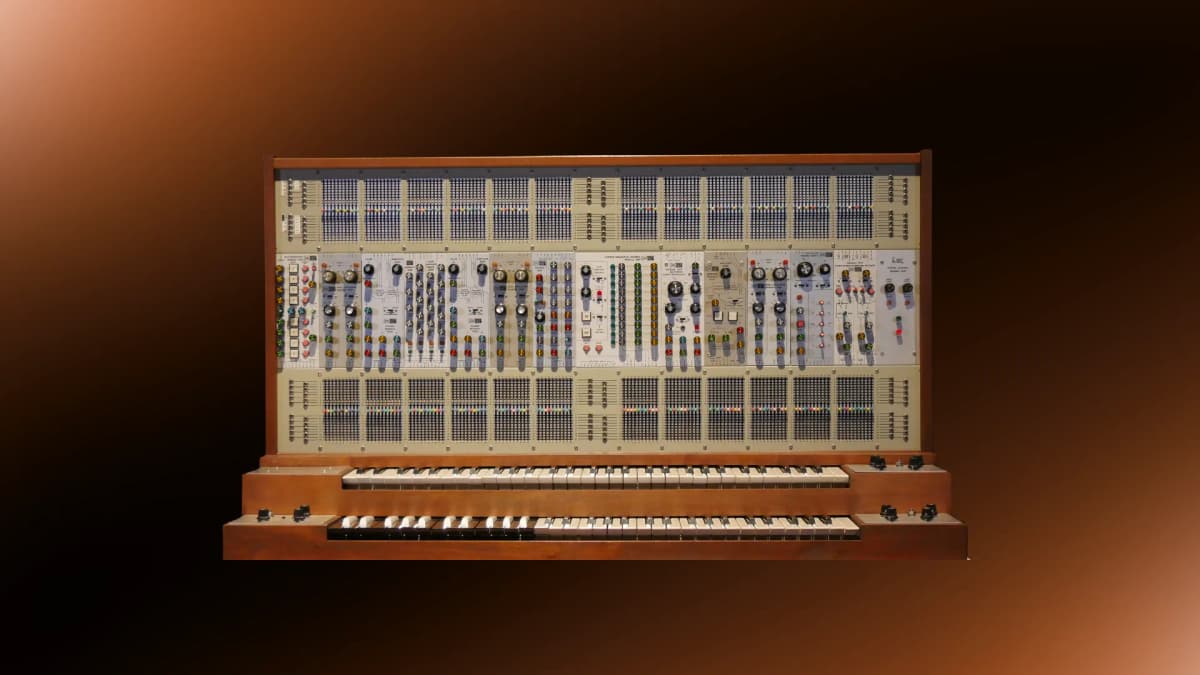
The ARP 2500 is a large analog modular synthesizer introduced in 1970 as the first product of the company Alan R. Pearlman founded, which began as Tonus before becoming ARP. Built from custom-ordered 1000-series modules housed in wooden cabinets, played from separate five-octave keyboards, and patched through rows of sliding matrix switches instead of cables, it was ARP’s direct answer to the Moog modular systems of the time. Only around 100 were sold, yet it established ARP’s reputation for stable oscillators, appeared on records by The Who and Elton John, became Éliane Radigue’s main instrument for decades, and played the alien-contact scene in Close Encounters of the Third Kind.
Table of Contents
Sound and character
The 2500 is usually described as rich, warm, and dense rather than delicate. Sound On Sound’s 1996 retrospective put it simply: richer, warmer, fatter than Moog, but essentially different. Pete Townshend spoke of the “incredibly rich harmonics” he was still learning to tame, even from a single voice. That weight comes partly from the oscillators, which offer five waveforms each (sine, triangle, pulse, sawtooth, and square) and can be stacked in numbers that smaller instruments never allowed. A loaded main cabinet could hold seven VCOs, and a full three-cabinet system far more.
The other defining element is pitch behavior. Pearlman designed the VCOs around his own exponential converter circuitry and potted key sub-circuits in epoxy, and both period and modern sources describe their tuning as notably more stable than the Moog oscillators of the day, which tended to drift as they warmed up. Stable oscillators allow multiple VCOs to be tuned into chords, intervals, or slow beating patterns that hold steady, which is exactly the territory Radigue explored in her long, slowly shifting drones.
The filters broaden the palette. Alongside the 1006 low-pass filter and amplifier, the 1047 multimode filter/resonator, a state-variable design that Dennis Colin presented as an alternative to the Moog ladder, offers simultaneous low-pass, high-pass, band-pass, and notch outputs with voltage-controlled resonance. This helps explain why the 2500 was used as much for atmospheres, string-like textures, and processed signals as for basses and leads. Its real character lies in sustained, evolving sound rather than quick punchy patches.
Features and architecture
- Manufacturer: ARP Instruments (originally trading as Tonus), founded by Alan R. Pearlman
- Year introduced: 1970, with an early version known as the 2002 preceding the 2500 name
- Production years: sources differ; commonly listed as 1970 to 1981, while others place the end of production in the mid-1970s or 1976
- Synthesis type: analog subtractive modular synthesis
- Category: cabinet-based modular synthesizer with separate keyboards
- Polyphony: monophonic per voice chain; keyboards were offered in one-voice, two-voice (duophonic), and split versions controlling up to four voices
- Original price: modules roughly $400 to $1,200 each; complete systems commonly cited from about $7,000 to $8,000 up to around $20,000
- Current market price: rare and expensive; recent industry coverage describes surviving working units trading in the six-figure range
- Oscillators: 1004 series VCOs (1004-P, 1004-T, and other variants) with sine, triangle, pulse, sawtooth, and square outputs; 1023 dual VCO; quoted range of 0.03 Hz to 16 kHz
- Filter: 1006 filter/amplifier with low-pass filter; 1047 multimode filter/resonator with low-pass, high-pass, band-pass, and notch outputs and voltage-controlled Q
- LFOs: no dedicated LFO module; the VCOs reach sub-audio rates and double as LFOs
- Envelopes: 1003 dual envelope generator, 1033 dual envelope with trigger delay, 1046 quad envelope generator
- Modulation system: matrix of slide switches above and below the module row routing outputs to inputs over horizontal buses; 1005 modulator/amplifier with balanced modulation; 1016 dual noise/random voltage source; 1036 dual sample and hold
- Sequencer / arpeggiator: 1027 clocked sequential control module with 10 steps in three rows; 1050 mix-sequencer; no arpeggiator
- Voice module: 1045 voltage-controlled voice combining VCO, VCF, VCA, and two envelopes in one module
- Effects: none onboard
- Memory: none
- Keyboard: separate 3000-series keyboards, mostly five octaves and 61 keys (models including 3001, 3002, 3212, and 3222), with tuning, interval, and portamento controls; smaller four-octave remote keyboards are also listed
- Inputs / outputs: 1/8-inch jacks at the ends of the matrix rows for external signals and for linking wing cabinets
- MIDI / USB: none; control is CV/Gate
- Display: none, apart from step lights on the sequencer
- Dimensions / weight: 2515 main cabinet about 47 inches wide and 22 inches tall; weight varies with configuration
- Power: AC mains via the 1002 power control module; cabinets of 15 modules (2515) or 8 modules (2508 wings)
Strengths
- The oscillators were ahead of their time in stability, a practical advantage for chords, drones, and layered textures built from multiple tuned VCOs.
- Matrix switching made complex patches visible and repeatable without a forest of cables, and the switches themselves can be moved during performance to change modulation in real time.
- The 1047 multimode filter offered simultaneous outputs and voltage-controlled resonance, giving the 2500 a wider tonal vocabulary than a single low-pass design.
- Sequencing was built in at a time when analog sequencers were rare. The 1027 offered 10 steps across three rows with internal or external clocking, and Townshend praised its “cascades of arpeggios.”
- Duophonic and split keyboards allowed two to four independent voices from one system, unusual for the period and useful for layered or contrapuntal playing.
- Construction quality was high. The 2500 was built with little regard for cost, and repair specialists note that ARP received relatively few service calls for it in the 1970s.
Limitations
- It was extremely expensive. A fully loaded system could approach $20,000 in early-1970s money, which confined it mostly to studios, wealthy artists, and institutions.
- The learning curve was steep. Sound On Sound noted that the manual explained synthesis theory but not how to make a sound, and that programming demanded real analog knowledge and many hours.
- The matrix could suffer from crosstalk and worn switch contacts. Sources disagree on how serious this was, with one specialist service blaming aging power supplies more than the switches, but the reputation stuck.
- Its size makes it a studio instrument. A three-cabinet system with two keyboards is effectively a fixed installation.
- There is no patch memory, no MIDI, and no onboard effects, so every sound must be built and documented by hand.
- Servicing is specialized. Encapsulated sub-modules, calibration points set by component selection rather than trimmers, and the absence of a published service manual mean restoration depends on a small number of experts, and replacement matrix switches are no longer made.
Historical context
When the 2500 appeared in 1970, the voltage-controlled synthesizer market was tiny, and Moog was the established name in modular systems. Pearlman, an engineer who had previously designed amplifiers for NASA’s Gemini and Apollo programs and run an op-amp company, was unimpressed by the tuning instability of Moog and Buchla oscillators. His response was to build a modular system on more rigorous engineering terms: stable oscillators, cleaner signal routing through matrix switches, and a complete voice module in a single panel. David Friend presented the design to the Audio Engineering Society in 1970.
The 2500 was a flagship statement that positioned the new company as a serious rival to Moog in studios and universities. Brown University and the University of Georgia were among documented owners, and Sound On Sound observed that many systems went to science departments rather than music departments.
Commercially, though, it was too big, too costly, and too complex to sell in volume. That realization pushed ARP toward the 2600 in 1971, a portable, pre-wired semi-modular instrument that could still integrate with 2500 systems, and then toward the Odyssey and the smaller performance synthesizers that defined ARP’s commercial success.