

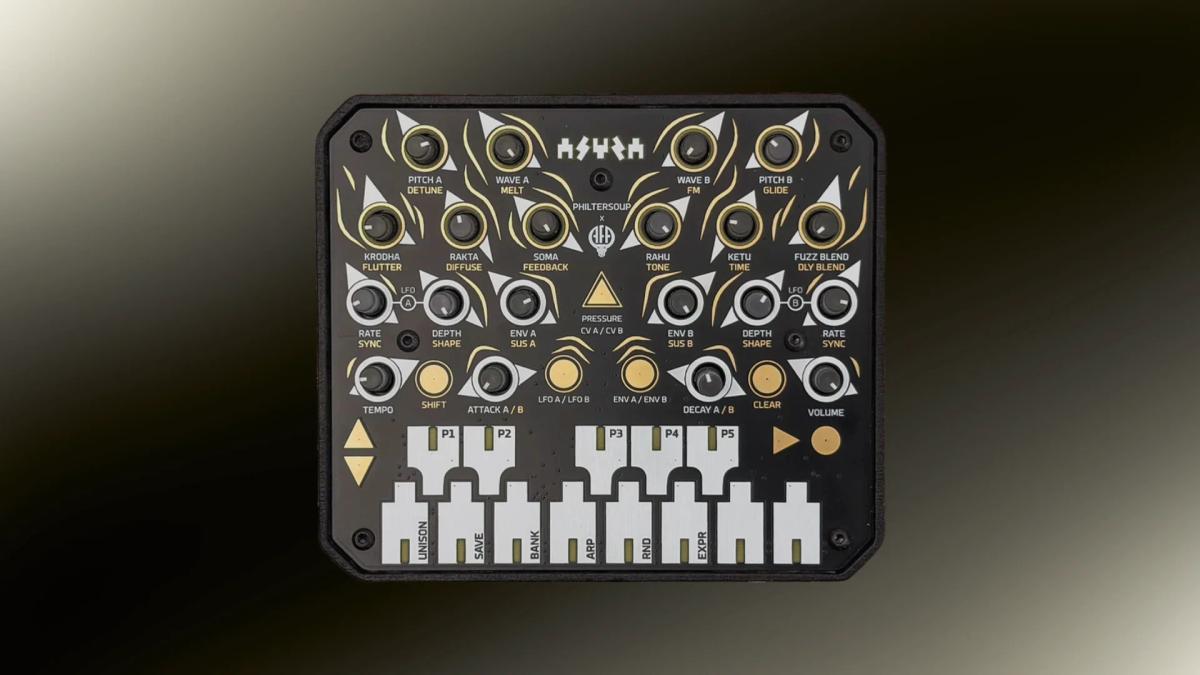
The Animal Factory Asura is a compact six-voice hybrid wavetable synthesizer from Animal Factory Amplification, the Mumbai company best known for aggressive fuzz pedals and Eurorack modules. Developed over more than five years with producer Sanjay Das, who records as philterSoup, it was officially unveiled on September 18, 2026, three years after a duophonic prototype appeared at Superbooth 2023. Each voice pairs two digital wavetable oscillators, and instead of a filter the signal runs through a dual-head granular delay and a digitally controlled analog fuzz circuit. Two envelopes, two LFOs, keyboard pressure and two CV inputs drive the modulation, while an eight-step sequencer with parameter locks, an arpeggiator and a pressure-sensitive touch keyboard handle performance. Pre-orders opened at launch, SchneidersLaden lists it at €499 and Happy Mag reported a UK price of £429. Its makers present it as the first original synthesizer conceived, designed and built in India.
Table of Contents
Animal Factory Asura sound and character
Animal Factory describes the sound it was after as ranging from ethereal to aggressive, and the instrument’s name points to the second half of that range. As of October 2026 no independent hands-on review has been published, so what is known about the Animal Factory Asura comes from the company’s lengthy walkthrough video, its dealer listing and launch coverage by Synth Anatomy, MATRIXSYNTH and Happy Mag. Those sources describe a synth built around distortion and time effects rather than subtractive filtering, which sets it apart from most wavetable polysynths on the market.
The tone starts with two wavetable oscillators per voice. Synth Anatomy reported seven built-in wavetables spread across two banks, plus a user bank for importing custom tables, with the main panel controls covering wavetable selection, master pitch and pitch offset. Shifted functions add detune, glide, FM and a control called Melt. Oscillator A can frequency-modulate oscillator B, which Happy Mag summarized as a two-operator FM engine. The SchneidersLaden listing also points to a softer side: a slight detune between the two oscillators produces slow beating in held notes and chords.
Melt is one of the more distinctive ideas. According to the dealer description, it introduces slow, unpredictable drift in pitch and wavetable position while relaxing the envelopes, so the instrument feels less rigidly digital. The stated aim is not to imitate vintage analog hardware but to loosen the precision that wavetable synths often carry. Synth Anatomy described the same function as analog-style voice fluctuation.
The fuzz section is where the Animal Factory Asura shows its pedal heritage. It is an analog circuit under digital control, with drive and gain, a filter that sweeps from notch to low-pass, a gated fuzz option and bipolar feedback that can add overtones or push the circuit into self-oscillation. Synth Anatomy named two of these functions: Krodha, a passive filter, and Soma, a gate that behaves somewhat like pulse-width modulation. Input level and the internal circuit level are set separately, so the same patch can move from mild coloration to heavy saturation. The 2023 prototype already replaced the filter with a distortion stage, as Sonicstate noted at the time, and the production model keeps that choice.
The delay is a custom dual-head granular design that runs forward or in reverse. It offers diffusion, tone, feedback, wow and flutter, and saturation, and the dealer listing says its fidelity drops on purpose at longer delay times. Synth Anatomy described the diffusion as a bass-focused, filter-based smear that can approach reverb. It also reported that the fuzz sits after the delay, the reverse of the usual pedalboard order, which means echoes and smeared repeats are distorted along with the dry signal.
Playing the Asura centers on its touch keyboard and voice modes. The standard mode gives six voices of two oscillators each; a second mode trades polyphony for density with three voices of four oscillators; a unison mode stacks all twelve oscillators; and a chord mode offers inversions that can be modulated. Keyboard pressure is a modulation source and also drives a randomizer that varies the current patch rather than replacing it. Modulation assignments are made with touch buttons and 20 backlit knobs, each source color-coded, and the official video includes a section on global versus local modulation depth.
Features and architecture
- Manufacturer: Animal Factory Amplification (Mumbai, India), co-developed with Sanjay Das (philterSoup)
- Year introduced: 2026 (officially launched September 18, 2026; prototype shown at Superbooth 2023)
- Production years: 2026 to present (pre-order stage as of October 2026)
- Synthesis type: Hybrid; digital wavetable oscillators with oscillator FM, processed by a granular delay and a digitally controlled analog fuzz circuit; no conventional filter
- Category: Compact polyphonic hybrid wavetable synthesizer with touch keyboard
- Polyphony: 6 voices (two oscillators per voice); 3-voice mode with four oscillators per voice; 12-oscillator unison; chord mode
- Multitimbrality: not specified by the manufacturer
- Original price: €499 including VAT (SchneidersLaden); £429 (Happy Mag); direct early-bird pre-order of Rs. 47,698.94, about €433 (Synth Anatomy); no US price published
- Current market price: Pre-order only; €499 at SchneidersLaden as of October 2026
- Oscillators: Two digital wavetable oscillators per voice; seven factory wavetables in two banks plus a user bank; detune, glide, Melt drift and A-to-B frequency modulation
- Filter: No conventional filter; the analog fuzz section has its own notch-to-low-pass filter and a passive filter function, and the delay has tone and diffusion controls
- LFO: Two morphing multiwave LFOs (monophonic), with tempo sync
- Envelopes: Two polyphonic ADSR envelopes
- Modulation system: Seven color-coded sources (two LFOs, two envelopes, keyboard pressure, two CV inputs) assigned with touch buttons and knobs, with global and local depth settings
- Sequencer / arpeggiator: Eight-step polyphonic sequencer with parameter locks and live knob recording; multimode arpeggiator with latch, half-latch and subdivisions; pressure-controlled randomizer
- Effects: Dual-head granular delay (forward or reverse, diffusion, tone, feedback, wow and flutter, saturation); analog fuzz with drive, gain, gated fuzz and bipolar feedback
- Memory: 25 onboard presets; user wavetable bank
- Keyboard: Small multitouch, pressure-sensitive touch keyboard; key count not specified by the manufacturer
- Inputs / outputs: Main audio output, headphone output, clock in and out, gate in and out, V/Oct in and out, two assignable CV inputs
- MIDI / USB: USB-C MIDI (bidirectional); TRS MIDI Type A in, out and thru; companion web editor
- Display: not specified by the manufacturer; 20 backlit knobs and touch-sensitive function buttons
- Dimensions / weight: not specified by the manufacturer; Synth Anatomy compared its footprint to the Modal CraftSynth 2
- Power: 12V DC, 1A external supply
Strengths
- The signal path is genuinely different. Replacing the filter with a granular delay followed by analog fuzz gives the Animal Factory Asura a character that most wavetable polysynths do not attempt.
- The fuzz comes from a specialist. Animal Factory has spent years building distortion pedals and modules, and the synth’s fuzz section carries that experience in features such as gated fuzz and bipolar feedback.
- Voice modes add flexibility. Moving between six thin voices, three thicker four-oscillator voices, full unison and chord mode lets one patch serve pads, leads and drones.
- Connectivity is unusually broad for its size. TRS MIDI in, out and thru, USB-C MIDI, clock, gate, V/Oct in and out, and two CV inputs let it sit in both MIDI and modular setups.
- Pressure is built into the design. The touch keyboard feeds pressure into the modulation system and the randomizer, so expression does not depend on an external controller.
- The sequencer is more capable than its length suggests. Eight polyphonic steps with parameter locks and live knob recording give room for evolving patterns.
- Pre-order pricing is accessible. The listed €499 and £429, plus an early-bird direct price of about €433, keep it under €500 in Europe.
Limitations
- It has not shipped yet. As of October 20, 2026, the Animal Factory Asura is a pre-order product, with shipping from India announced for the end of October.
- There are no independent reviews. Everything known about its sound comes from the manufacturer’s video, a dealer listing and news coverage.
- There is no conventional filter. Players who rely on a resonant low-pass for classic subtractive tones will have to work through the fuzz section’s filter and the delay’s tone controls instead.
- Polyphony is modest. Six voices is enough for chords, but the denser four-oscillator mode drops to three.
- Key specifications are missing. Launch materials do not give dimensions, weight, key count or display details, and no US price has been published.
- The keyboard is small and touch-based. A compact touch surface suits sound design and sequencing more than traditional keyboard technique.
- Dealer support is still forming. Outside SchneidersLaden in Germany and the company’s own store, retail availability was not yet documented at launch.
Historical context
Animal Factory Amplification is the company of Aditya Nandwana, based in Mumbai. It built its name on extended-range silicon fuzz pedals such as the Chemical Burn and Baron Samedi, which Guitar Pedal X covered in 2022 while noting that the company had moved its focus toward Eurorack. That move had started years earlier. At Superbooth 2018, Nandwana presented a range of effects, Eurorack modules and a budget modular system intended to make modular synthesis more accessible in India. Later that year Gearnews covered the Coma Reactor, the company’s third Eurorack module, a PT2399-based delay with a bandpass filter in the feedback path.