

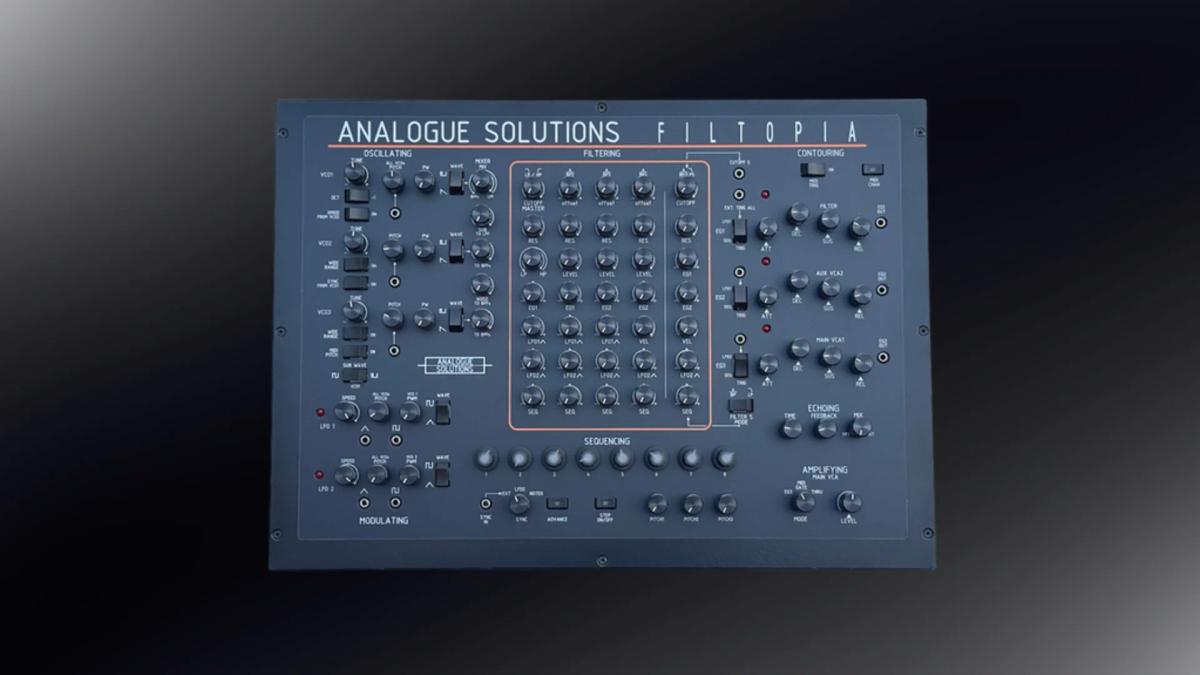
The Analogue Solutions Filtopia is a stereo analog monophonic synthesizer built around a bank of five resonant filters wired in parallel. It comes from Analogue Solutions, the small British company led by designer Tom Carpenter, and it surfaced on July 8, 2026, when MATRIXSYNTH and Synth Anatomy published the first details, with wider coverage following through mid-July. The voice starts with three VCOs, two sub-oscillators and a noise source, and each oscillator can be sent to different filters in the bank. Two VCAs, one of them carrying an onboard echo, feed separate outputs for stereo use, while three ADSR envelopes, two LFOs and an 8-step CV sequencer animate the filters. The first run was limited to 200 handmade units at £1,799, and a second batch was reported in October 2026. What makes the Analogue Solutions Filtopia matter is its approach: instead of one filter shaping the whole sound, it splits the spectrum into bands that can move independently.
Table of Contents
Analogue Solutions Filtopia sound and character
The Analogue Solutions Filtopia is defined by its filter section, and the rest of the instrument is arranged to feed it. The bank holds five analog filters running side by side rather than in series. According to Synth Anatomy, the leftmost filter sweeps from low-pass to high-pass and has its own cutoff control, the three middle filters are band-pass types set with an offset control, and the fifth moves between band-pass and low-pass with a cutoff of its own. Every filter has separate resonance and level controls, so the bank behaves less like a single tone control and more like a small mixing desk for parts of the spectrum.
That layout points the instrument toward moving, vocal timbres. The manufacturer’s launch text, reproduced by MATRIXSYNTH, says that offsetting the cutoff frequencies and raising resonance can produce vowel-like sounds that a single filter cannot reach. Adam Douglas of Gearnews made the same point in plainer terms, noting that because all five filters are resonant, the bank can build formants of the kind that shape the human voice. Multi-band sweeps, where one region of the spectrum opens while another closes, are the other headline use.
Modulation is spread across the bank instead of applied to it as a whole. Will Vance of Magnetic Magazine described the routing in detail: the first envelope reaches filters one and two, the second envelope reaches filters three and four, and filter five can take both. LFO 2 can move all five filters, LFO 1 the first three, and filters four and five respond to velocity. Synth Anatomy’s summary lists EG 1, both LFOs and the sequencer as per-filter sources, so the exact assignments differ slightly between write-ups, but both agree that each band can be animated on its own terms.
The sources are conventional in count and generous in options. Three multi-wave VCOs offer pulse-width modulation, sync and a cross-modulation setting, Gearnews and Bonedo both mention true ring modulation, and two sub-oscillators and a noise generator sit alongside them. The three-oscillator count invites comparison with the Minimoog Model D, but the Filtopia’s routing changes the picture. A small mixer precedes the bank, and the front panel lets each VCO be sent to some or many of the filters. In Vance’s description, VCO 1 can feed the band-pass filters or the low-pass option, while noise and the other two oscillators go to the band-pass section, so different sources can occupy different bands of the same patch.
Stereo comes from the output stage. The Analogue Solutions Filtopia has two VCAs with their own 6.3 mm jacks, labeled MAIN and AUX on the rear panel. Synth Anatomy reports that the main VCA can follow EG 3, follow the MIDI gate or pass audio straight through, while the second VCA carries the built-in echo with time, feedback and level controls. Magnetic Magazine describes the split the other way round, with the echo feeding the main VCA and the aux VCA staying dry, so the precise signal flow is best confirmed in the manual. Either way, a dry and an effected signal can be sent to opposite sides of a mix.
Movement over time comes from an 8-step CV sequencer along the bottom of the panel. Gearnews lists per-step pitch settings, performance controls and a sync input, and notes that the sequencer has no MIDI output. Front-panel patch points, a rear audio input for external signals and MIDI-to-CV conversion let the Filtopia work alone or as part of a modular rig, and Bonedo framed it as a semi-modular instrument. Vance singled out the audio input as a possible sleeper feature, since any external source can be run through the five-band filter. No independent hands-on review had appeared by October 2026, and the main audio reference remains Analogue Solutions’ own first demo, recorded in stereo and described by the company as a set of early patches rather than a full tour.
Features and architecture
- Manufacturer: Analogue Solutions (United Kingdom), designed by Tom Carpenter
- Year introduced: 2026 (first details published July 8, 2026)
- Production years: 2026 to present; limited edition announced as 200 units, with a second batch reported in October 2026
- Synthesis type: Analog subtractive, with a parallel filter bank
- Category: Stereo analog monosynth, tabletop format with semi-modular patch points
- Polyphony: Monophonic
- Multitimbrality: None
- Original price: £1,799 from Analogue Solutions (Sonicstate lists this figure excluding VAT); no official US or euro price found
- Current market price: £1,799 direct from the manufacturer; no independent street price documented
- Oscillators: Three multi-wave VCOs with PWM, sync and cross-modulation; ring modulation; two sub-oscillators (Magnetic Magazine mentions one); noise generator; small mixer before the filters
- Filter: Five analog filters in parallel: one low-pass to high-pass, three band-pass, one band-pass to low-pass; each with resonance, level and its own modulation routing; Magnetic Magazine describes them as 12 dB per octave designs with roots in the Oberheim SEM
- LFO: Two multi-wave LFOs
- Envelopes: Three ADSR envelopes (filter, VCA and auxiliary)
- Modulation system: Hardwired per-filter routing from envelopes, LFOs, velocity and the sequencer, plus front-panel patch points
- Sequencer / arpeggiator: 8-step CV sequencer with per-step pitch, performance controls and sync input; no MIDI output from the sequencer; no arpeggiator listed
- Effects: Built-in echo on one VCA with time, feedback and level controls, described by Gearnews and Bonedo as solid-state
- Memory: None; no patch storage
- Keyboard: None (tabletop unit played over MIDI or CV)
- Inputs / outputs: Stereo output on two 6.3 mm jacks (MAIN and AUX); rear audio input; front-panel CV patch points
- MIDI / USB: 5-pin MIDI In and Thru with internal MIDI-to-CV conversion; no USB
- Display: None
- Dimensions / weight: Not specified in the sources consulted
- Power: Rear power input with on/off switch; supply rating not specified in the sources consulted
Strengths
- The filter bank is genuinely unusual. Five resonant filters in parallel, each with its own level and modulation, give a monosynth spectral control that a single-filter design cannot match.
- It is built for vocal and formant tones. Offset cutoffs and high resonance let the bank imitate vowel shapes, a point stressed by both the manufacturer and Gearnews.
- Oscillators can be split across the bank. Sending different VCOs, sub-oscillators and noise to different filters makes layered patches possible inside one voice.
- The output stage is truly stereo. Two VCAs with separate outputs, one carrying the echo, spread a single monophonic voice across the stereo field without an external effect.
- It doubles as an external filter processor. The rear audio input sends any outside signal through the five-band filter and echo, which widens its role beyond that of a synth voice.
- It fits into modular setups. Front-panel patch points, CV control and MIDI-to-CV conversion let it run alone or alongside Eurorack gear.
Limitations
- Availability is limited. The first run of 200 units was down to four within days of the announcement, and Sonicstate reported it sold out by July 14, 2026.
- It is expensive for a monosynth. At £1,799, before VAT according to Sonicstate, it is a significant outlay for a single-voice tabletop instrument without keys or memory.
- There is no patch memory. As a fully analog instrument without digital control, sounds must be set by hand and documented by the player.
- Independent reviews are missing. As of October 2026, coverage consists of news reports and the manufacturer’s own demo rather than hands-on tests.
- Key specifications are undocumented. Dimensions, weight, power supply rating and an official US price did not appear in the sources consulted.
- Sources disagree on some details. Write-ups differ on the number of sub-oscillators, the exact filter modulation assignments and which VCA carries the echo.
Historical context
Analogue Solutions was founded in the UK in 1995 by Tom Carpenter, according to Sweetwater’s brand page, which describes a company kept small by choice and an instrument range designed by Carpenter and built by hand in England. In a 2012 interview with The Electricity Club, Carpenter traced the business back to buying, selling and modifying used synths. His first working build was a module based on the TR-808 kick drum, followed by a TR-909 kick and a gate sequencer, and those projects grew into the company’s first modules.