

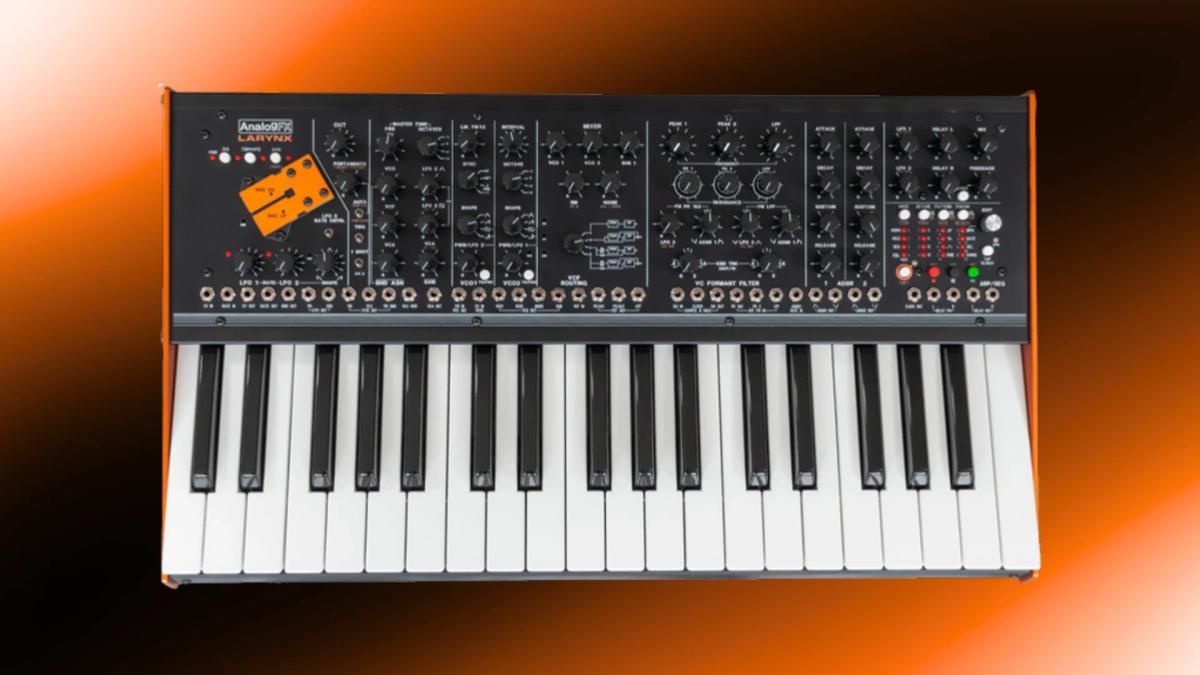
The AnalogFX Larynx is a monophonic, semi-modular analog formant synthesizer with a 37-key keyboard, made in the Netherlands by the small Deventer company AnalogFX. Announced on April 24, 2026 and shown at Superbooth 26 in Berlin that May, it was declared available on October 1, 2026 in a first run limited to 50 units. The instrument takes the engine of the company’s 2022 SER-2020 desktop synth, itself modeled on the 1983 Synton Syrinx, and builds it into a keyboard. That engine pairs two CEM3340-based oscillators with three CEM3350-based filters, a 24 dB low-pass and two resonant peak filters that can shape vowel-like formants. The keyboard version adds 16 preset voice formants, a five-voice digital chord mode, a stereo delay, an arpeggiator and a 16-step sequencer. AnalogFX lists it at €1,249 including VAT. It is one of very few new instruments built around fixed analog formant filtering rather than a vocoder.
Table of Contents
AnalogFX Larynx sound and character
The core of the AnalogFX Larynx is its filter section, and that is where its character comes from. Instead of a single low-pass filter, the signal can pass through three CEM3350-based filters: a 24 dB per octave low-pass and two independent resonant band-pass filters, labeled PEAK 1 and PEAK 2 on the panel. Gearnews reported four selectable filter routings, so the peaks can work with the low-pass or alongside it. Each filter has its own frequency and resonance controls, and Synth Anatomy noted two keyboard tracking controls and a filter modulation matrix. Two resonant peaks set at different frequencies are the basic recipe for a vowel, which is why the design is described as a formant synthesizer.
Formant Mode turns that principle into something faster to use. It provides 16 preprogrammed filter settings modeled on human vowel sounds, and Bonedo reported that these formants can be assigned to the keyboard, so playing different keys can step through different vowel shapes. The source material still matters a great deal: a bright sawtooth or a narrow pulse gives the peak filters plenty of harmonics to emphasize, while a softer wave produces subtler, more muted vowels. AnalogFX itself describes the range as running from deep basses and cutting leads to evolving textures and speech-like timbres.
The oscillator section is classic analog monosynth territory with a few aggressive options. The two CEM3340-based VCOs offer sync, FM and pulse-width modulation, a sub oscillator tied to VCO 1, a ring modulator and a noise generator, with a dedicated ring modulation level in the mixer. On the original Syrinx, Mark Jenkins of Electronics & Music Maker singled out PWM chorusing and the harmonic distortion of hard sync as highlights in 1983, and the same ingredients are present here. Fed into resonant band-pass filters, sync sweeps and ring-modulated tones take on a nasal, talking quality that a single low-pass cannot produce.
Playing the AnalogFX Larynx relies on the Touch’n’Bend controller rather than wheels. It is a rectangular pressure pad to the left of the keys, in roughly the same place as on the Syrinx according to MusicTech, and it can modulate the VCOs, filters and VCA in real time. The 37-key keyboard is velocity sensitive with channel aftertouch, and the instrument also supports MPE, so an external expressive controller can drive pitch and timbre per note. Auto glide echoes the auto portamento of the original Syrinx.
The Larynx can also move beyond strict monophony. Analog duophonic operation is available, and a Chord Mode uses a digital five-voice oscillator for stacked intervals, so that part of the signal is not purely analog. The stereo delay is built into the instrument rather than added as an afterthought: Synth Anatomy listed time, feedback and mix controls, modulation from either LFO for chorus-like effects, and dedicated CV inputs. That gives the formant voice some space and width without external processing, something the SER-2020 lacked.
Independent impressions of the AnalogFX Larynx are still limited. Synthtopia’s April announcement illustrated the sound with an older SER-2020 video, and a reader there pointed out that it was not an official demo of either instrument. Sonicstate filmed a walkthrough at Superbooth 26, embedded above, which is the clearest look at the keyboard so far. As of October 2026, no full independent review from a major publication had appeared in the sources consulted.
Features and architecture
- Manufacturer: AnalogFX (Deventer, the Netherlands); founder and lead developer Marc Stroobach
- Year introduced: 2026 (announced April 24, 2026; shown at Superbooth 26 in May; availability announced October 1, 2026)
- Production years: 2026 to present; first production run limited to 50 units, built in batches in the Netherlands
- Synthesis type: Analog subtractive and formant synthesis, with a digital five-voice oscillator for Chord Mode
- Category: 37-key semi-modular analog formant synthesizer with Eurorack-compatible patch points
- Polyphony: Monophonic, with analog duophonic mode and a five-voice digital Chord Mode
- Multitimbrality: None
- Original price: €1,249 including VAT (AnalogFX SRP); pre-order price €1,124.09, reported by some outlets as €929 against a normal €1,032.23; no US price published
- Current market price: New only; €1,249 SRP from AnalogFX’s shop, with Perfect Circuit listing the model as out of stock with pre-orders opening soon
- Oscillators: Two CEM3340-based VCOs with sync, FM and PWM; sub oscillator linked to VCO 1; ring modulator; noise generator
- Filter: Three CEM3350-based filters: one 24 dB per octave low-pass (LPF) and two resonant band-pass peak filters (PEAK 1, PEAK 2); four selectable routings; Formant Mode with 16 preset vowel formants
- LFO: Two LFOs plus a sample and hold generator
- Envelopes: Two ADSR envelopes
- Modulation system: Filter modulation matrix, routable aftertouch, Touch’n’Bend pad acting on VCO, VCF and VCA, MPE support and CV inputs for most functions
- Sequencer / arpeggiator: Arpeggiator and 16-step pattern sequencer with 16 pattern memories
- Effects: Stereo delay with time, feedback and mix controls, LFO modulation and dedicated CV inputs
- Memory: 16 sequencer patterns and eight scenes with 16 slots each; the contents of a scene are not specified by the manufacturer in the sources consulted
- Keyboard: 37 keys, velocity sensitive, with channel aftertouch; Touch’n’Bend pad instead of pitch and modulation wheels; auto glide
- Inputs / outputs: Front-panel CV inputs and outputs for Eurorack integration; stereo line output; headphone output; expression, sustain and hold pedal input
- MIDI / USB: MIDI In and Out on 5-pin DIN; USB MIDI on a type B port; MPE support
- Display: not specified by the manufacturer
- Dimensions / weight: 530 × 120 × 296 mm; 7.25 kg (figures reported by Bonedo)
- Power: not specified by the manufacturer (Perfect Circuit lists it as to be determined)
Strengths
- The filter design is genuinely different. Two resonant peak filters next to a 24 dB low-pass give it vowel and formant shapes that standard monosynths do not reach easily.
- Formant Mode makes vocal tones quick to find. Sixteen preset vowel settings, assignable to the keyboard, save the careful tuning of two peak frequencies by hand.
- The analog voice is built on proven parts. CEM3340 oscillators and CEM3350 filters come from the same Curtis family that Vintage Synth Explorer lists inside the original Syrinx.
- It works as a keyboard and as part of a modular rig. Front-panel CV inputs and outputs, MIDI, USB MIDI and MPE let it play on its own or be patched into Eurorack.
- The keyboard adds real performance features. Aftertouch, the Touch’n’Bend pad, duophonic and chord modes, an arpeggiator and a sequencer go well beyond what the desktop SER-2020 offered.
- The stereo delay is integrated. With LFO modulation and CV control, it supplies width and movement without external effects.
Limitations
- Supply is very small. The first run is limited to 50 units, and no dates for later batches appear in the sources consulted.
- It costs more than mass-market monosynths. At €1,249 including VAT, it sits in boutique territory, and no official US price had been published by October 2026.
- There is no independent review yet. Coverage so far consists of announcements, press releases and trade-show videos rather than full hands-on tests.
- There are no pitch or modulation wheels. Players who rely on wheels must adapt to the Touch’n’Bend pad, aftertouch or an external controller.
- Some specifications are still missing. Power requirements, the display and the exact contents of the scene memory had not been documented in the sources consulted.
- It is not entirely analog in every mode. Chord Mode relies on a digital five-voice oscillator, while the analog engine itself is monophonic or duophonic.
Historical context
The AnalogFX Larynx descends from Synton, the Dutch company Felix Visser founded in 1973 after buying an EMS Synthi AKS and deciding to build instruments with the features he wanted. Synton became known for its Syntovox vocoders, part of the same wave of vocal processors that included the Roland VP-330 Vocoder Plus, and for the System 2000 and System 3000 modular synthesizers, which were sold to Karlheinz Stockhausen and distributed in the United States by Bob Moog’s Big Briar. The company was also a major European importer of E-mu, Ensoniq and Fairlight gear before it went bankrupt in 1989. Visser’s death was reported by Synth Anatomy in December 2025.