

Home›Articles›Understanding the basics of analog synthesis: a beginne…
Articles

Understanding the basics of analog synthesis: a beginner’s guide to subtractive sound

Learn analog synthesis: oscillators, filters, envelopes, LFOs, CV and gate, and three first patches, plus affordable synths and free tools to practice.

Bernardo de Azevedo
Bernardo de Azevedo
· Updated
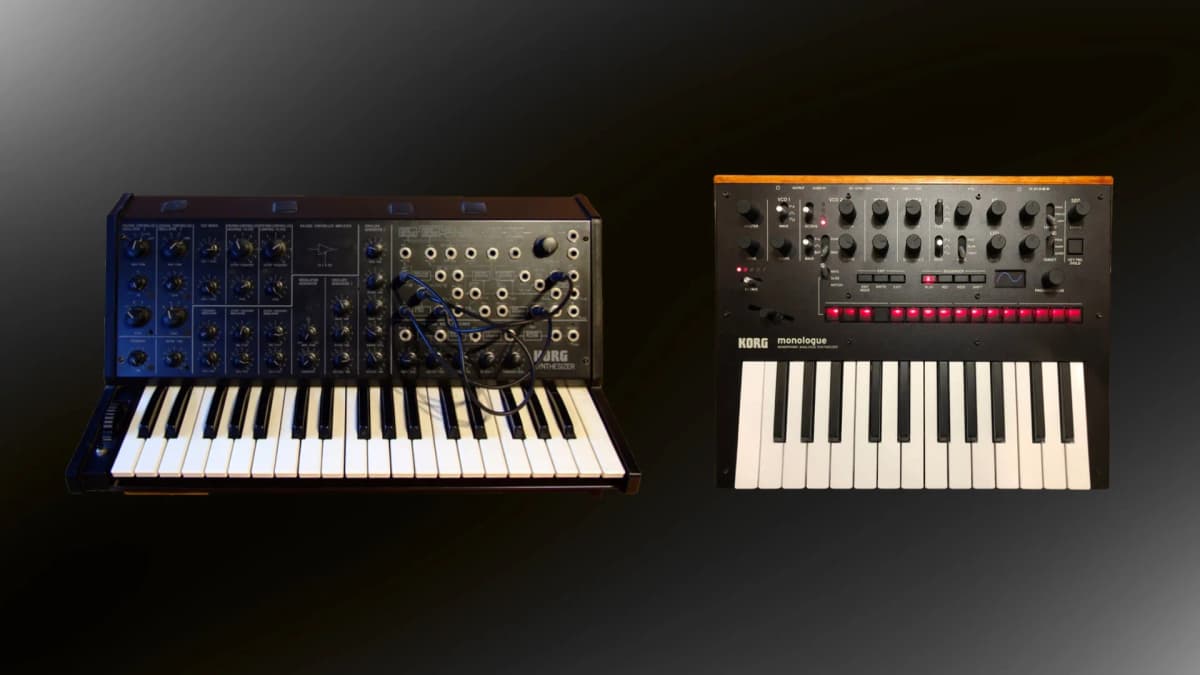
Analog synth basics: Korg MS-20 and monologue

The basics of analog synthesis come down to its most common form, which is subtractive: an oscillator produces a harmonically rich waveform, a filter removes part of that sound, and an amplifier shaped by an envelope controls how loud it is over time. Learn those three stages and the modulators that move them, and you can understand almost any analog synth panel. This guide walks through each block, then gives you three first patches to try.

Table of Contents

A short history

Robert Moog showed his first modular synthesizer prototype at the Audio Engineering Society convention in 1964, and he popularized the one volt per octave control standard that most synths still use. On the American west coast, Don Buchla released his first modular system in 1965, with an approach that leaned toward complex waveforms and less toward keyboards and filters. These early modulars were large, expensive and patched entirely with cables.

The Minimoog Model D, released in 1970, changed that. It put three oscillators, a 24 dB per octave filter and an amplifier behind one panel with a keyboard, and wired them together internally so no cables were needed. Its oscillator, filter, amplifier signal path became the template for most synthesizers that followed. You can read more in our Minimoog Model D profile. ARP took a middle path with the 2600 in 1971, a semi-modular instrument with default internal connections that you could override with cables. That idea of a playable default with optional patching is still at the center of many beginner synths today.

The basics of analog synthesis: the signal path

Think of a subtractive synth as two kinds of parts. Audio parts make and shape the sound: oscillators, mixer, filter and amplifier. Control parts move those audio parts over time: envelopes, LFOs, the keyboard and the modulation wheel. Nearly every knob on the panel either sets a value on an audio part or sets how strongly a control part moves it.

The oscillator (VCO) in an analog synth

The voltage-controlled oscillator generates the raw tone. Its pitch follows the keyboard, and its waveform decides which harmonics are present before the filter does its work.

  • Sawtooth: bright and buzzy, containing all harmonics. The default choice for basses, brass and strings.
  • Square: hollow and woody, containing only odd harmonics. Think clarinet-like leads and classic video game tones.
  • Pulse: a square wave with an uneven cycle. Narrow pulses sound thin and nasal.
  • Triangle: soft, with only weak odd harmonics. Good for flutes and gentle sub tones.
  • Sine: a pure tone with no harmonics. Useful for sub bass and as a modulation source.

Pulse width modulation (PWM) means sweeping the width of the pulse wave over time, usually with an LFO. The result is a moving, chorus-like shimmer that is central to classic string and pad sounds.

Two oscillators slightly detuned against each other create a thicker, beating sound. Setting one oscillator an octave or a fifth away gives you instant harmonic layering.

The mixer and noise

The mixer sets the level of each oscillator before the filter. Most synths also add a noise generator, which produces a hiss containing all frequencies at once. Noise is used for percussion, wind effects and breath on leads. Pushing mixer levels high on some synths overdrives the filter for extra grit.

The filter (VCF) in an analog synth

The voltage-controlled filter is where subtractive synthesis gets its name. It removes frequencies from the oscillator signal.

  • Cutoff sets the frequency where the filter starts working. On a low-pass filter, lowering the cutoff makes the sound darker.
  • Resonance (also called emphasis or Q) boosts the frequencies right at the cutoff point. Moderate settings add a vocal, squelchy quality; high settings can make the filter whistle or self-oscillate into a sine tone of its own.
  • Slope describes how steeply frequencies above the cutoff are reduced. A 12 dB per octave (two-pole) filter is gentler and lets more brightness through; a 24 dB per octave (four-pole) filter is steeper and rounder. The Minimoog used a four-pole design.

Filter types describe which part of the spectrum passes through. Low-pass keeps the lows and removes highs, and is by far the most common. High-pass removes lows, useful for thinning a pad so it does not clash with the bass. Band-pass keeps a range around the cutoff and removes both extremes, producing telephone-like or nasal tones. Some synths offer a notch mode, which removes a narrow band.

The amplifier (VCA) in an analog synth

The voltage-controlled amplifier controls loudness. Usually an envelope controls it, turning the sound up when you press a key and down when you let go.

Envelopes (ADSR) in an analog synth

An envelope generator produces a shape over time each time a note is played. The most common type has four stages.

  • Attack: how long it takes to rise from zero to full level after the key is pressed.
  • Decay: how long it takes to fall from full level to the sustain level.
  • Sustain: the level held for as long as the key is down. This is a level, not a time.
  • Release: how long it takes to fade to zero after the key is released.

Most synths have at least two envelopes, one for the amplifier and one for the filter. A plucked bass might have zero attack, a short decay, low sustain and short release. A pad might have slow attack and long release. Sending an envelope to the filter cutoff, with an amount knob controlling how far it opens, is the single most important move in subtractive programming.

The LFO in an analog synth

A low-frequency oscillator runs below the range of hearing, usually from a few cycles per minute up to about 20 times per second. Instead of being heard directly, it moves other parameters. Sent to pitch, it produces vibrato. Sent to the amplifier, tremolo. Sent to the filter cutoff, a rhythmic wah. Sent to pulse width, the PWM shimmer described above.

Performance and tone-shaping controls

Keyboard tracking on an analog synth

Keyboard tracking makes the filter cutoff follow the note you play. Without it, high notes sound dull because the cutoff stays put while the pitch rises. With full tracking, the tone stays consistent across the keyboard. With resonance at maximum and full tracking, a self-oscillating filter can even be played in tune.

Glide on an analog synth

Glide, or portamento, makes the pitch slide smoothly from one note to the next. Short glide times are a staple of acid basslines and expressive leads.

Oscillator sync on an analog synth

With hard sync, one oscillator (the follower) is forced to restart its cycle each time the other (the leader) restarts. Sweeping the follower’s pitch then changes the timbre rather than the note, producing the tearing, vocal lead sound heard on many 1980s records.

Cross-modulation and FM on an analog synth

Cross-modulation means using one oscillator to modulate the pitch of another at audio rates. This is frequency modulation (FM), and it creates new sidebands that range from bell-like tones to clanging, metallic noise.

Ring modulation on an analog synth

A ring modulator multiplies two signals and outputs their sum and difference frequencies while removing the originals. The results are inharmonic: bells, gongs and robotic tones.

Voltage control, CV and gate

In analog synths, parameters are controlled by voltages. A control voltage (CV) carries values such as pitch or cutoff, and a gate signal says when a key is held down. The most common pitch standard is one volt per octave: raising the pitch CV by one volt raises the note by one octave. Some older instruments, including the Korg MS-20 and many Yamaha synths, used a Hz per volt standard instead, and some Buchla instruments used 1.2 volts per octave. These are not compatible without conversion, which matters if you connect vintage gear or recreations such as the Behringer K-2; see our K-2 vs MS-20 comparison. Today, most synths also accept MIDI and convert it to internal control signals.

Monophonic, paraphonic and polyphonic

  • Monophonic synths play one note at a time. Most classic bass and lead synths, from the Minimoog onward, are monophonic.
  • Paraphonic synths can play several pitches at once, but the notes share a filter, envelope or amplifier. A chord swells and fades as one, and a new note can retrigger the envelope for all held notes. The Moog Matriarch is a well-known modern paraphonic analog; see our Matriarch profile.
  • Polyphonic synths give each voice its own complete signal path, so every note in a chord is shaped independently. Analog polysynths such as the Prophet-5 need a full set of circuits per voice, which is why they cost more. Our Prophet-5 article covers the classic example.

Semi-modular patching

A semi-modular synth is wired internally so it makes sound with no cables, like a Minimoog, but it also has a patch bay that lets you override those connections, like an ARP 2600. These default connections are called normalled connections. Plugging a cable into an input breaks the default and replaces it with your new source.

This makes semi-modulars excellent teachers: start from the default sound, then patch an LFO to the filter or noise to the cutoff and hear the result immediately. The Moog Grandmother is a good illustration of this approach; see our Grandmother profile.

Your first patch

Start each patch from a neutral setting: one oscillator on, filter fully open, resonance at zero, envelope amounts at zero, LFO off. If your synth has an initialize function, use it.

  1. A basic bass: Select a sawtooth on oscillator 1 and set it one octave down. Add oscillator 2 as a square wave at the same octave, slightly detuned. Set the low-pass filter to 24 dB if you have the choice, with cutoff around a quarter open and a little resonance. Set the filter envelope to zero attack, short decay, zero sustain, short release, and turn up the filter envelope amount until each note has a clear pluck. Set the amp envelope to zero attack, full sustain and short release. Play low notes and adjust decay to taste.
  2. A warm pad: Use two sawtooth oscillators detuned by a few cents, or one pulse wave with an LFO slowly modulating its width. Set the cutoff around halfway with low resonance. Give the amp envelope a slow attack of one to two seconds, full sustain and a long release. Give the filter envelope a slow attack as well, with a modest amount, so the sound brightens as it swells. On a polyphonic synth, play chords; on a mono, hold single notes and use glide.
  3. A simple lead: Start with a sawtooth or square wave at normal pitch. Set the cutoff fairly high with moderate resonance. Use a fast attack, medium decay, high sustain and medium release on the amp envelope. Route an LFO to pitch at a gentle depth and about five or six cycles per second, then bring it in with the modulation wheel for vibrato. Add a short glide time. For a more aggressive tone, try oscillator sync and sweep the follower oscillator’s pitch with the filter envelope.

After each patch, change one thing at a time and listen. Most learning in synthesis comes from that single habit.

Affordable analog synths to learn on

These were on sale new as of October 2026. Prices vary by region and retailer, so treat them as approximate.

  • Behringer Crave: a small semi-modular desktop mono with a 3340-type VCO, a 24 dB ladder-style filter, a patch bay and a 32-step sequencer, typically under $200. A cheap way to learn patching, though it needs a MIDI keyboard to play.
  • Behringer Model D: a low-cost analog recreation of the Minimoog layout, at roughly $190 to $250. Learning on it teaches you the classic normalled architecture directly.
  • Korg monologue: a monophonic analog synth with a keyboard, sequencer and patch memory, at around $250 to $400 depending on retailer.
  • Novation Bass Station II: a two-oscillator analog mono with a sub oscillator, two filter types, patch memory and a full-size keyboard, at around $400 to $600. Our Bass Station II profile covers it in depth.
  • Moog Messenger: the most expensive option here; it launched at $899 and US retailers listed it around $699 in October 2026. It has two VCOs, a sub oscillator, wavefolders, a multimode ladder filter, two loopable envelopes and six CV patch points. See our Messenger profile.

If you want polyphony from the start, the four-voice Korg minilogue is a common choice; our minilogue article explains what it can do. Hybrid instruments such as the Arturia MicroFreak use digital oscillators with an analog filter; they teach the same filter and envelope concepts, but are not fully analog.

Free tools to practice with

  • Surge XT: a free, open-source hybrid synth for Windows, macOS and Linux, available as a plugin and standalone app. Its classic oscillator mode and multiple filter types are enough to practice every concept in this guide.
  • VCV Rack 2 Free: a free, open-source virtual modular environment that runs as a standalone application. It is ideal for learning CV, gate and patching, since every connection is a visible cable. The paid Pro edition adds plugin use inside a DAW.
  • TAL-NoiseMaker: a free virtual analog plugin with a simple layout that maps closely to the blocks described above.

Once oscillator, filter, amplifier, envelope and LFO make sense together, every other analog synth is a variation on the same plan.

Related articles

Sources

Image credits: Korg MS-20 photo by Zinnmann, Wikimedia Commons, CC BY-SA 3.0; Korg monologue photo by medicalfools / David Chancey, Wikimedia Commons, CC BY-SA 4.0. Photos were cropped, cut out and placed on a gradient background for the featured image.

Bernardo de Azevedo
Written by
Bernardo de AzevedoFounder & Editor

His connection with music began at age 6, in the 1980s, when his father introduced him to Jean-Michel Jarre's Rendez-Vous on vinyl. He works professionally in the legal field, while synthesizers became his space for abstraction and creative exploration. Founder of The Synth Source.