

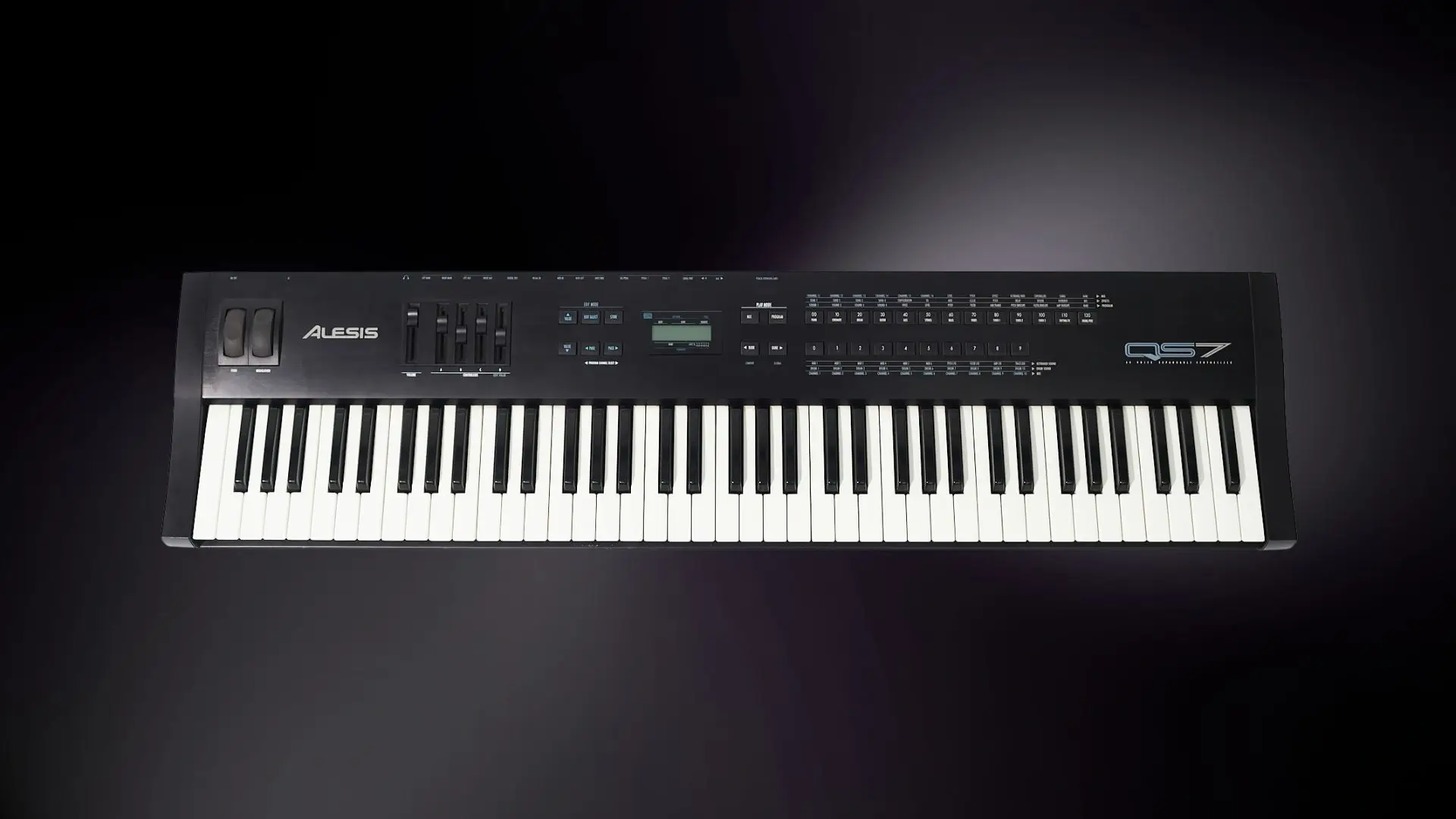
The Alesis QS7 is a 76-key, 64-voice, sample-based digital synthesizer introduced in 1996 as part of Alesis’ QS family. It took the company’s QuadraSynth-derived approach—large ROM-based sound libraries, multitimbral sequencing power, deep modulation, onboard effects, and ADAT-friendly studio integration—and placed it in a stage-oriented format with a semi-weighted keyboard, aftertouch, four assignable sliders, two PCMCIA card slots, and a broad set of acoustic, orchestral, electronic, and General MIDI sounds. It was not a knob-per-function synthesizer or a romantic analog machine. Its importance lies elsewhere: it represents the mid-1990s moment when the synthesizer, the ROMpler, the MIDI controller, and the project-studio sound module began to collapse into one practical instrument.
Table of Contents
Alesis QS7 sound and character
The Alesis QS7 sounds like a serious 1990s digital performance synthesizer: polished, wide, somewhat glossy, and more comfortable with layered musical usefulness than with raw analog instability. Its identity comes from 16-bit linear sample ROM, 64-voice polyphony, four-sound program construction, and effects derived from Alesis’ established digital processing vocabulary.
Its strongest territory is broad rather than narrow. Pianos, organs, strings, brass, woodwinds, drums, percussion, loops, vintage synth textures, and atmospheric pads are all part of the instrument’s intended language. The QS7 was built for musicians who needed one keyboard to cover many roles: stage piano, pad machine, MIDI master keyboard, multitimbral sequencing module, and digital synth texture source.
The sonic character is not especially raw or tactile by modern analog standards. Its filter is a sweepable low-pass design, but the Alesis QS7’s personality is less about resonant filter drama and more about sample choice, layering, modulation routing, and effects. In practice, this makes it better at finished, mix-ready textures than at bare oscillator experimentation. Pads can feel spacious, organs can benefit from rotary-style processing, orchestral layers can become large quickly, and synth textures often carry that unmistakably mid-1990s sheen: bright, detailed, sometimes glassy, and clearly designed for records, stage rigs, and MIDI arrangements rather than boutique sound-design minimalism.
The Alesis effects architecture matters to the sound. The Alesis QS7 was not merely a keyboard with reverb added at the end. Its four-bus effects system gave players a way to build complex patches and mixes with reverb, delay, chorus, rotary speaker simulation, distortion, and related processing as part of the instrument’s identity. That heritage explains why the Alesis QS7 often feels more spacious and produced than its front-panel simplicity might suggest.
Features and architecture
- Manufacturer: Alesis.
- Year introduced: 1996.
- Production years: the exact end of original QS7 production is not confidently documented; the model was introduced in 1996 and was later followed by the QS7.1 generation in 1999.
- Synthesis type: sample-based digital synthesis, described by Alesis as QS Composite Synthesis.
- Category: 76-key digital synthesizer, ROMpler, multitimbral performance keyboard, and MIDI master controller.
- Polyphony: 64 voices, with practical polyphony reduced when programs use multiple layered sounds.
- Original price: $1,599 list price.
- Current market price: generally in the low-to-mid used market, often around the $200–$360 range depending on condition, location, shipping, and whether cards or accessories are included.
- Oscillators / sound source: 16-bit linear 48 kHz sample ROM; 16 MB onboard, expandable to 32 MB through two PCMCIA ROM/RAM card slots.
- Program structure: up to four sounds per program, with sounds layerable, splittable, overlappable, and editable.
- Filter: sweepable low-pass filter per voice.
- LFOs: dedicated pitch, filter, and amp LFO functions.
- Envelopes: three independent envelope generators per Program Sound, assigned to pitch, filter, and amplitude.
- Modulation system: QS Modulation Matrix with six general-purpose matrix modulation routes, plus performance control from wheels, aftertouch, pedals, and assignable sliders.
- Sequencer / arpeggiator: no conventional onboard sequencer or arpeggiator; can play Standard MIDI File sequences from compatible PCMCIA cards.
- Effects: onboard multi-effects system based on Alesis’ QuadraVerb/Q2 lineage, using four discrete effects busses with reverb, delay, chorus, rotary speaker simulation, distortion, and related processing.
- Memory: 512 preset programs, 128 user programs, 400 preset mixes, and 100 user mixes, expandable via PCMCIA cards.
- Keyboard: 76-note semi-weighted synth-action keyboard with velocity and aftertouch sensitivity.
- Inputs / outputs: four independent 1/4-inch audio outputs, headphone output, sustain pedal input, two assignable pedal inputs, ADAT optical digital output, and 48 kHz clock input.
- MIDI / USB: MIDI In, Out, and Thru; serial Mac/PC connection; USB was not part of the original QS7 specification.
- Display: front-panel LCD used for Program, Mix, Global, and Edit navigation.
- Dimensions / weight: 44 1/4 inches wide, 11 inches deep, and 3 1/4 inches high; a confidently verified original weight figure was not found.
- Power: AC power via supplied IEC-style cable, configured for the voltage of the destination market.
Strengths
- The QS7 offers a unusually practical middle ground between a 61-key synth and a full 88-key weighted workstation. Its 76-note range gives players more room for splits, layers, piano parts, and orchestral voicings without the bulk of a hammer-action board.
- Its 64-voice polyphony and 16-part multitimbral structure made it useful for MIDI sequencing at a time when many project studios depended on hardware sound sources rather than software instruments.
- The sound library is broad enough to cover stage and studio fundamentals: piano, organ, strings, brass, winds, percussion, pads, synth leads, loops, and General MIDI material. That breadth is the main reason the Alesis QS7 remained useful long after its release.
- The four assignable sliders, aftertouch, pedal inputs, and modulation matrix make the Alesis QS7 more expressive than a preset-only ROMpler. It rewards players who take the time to program performance control into patches.
- The two PCMCIA slots are central to the instrument’s identity. They allow expansion through QCards or RAM cards and make the Alesis QS7 feel more open-ended than many fixed-ROM digital keyboards of its period.
- The ADAT optical output is historically important. It links the QS7 directly to Alesis’ recording ecosystem and reflects the company’s broader project-studio philosophy.
- The effects are not an afterthought. Alesis’ digital effects background gives the Alesis QS7 a produced, spatial sound that fits especially well with pads, organs, layered textures, and multitimbral arrangements.
Limitations
- The interface is menu-driven and can be tedious for deep editing. The Alesis QS7 is powerful under the surface, but it does not invite immediate hands-on synthesis in the way a knob-heavy analog or virtual-analog instrument does.
- The display is small for the depth of the architecture. Editing programs, effects, modulation, and multitimbral mixes requires patience.
- It has no conventional onboard sequencer and no arpeggiator. Its sequence playback from PCMCIA cards is useful, but it is not the same as a self-contained workstation sequencer.
- Polyphony can disappear quickly when sounds are heavily layered. A four-sound program can reduce practical polyphony significantly, especially in dense Mix setups.
- The filter is useful for shaping samples but should not be mistaken for the centerpiece of an analog-style subtractive synth. The Alesis QS7’s strengths are layering, samples, modulation, and effects, not resonant analog behavior.
- Some of the acoustic sounds inevitably carry their period. They can be musically useful, but they do not compete with modern multi-gigabyte software libraries on realism.
- The PCMCIA expansion system is historically interesting but less convenient today. Compatible cards, QCards, and reliable transfer workflows can require patience.
- Market listings sometimes confuse QS7, QS7.1, QS8, and related QS-family models, so buyers must check the exact model, key count, outputs, card slots, condition, and included accessories carefully.
Historical context
The QS7 appeared at a specific point in Alesis history. The company had built its reputation on affordable digital studio technology: effects processors, drum machines, and especially ADAT, which helped bring digital multitrack recording into project studios. By the time the Alesis QS7 arrived in 1996, Alesis was not approaching synthesizers as a traditional analog keyboard manufacturer. It was approaching them as a digital studio company.
That matters. The Alesis QS7 was not designed as a nostalgic instrument. It was designed for the world of MIDI sequencing, hardware multitimbrality, sample ROM, digital effects, and direct integration with recording systems. Its ADAT optical output was not a decorative feature. It expressed Alesis’ larger ecosystem: keyboard, effects, digital audio, and project-studio recording were meant to work together.
The QS7 also sits between the original QuadraSynth and the later QS7.1. The original QuadraSynth, introduced in 1993, had already established Alesis as a serious synthesizer maker, combining 64 voices, 16 MB of sample ROM, multitimbral capability, and ADAT digital output. The Alesis QS7 refined that approach into a more focused 76-key instrument with expanded control and card capability. The later QS7.1 improved the interface with a larger display and additional access buttons, but the original QS7 remains the point where the format became clearly stage-and-studio oriented.
In the broader market, the Alesis QS7 belongs to the great ROMpler age. The key question was no longer whether a synthesizer could imitate analog circuits, but whether one keyboard could supply the practical vocabulary of an entire production: piano, strings, brass, drums, pads, basses, synth textures, and multitimbral MIDI playback. The Alesis QS7 answered that question in an Alesis way: affordable by professional standards, expandable, studio-connected, and effects-rich.