

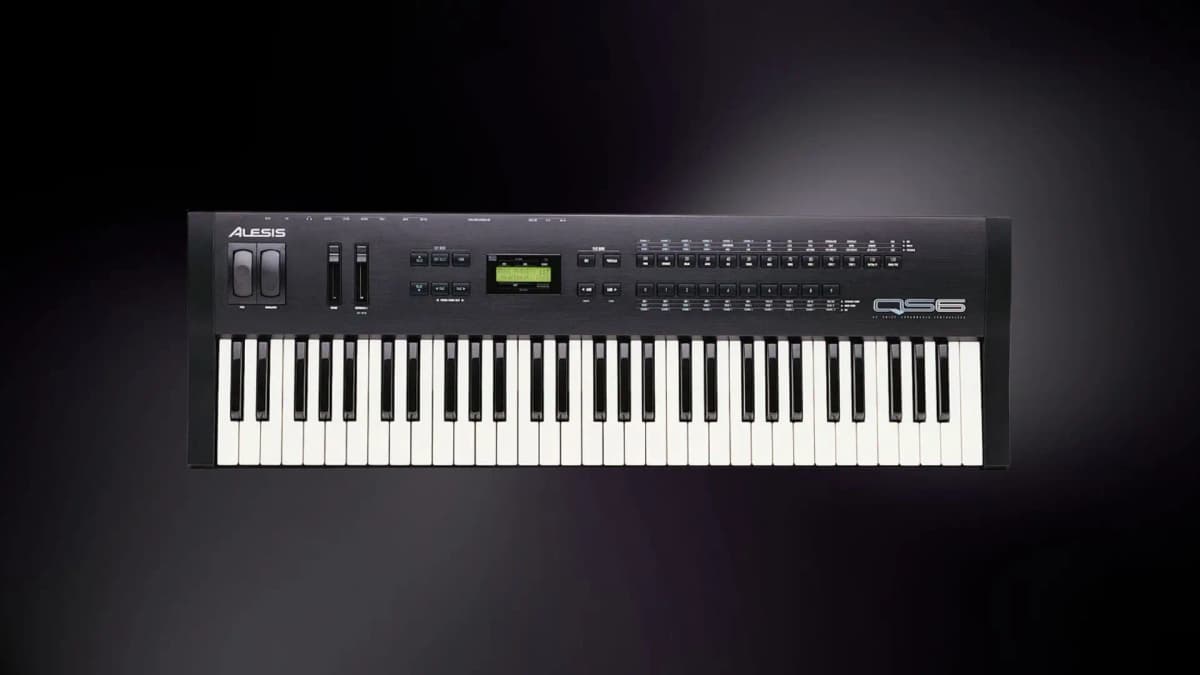
The Alesis QS6 is a 61-key, 64-voice digital sample-playback synthesizer introduced in 1996 as the more affordable five-octave member of the QS family. Built around 8 MB of 48 kHz linear sample ROM, PCMCIA expansion, 16-part multitimbrality, General MIDI compatibility, and an effects section derived from Alesis’ studio-processing lineage, it translated the larger QuadraSynth concept into a practical performance keyboard for players who needed breadth, portability, and MIDI-era flexibility more than analog-style immediacy. Its importance lies not in radical synthesis innovation, but in how effectively it condensed the mid-1990s rompler workstation idea into a comparatively accessible instrument.
Table of Contents
Alesis QS6 sound and character
The Alesis QS6 sounds unmistakably like a mid-1990s digital performance synthesizer: clean, broad, polished, and strongly shaped by its internal sample set and effects. Its factory palette covers stereo pianos, organs, strings, brass, woodwinds, guitars, drums, percussion, classic synth textures, General MIDI sounds, and rhythmic or sonic loops. That range tells you a lot about its intended role. This was not designed as a narrow specialist instrument; it was built to sit in a live rig, respond to a sequencer, cover many parts in one arrangement, and deliver finished-sounding patches without requiring a rack of external processors.
Its strongest identity comes from the combination of sample playback, layering, and effects. A single Program can be constructed from multiple sound layers, and the QS modulation system allows performance sources such as velocity, aftertouch, wheels, pedals, and MIDI controllers to animate those layers. The result is often more expressive than the term “rompler” suggests, especially in pads, hybrid digital textures, layered keyboards, evolving strings, and atmospheric synthetic sounds.
The Alesis QS6 is less convincing when judged as a substitute for a resonant analog synthesizer. Its low-pass filtering is useful for shaping samples, but the absence of resonant filter behavior limits classic sweeps, acid-style lines, and aggressive subtractive animation. In practice, the Alesis QS6 does not get its character from raw oscillator instability or filter drama. It gets it from sample selection, velocity response, layering, aftertouch, multitimbral organization, and the spacious, sometimes glossy quality of Alesis effects. That makes it more of a flexible digital arranger’s instrument than a hands-on tone-sculpting machine.
Features and architecture
- Manufacturer: Alesis.
- Year introduced / date produced: 1996.
- Production years: documented as a 1996 QS model; it was succeeded in the late 1990s by the QS6.1, which expanded ROM, controls, display, and card capability.
- Synthesis type: digital sample-playback synthesis with subtractive-style sound shaping.
- Category: 61-key multitimbral performance synthesizer, rompler, and MIDI master keyboard.
- Polyphony: 64 voices.
- Original price: listed at $1,099.
- Current market price: commonly seen in the used market around the low-to-mid hundreds of US dollars, with condition, display health, power supply, card accessories, and local availability affecting price.
- Oscillators / sound sources: 48 kHz linear samples from 8 MB internal ROM, expandable to 16 MB using PCMCIA ROM or RAM cards.
- Filter: digital low-pass filtering; not a resonant filter design.
- LFOs: pitch LFO, filter LFO, and amp LFO available within the Program architecture.
- Envelopes: pitch envelope, filter envelope, and amp envelope.
- Modulation system: QS modulation matrix with assignable sources including keyboard performance controls, MIDI controllers, aftertouch, pedals, LFOs, envelopes, and tracking functions.
- Sequencer / arpeggiator: no conventional onboard sequencer or arpeggiator; Standard MIDI Files could be played from compatible PCMCIA cards using the Sound Bridge workflow.
- Effects: onboard multi-effects with four effect busses, based on Alesis’ QuadraVerb 2 / Q-series processing lineage, including reverb, delay, modulation, rotary-style, distortion, and related treatments.
- Memory: 512 preset Programs, 128 user Programs, 400 preset Mixes, and 100 user Mixes, with expansion through PCMCIA cards.
- Keyboard: 61-note synth-action keyboard with velocity and aftertouch.
- Inputs / outputs: main left/right audio outputs, stereo headphone output, MIDI In, switchable MIDI Out/Thru, computer serial interface for Mac or PC, PCMCIA card slot, and pedal inputs.
- MIDI / USB: 5-pin DIN MIDI and serial computer connection; no USB.
- Display: small LCD display used for program, mix, and parameter navigation.
- Dimensions / weight: not included here because the original Alesis QS6 dimensions and weight could not be confidently verified from the reliable QS6-specific sources used for this article.
- Power: external power adapter / mains transformer, with regional voltage depending on the market in which the unit was sold.
Strengths
- The Alesis QS6 offers unusually strong polyphony for its period and price class, giving players 64 voices at a time when dense sequencing, layered keyboard parts, and multitimbral arrangements could quickly expose weaker instruments.
- Its 16-part multitimbrality makes it useful as a self-contained MIDI sound source, not merely as a single-patch keyboard. In Mix mode, it can function as a compact arrangement engine for external sequencers or live splits and layers.
- The internal effects are central to the instrument’s appeal. Alesis was already known for affordable digital effects, and the Alesis QS6 benefits from that heritage by making many patches feel more complete and mix-ready than their raw samples alone would suggest.
- PCMCIA expansion and Sound Bridge support gave the QS6 an unusually open-ended quality for a budget-conscious rompler. The ability to use expansion cards, user samples, and Standard MIDI File playback made it more flexible than many fixed-ROM competitors.
- The 61-key format with velocity and aftertouch gives it real performance value. Aftertouch matters because many QS patches respond musically to pressure, helping compensate for the limited number of front-panel controls.
- Its sound library covers the practical needs of mid-1990s stage and studio work: pianos, organs, strings, brass, drums, pads, synth textures, loops, and GM-compatible material.
- The Alesis QS6 occupies a useful middle ground between preset convenience and deeper programming. It can be used as a straightforward bread-and-butter keyboard, but its modulation and layering system allow more sophisticated programming for users willing to work through the menu structure.
Limitations
- The lack of resonant filtering is the main synthesis limitation. It can shape sample brightness, but it does not behave like an analog-style resonant low-pass filter, which limits expressive filter sweeps and more aggressive electronic sound design.
- The original Alesis QS6 has only 8 MB of internal sample ROM, half of what the later QS6.1 offered. That does not make it unusable, but it does place it behind its own successor in acoustic realism and factory-sound breadth.
- Deep editing is menu-driven and display-dependent. The small LCD and page-based navigation make serious programming slower than on instruments with larger screens or more direct controls.
- Physical real-time control is limited compared with later QS revisions. The QS6.1 expanded the control surface, making the original Alesis QS6 feel more restrained for live tweaking.
- There is no conventional onboard sequencer or arpeggiator. Although MIDI file playback from card media was a useful workaround, the Alesis QS6 should not be mistaken for a full workstation in the later Triton/Fantom/Motif sense.
- The external power supply is a practical weakness today. Missing, damaged, or incorrect power adapters can complicate used purchases, and proprietary-style connections are less convenient than standard IEC power.
- Its broad sound set is historically useful, but not all patches age equally. Some acoustic sounds inevitably reveal their 1990s ROM limitations when compared with modern sample libraries or contemporary stage keyboards.
- The later QS6.1 and QS6.2 can be more attractive to buyers who want the QS engine with expanded ROM, improved display, more controls, and more refined hardware.
Historical context
The Alesis QS6 arrived after Alesis had established the QuadraSynth concept: a 64-voice, sample-based, multitimbral digital synthesizer built around broad ROM content, layered programs, MIDI sequencing, and onboard effects. In the 1990s, that formula mattered because the center of keyboard culture had shifted. Many musicians needed one instrument that could cover entire arrangements, communicate fluently with sequencers, and provide credible approximations of many instrument families without relying on expensive sampler setups.
Alesis’ strategic angle was affordability. The company had built much of its identity by bringing previously expensive studio technologies into lower price brackets, and the Alesis QS6 followed that pattern. Its list price placed it below many professional keyboard flagships while still offering 64 voices, aftertouch, 16-part operation, expansion, and a serious effects engine. That made it a practical instrument for home studios, small project rooms, working bands, church players, and MIDI composers who needed range more than prestige.
The Alesis QS6 also sat at an important transitional point between hardware-centric and computer-assisted workflows. Its serial computer connection, Sound Bridge software, and PCMCIA card support reflected a moment before USB became standard, when manufacturers were beginning to treat the computer not only as a sequencer but also as a librarian, sample-transfer tool, and extension of the instrument’s memory system.