

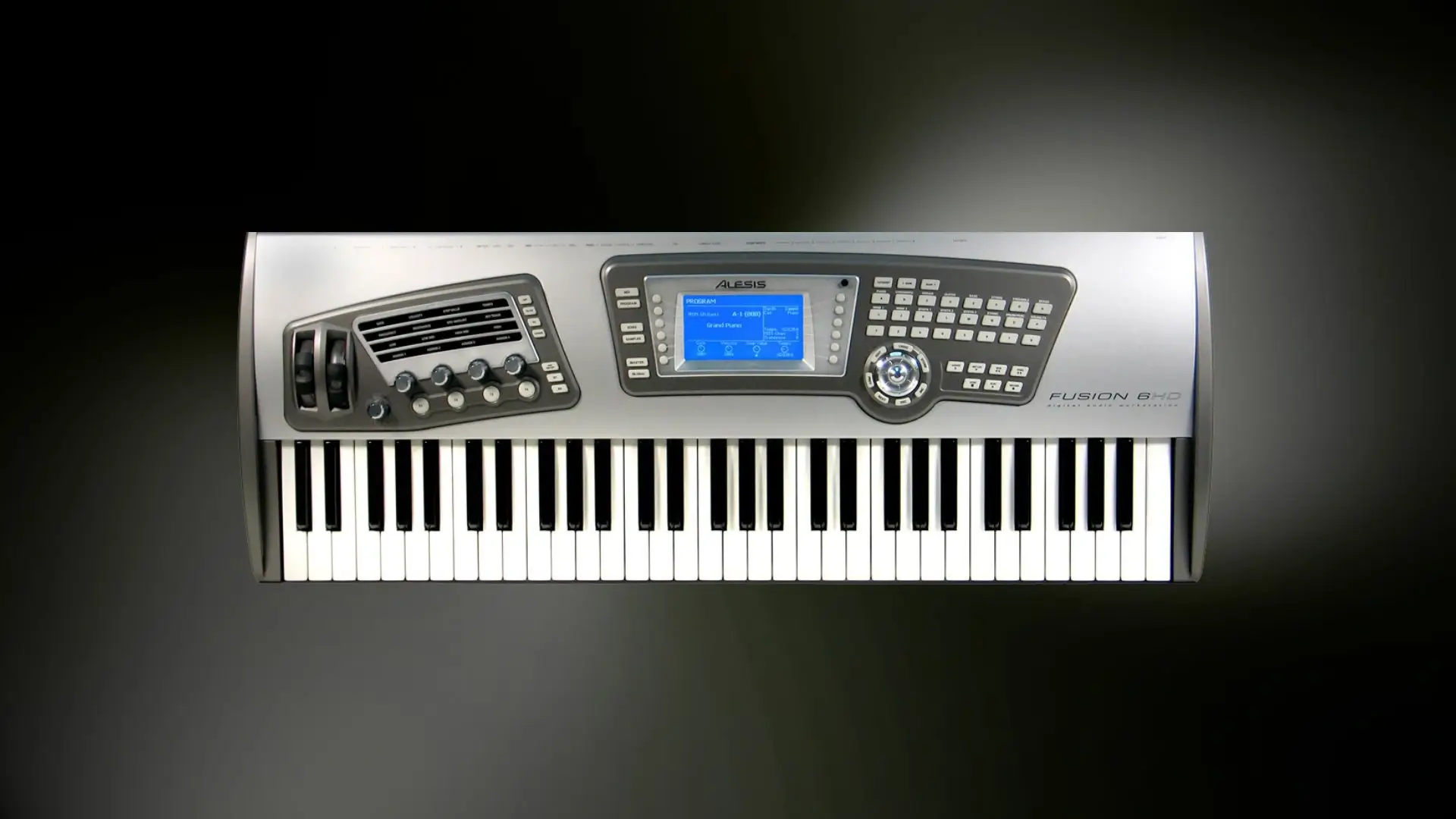
The Alesis Fusion 6HD is a 61-key semi-weighted digital music-production workstation announced at Winter NAMM 2005. It combined sample playback, virtual analog synthesis, FM synthesis, physical modeling, user sampling, a 32-track MIDI sequencer, and an 8-track 24-bit hard-disk recorder built around an internal 40GB drive. At a glance, its importance lies less in any single feature than in the ambition of the whole design: Alesis tried to build a workstation that was not merely a preset machine, but a self-contained synthesis, sampling, sequencing, and recording environment.
Table of Contents
Alesis Fusion 6HD sound and character
The Alesis Fusion 6HD does not have one simple sonic identity. It is not a pure analog emulation instrument, not merely a ROMpler, and not just a sampling workstation. Its character comes from the friction between those roles. The sample-playback side gives it the expected workstation vocabulary: pianos, drums, strings, guitars, layered pads, and general-purpose keyboard sounds. The onboard grand piano was based on Q Up Arts’ “Holy Grail Piano,” which shows where Alesis wanted the Alesis Fusion 6HD to sit: not only as a programmer’s synth, but also as a stage and studio keyboard capable of conventional duties.
The more interesting side of the Alesis Fusion 6HD is its synthesis architecture. The virtual analog engine gives it access to subtractive basses, leads, pads, sweeps, and synthetic textures without requiring samples as the starting point. The analog-modeling section is not just a token inclusion: it offers up to three oscillators using basic waveforms and noise sources, with filter, envelope, LFO, and modulation routing. That gives the Fusion a more programmable character than many workstations whose synth identity depends mostly on filtering PCM waveforms.
The FM engine gives the Alesis Fusion 6HD a sharper and more glassy digital vocabulary. It is better suited to metallic keys, bells, electric-piano-like tones, synthetic percussion, animated harmonic motion, and colder digital textures than to warm analog imitation. The physical-modeling section, focused on wind and reed behavior, is narrower than the phrase “physical modeling” might suggest, but it adds another conceptual layer: the Fusion was trying to be a workstation of synthesis methods, not just a workstation of sounds.
In practice, the Alesis Fusion 6HD is strongest when treated as a hybrid sound-design machine. It can produce broad evolving pads, digital atmospheres, layered cinematic textures, synthetic basses, FM motion, sample-based performances, and odd acoustic-electronic hybrids. It is less convincing when judged only by the instant polish of its factory ROM sounds against the most established workstations of its era. Its personality is exploratory rather than luxurious: deep, flexible, sometimes uneven, and more rewarding for users willing to program than for players who want every preset to sound finished immediately.
Features and architecture
- Manufacturer: Alesis.
- Year introduced: Announced at Winter NAMM 2005.
- Production years: Commonly listed as 2005–2008; Alesis currently lists the Fusion 6HD as discontinued.
- Synthesis type: Digital multi-engine workstation with sample playback, virtual analog, FM synthesis, and physical modeling.
- Category: Music-production workstation / synthesizer workstation.
- Polyphony: Dynamic processor allocation; published retail specifications list up to 180 voices of sample playback, with available polyphony depending on engine type and program complexity.
- Original price and current market price: Period references report a U.S. MSRP of $2,399 for the Alesis Fusion 6HD, though Alesis’ current legacy page does not publish launch pricing. Current used-market signals are irregular, commonly clustering around the lower hundreds to roughly the $500–$700 range when units appear.
- Oscillators: Sample synthesis uses two oscillators; analog synthesis uses up to three oscillators with sawtooth, pulse, sine, noise, and external-input sources; FM synthesis uses six oscillators; drum synthesis and physical modeling use their own engine-specific structures.
- Filter: Variable digital filtering, including low-pass, high-pass, band-pass, band-stop, and band-boost types, with selectable steepness and resonance on most configurations.
- LFOs: Up to eight LFOs per program, assignable through the modulation system.
- Envelopes: Up to eight envelopes per program, assignable to volume, filter, pitch, and other modulatable parameters.
- Modulation system: Modulation matrix with up to 32 modulation routes per program, designed as a flexible routing system for connecting controllers, envelopes, LFOs, and destinations.
- Sequencer / arpeggiator: 32-track MIDI sequencer with 480 PPQ resolution; programmable arpeggiator with standard, phrase, and drum-machine playback.
- Effects: Published specifications list 20 reverbs, 10 chorus effects, 50 insert effects, and EQ processing.
- Memory: 64MB sampler RAM installed, expandable to 192MB; internal 40GB hard drive; CompactFlash support.
- Keyboard: 61-note semi-weighted keyboard with velocity response and aftertouch.
- Inputs / outputs: Stereo sampling inputs, headphone output, main stereo outputs, auxiliary stereo outputs, eight 1/4-inch recording inputs, S/PDIF output, optical ADAT output, sustain pedal input, footswitch input, expression pedal input, and external drive connection.
- MIDI / USB: MIDI In, Out, and Thru are provided. USB 2.0 is used for file transfer / mass-storage operation; the Fusion reference manual states that MIDI data over USB was not supported in the operating system version described there.
- Display: 240 x 128 backlit LCD.
- Dimensions / weight: Common retail specifications list the Alesis Fusion 6HD at 35-1/2 inches wide, 4 inches high, 14 inches deep, and 25 lb.
- Power: Internal universal switching power supply; published retail specifications list 50W power consumption.
Strengths
- The Alesis Fusion 6HD’s main strength is architectural ambition. Four synthesis methods, sampling, sequencing, hard-disk audio, effects, and storage were placed inside one keyboard at a time when many workstations still felt primarily like sample-playback instruments with sequencing attached.
- Its synthesis depth gives it a longer creative life than its factory presets alone suggest. The virtual analog and FM engines allow users to build sounds from synthesis principles rather than merely edit PCM-based patches.
- The modulation matrix is unusually important for a workstation. Up to 32 routes per program make the Fusion feel closer to a programmable synthesizer than to a preset-driven stage keyboard.
- The internal hard drive changes the practical logic of the Alesis Fusion 6HD. Programs, samples, songs, and user material can live inside the keyboard, making the Fusion less dependent on slow removable media than many older workstation workflows.
- The 61-key semi-weighted format makes the Alesis Fusion 6HD more manageable than the 88-key 8HD while retaining the same core engine. For players who want the Fusion architecture without the weight and footprint of the hammer-action version, the Alesis Fusion 6HD is the more practical model.
- The official availability of OS files and downloadable sound material gives the Alesis Fusion 6HD a stronger support afterlife than many discontinued workstations receive.
Limitations
- The Alesis Fusion 6HD’s greatest problem is not lack of features, but uneven immediacy. It is deep on paper, yet not every factory sound communicates that depth instantly.
- Its physical-modeling engine is narrower than the broad phrase may imply. The modeling side is oriented around wind and reed behavior rather than being a universal physical-modeling laboratory.
- USB integration is limited by modern standards. The reference manual states that USB MIDI was not supported in the operating system version described, which makes the Fusion feel older than later computer-integrated workstations.
- The hard-drive-based design is historically interesting but also a maintenance concern today. Any used unit should be checked for drive health, storage reliability, boot behavior, and the condition of its removable-media workflow.
- The interface is capable, but not modern. A 240 x 128 LCD and deep menu architecture require patience compared with large color touchscreens or software editors.
- Its market visibility is weaker than its specification sheet. The Fusion never became a universally recognized classic in the way some competing workstations did, which affects availability, documentation culture, and resale predictability.
Historical context
The Alesis Fusion 6HD appeared during a transitional moment in the workstation market. By the mid-2000s, keyboard workstations were expected to provide polished acoustic sounds, sequencing, performance setups, effects, sampling, and broad studio utility. Korg, Yamaha, and Roland had already built strong identities around the Triton, Motif, and Fantom lines. Against that backdrop, Alesis entered with a different argument: instead of competing only through a larger ROM soundset or a familiar workstation interface, the Fusion proposed a multi-engine production instrument.
That timing matters. The Fusion arrived when laptop-based music production was becoming increasingly practical, yet many players still wanted self-contained hardware. Alesis responded by combining two strands of its own identity: the company’s history in synthesizers and its history in recording technology. The result was a keyboard that tried to absorb the studio into the workstation rather than simply control it.