

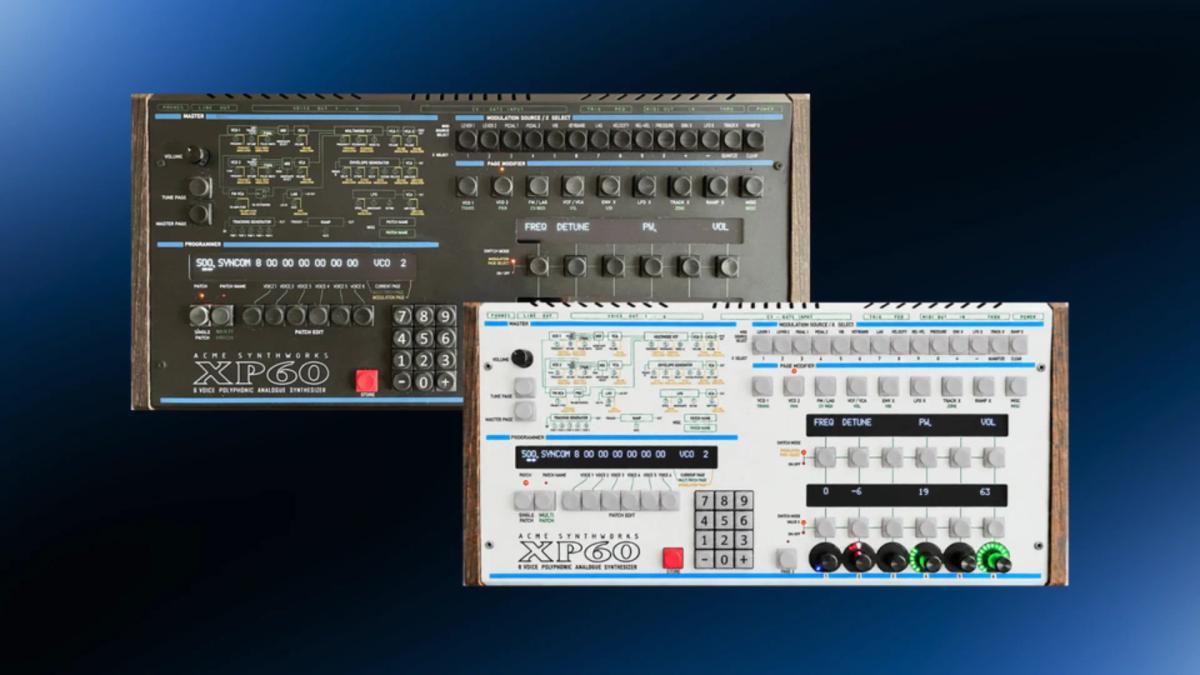
The ACME Synthworks XP60 is a six-voice analog polyphonic synthesizer that recreates the 1984 Oberheim Xpander in a smaller desktop enclosure. It is built in Germany by ACME Synthworks, the small company of developer and synth technician Markus Malik, who first showed the project in February 2025 and opened pre-orders in October 2026, with deliveries scheduled to begin in November 2026. Each voice pairs two analog oscillators built around replacements for the Curtis CEM3374 dual VCO with a 15-mode filter based on the AS3372 chip, while the original Oberheim firmware, running on a dual-processor design, handles the five envelopes, five LFOs and matrix modulation of every voice. Prices start at €2,699 with LCD displays, rising to €2,799 with OLED and €3,149 with VFD displays, including German VAT. The XP60 matters because the Xpander, which Vintage Synth Explorer counts among the most flexible non-modular analog synths, went out of production in 1988, and this project rebuilds its circuit and firmware instead of emulating them.
Table of Contents
ACME Synthworks XP60 sound and character
No official sound demo of the ACME Synthworks XP60 had been published when pre-orders opened, so the video above shows the original Oberheim Xpander that the XP60 recreates. That is a fair reference point, because the stated goal of the project is to reproduce the Xpander’s voice architecture, modulation logic and behavior as closely as possible. Early prototype reports in 2025 described voice cards built partly with original oscillator ICs and partly with clone chips, and, as Synthtopia and Gearnews reported, Malik’s blind comparisons revealed no audible difference between the two.
The core of the sound is a classic Oberheim voice: two oscillators with sawtooth, triangle and variable pulse waves, plus noise, feeding a filter and VCA in a fixed order. What sets the Xpander apart, and therefore the ACME Synthworks XP60, is the filter. Its 15 modes cover one- to four-pole low-pass, one- to three-pole high-pass, band-pass, notch and a three-pole phase-shift response, along with combined modes such as high-pass plus one-pole low-pass. Malik told Sonicstate that the circuit around the AS3372 filter chip was tuned to match the resonance behavior of the later Rev. D Xpanders, a detail aimed squarely at owners who know the original well.
Linear FM between the two oscillators is part of the recipe. David Fox, reviewing the Xpander for Electronic Soundmaker & Computer Music in October 1984, noted that this FM was nothing like a Yamaha DX7 but could produce metallic and harmonically rich tones, and he compared the Xpander’s LFO-on-LFO modulation to the Poly Mod section of Sequential’s Prophets. MATRIXSYNTH reported that Malik tried rebuilding the chip circuitry from discrete transistors, then abandoned that route because FM behavior and temperature stability were not good enough.
Modulation is where the instrument earns its reputation. Each voice has five DADSR envelopes, five LFOs with sampling options, four ramp generators, three tracking generators and a lag processor. Simon Lowther’s 1998 Sound On Sound retrospective described a software matrix of 27 sources and 47 destinations, with up to 20 connections per voice. Because the XP60 keeps the original firmware, these generators and the matrix should behave as they do on the 1980s unit. Sound On Sound also noted that envelope times and LFO rates are quantized, a trait that should carry over with the retained software.
ACME adds one optional departure from the original. A Turbo Mode runs the voice processor about 50% faster, which scales envelopes, LFOs and lag times accordingly, and switching it off returns the instrument to stock Xpander timing. Malik also described a refinement in how control voltages are shaped, so that very fast envelope stages keep a more natural exponential curve while programmed times stay the same. As an example patch, he described to Sonicstate a hard-edged bass built from two sawtooth oscillators with slow LFO pulse-width modulation, a slightly detuned triangle on the second oscillator and a three-pole low-pass filter with a little resonance.
The playing experience follows the original page-based concept. The ACME Synthworks XP60 has three displays, a smaller version of the Xpander’s front-panel flow chart, modern switches with 3D-printed caps modeled on the original Marquardt caps, and six encoders surrounded by RGB LED rings on the OLED version. There is no keyboard, so the XP60 is played from an external MIDI controller or from analog CV and gate sources, which the six per-voice CV and gate inputs make practical.
Features and architecture
- Manufacturer: ACME Synthworks (Germany), led by developer Markus Malik
- Year introduced: 2025 (project first reported February 2025); pre-orders opened October 2026
- Production years: 2026 to present; first deliveries scheduled for November 2026, in a small run of 50 units
- Synthesis type: Analog subtractive with linear FM; analog oscillators, filters and VCAs under digital control from the original Oberheim firmware
- Category: Desktop polyphonic analog synthesizer module (recreation of the Oberheim Xpander)
- Polyphony: 6 voices
- Multitimbrality: Six-part, following the original Xpander’s single and multi modes, according to Gearnews
- Original price: €2,699 (LCD), €2,799 (OLED) and €3,149 (VFD), including 19% German VAT, plus shipping; no US or UK price announced
- Current market price: Pre-order only; a 50% deposit reserves a unit and the balance is due before dispatch
- Oscillators: Two analog VCOs per voice (12 in total) based on the Curtis CEM3374 dual VCO design; sawtooth, triangle, pulse with PWM and noise; linear FM of VCO 1 by VCO 2
- Filter: One 15-mode analog filter per voice based on the AS3372 (a reissue of the CEM3372), tuned to match the resonance of Rev. D Xpanders; low-pass, high-pass, band-pass, notch and phase-shift modes
- LFO: Five per voice with multiple waveforms and a sampling function, as on the original
- Envelopes: Five DADSR envelopes per voice
- Modulation system: Oberheim matrix modulation from the original firmware, with ramp generators, tracking generators and a lag processor; optional Turbo Mode speeds up LFOs, lags and envelopes by about 50%
- Sequencer / arpeggiator: None
- Effects: None
- Memory: Not specified by the manufacturer; the original Xpander firmware it retains stores 100 single patches and 100 multi patches
- Keyboard: None
- Inputs / outputs: Stereo/mono line outputs, six individual voice outputs, CV and gate inputs for each voice, trigger and pedal inputs, headphone output with a dedicated amplifier and four gain settings
- MIDI / USB: MIDI In, Out and Thru on 5-pin DIN; no USB; compatible with the Xplorer SysEx editor for the Xpander; parameter control via SysEx rather than MIDI CC
- Display: Three displays, ordered as OLED, VFD or LCD; the OLED version adds six RGB LED encoder rings
- Dimensions / weight: 19-inch-wide desktop format, not intended for rack mounting; exact dimensions and weight not specified by the manufacturer
- Power: Not specified by the manufacturer
Strengths
- It rebuilds the Xpander rather than imitating it. The analog signal path, original processor layout and original firmware mean there is no emulation or FPGA layer between the player and the classic architecture.
- The filter is the real attraction. Fifteen analog modes per voice, tuned toward the later Rev. D resonance character, give it a wider choice of filter responses than a typical single-mode analog polysynth.
- Modulation depth is exceptional for a non-modular instrument. Five envelopes, five LFOs, ramp and tracking generators and a lag processor per voice cover ground that usually requires a modular system.
- The connections suit studio and modular use. Six individual outputs and six pairs of CV and gate inputs let each voice be processed, mixed or driven separately.
- Existing tools still work. Compatibility with the Xplorer SysEx editor gives owners a mature software interface for the deep page structure from day one.
- It is smaller and newer than the original. A compact enclosure, modern switches and encoders, a new headphone amplifier and a choice of displays address the size and aging parts of a 1980s unit.
Limitations
- Supply is very limited. The first allocation of 40 units was listed as sold out on ACME’s shop, with a further batch of 10 announced for December 2026.
- It is still expensive. Even the cheapest LCD version costs €2,699, and buyers outside the EU face import duties and taxes on top of the price and shipping.
- Independent reviews are scarce. Synth Anatomy reports a review of the ACME Synthworks XP60 in the German magazine SynMag, but no English-language hands-on reviews or official sound demos were available when pre-orders opened.
- There is no USB connection. All MIDI communication and editing run through 5-pin DIN, although Bonedo’s 2025 prototype report listed an isolated USB port among the planned connections.
- The original firmware brings its old habits. Parameter control works through SysEx rather than MIDI CC, and Sound On Sound described the Xpander’s page navigation and multi setup as slow work.
- The VFD option drops a feature. Malik told Sonicstate that the VFD version omits the LED encoder rings because of its higher power draw and heat.
Historical context
Tom Oberheim founded his company in 1969, first designing effects for Maestro, and by the late 1970s Oberheim was one of the defining American polysynth makers with the SEM, the Four Voice and the OB-X, OB-Xa and OB-8. The Xpander arrived in 1984; Sound On Sound dates its debut to that year’s NAMM show. It was a keyboardless, six-voice instrument with two VCOs, a 15-mode filter and software-generated envelopes and LFOs on each voice, all tied together by a modulation matrix. David Fox of Electronic Soundmaker & Computer Music found it closer to a new design than to a keyboardless version of an existing synth, and noted that at £3,950 it cost about as much as an OB-8. Wikipedia lists a US price of $3,995; Sound On Sound gives a lower UK launch figure that rose by 1986, so period prices vary between sources.