


The Access Virus TI Keyboard is a 61-key performance synthesizer introduced in 2005 as part of Access Music’s Virus TI generation, the line that pushed the long-running Virus concept furthest into the hybrid hardware-software age. Built around a dual-DSP virtual-analog engine but expanded with wavetable, HyperSaw, formant and graintable capabilities, it was designed not only as a powerful standalone synth, but as a hardware instrument meant to behave like a tightly integrated studio device. That ambition made it more than another late-period VA flagship: it became one of the clearest statements of what mid-2000s electronic musicians wanted from serious digital hardware.
Sound and character
The Virus TI Keyboard sounds big, polished, assertive, and deliberately controlled. Where some virtual-analog instruments aim for fragile vintage softness or raw instability, the TI tends toward density, width, focus, and impact. It excels at the kinds of sounds that need to occupy space with authority: supersaw stacks, trance leads, hard-edged basses, metallic sequences, glossy pads, animated textures, and highly sculpted digital hybrids that move well beyond simple analog emulation.
A large part of that identity comes from how much the engine can pile into a single patch without losing its sense of organization. The three-oscillator structure, sub-oscillator, noise source, wavetable and graintable options, and famously thick HyperSaw mode give it a naturally layered voice architecture. The filters add another crucial dimension. They are not there merely to soften or tame the oscillators; they are central to the instrument’s personality, helping it move from crisp and clinical to growling, saturated, or oddly vocal. The result is a synth that can sound sleek and expensive one moment, and sharp, abrasive, or almost industrial the next.
In practice, the TI Keyboard often feels less like a “vintage emulator” than like a complete electronic production instrument from the peak hardware era of trance, electro, industrial, soundtrack work, and polished club music. It can absolutely do warm pads and restrained subtractive work, but that is not why it became iconic. It became iconic because it could deliver size, detail, and motion at once. Even now, its sound still carries a particular kind of mid-2000s authority: high-definition, mix-ready, and unmistakably electronic.
Features and architecture
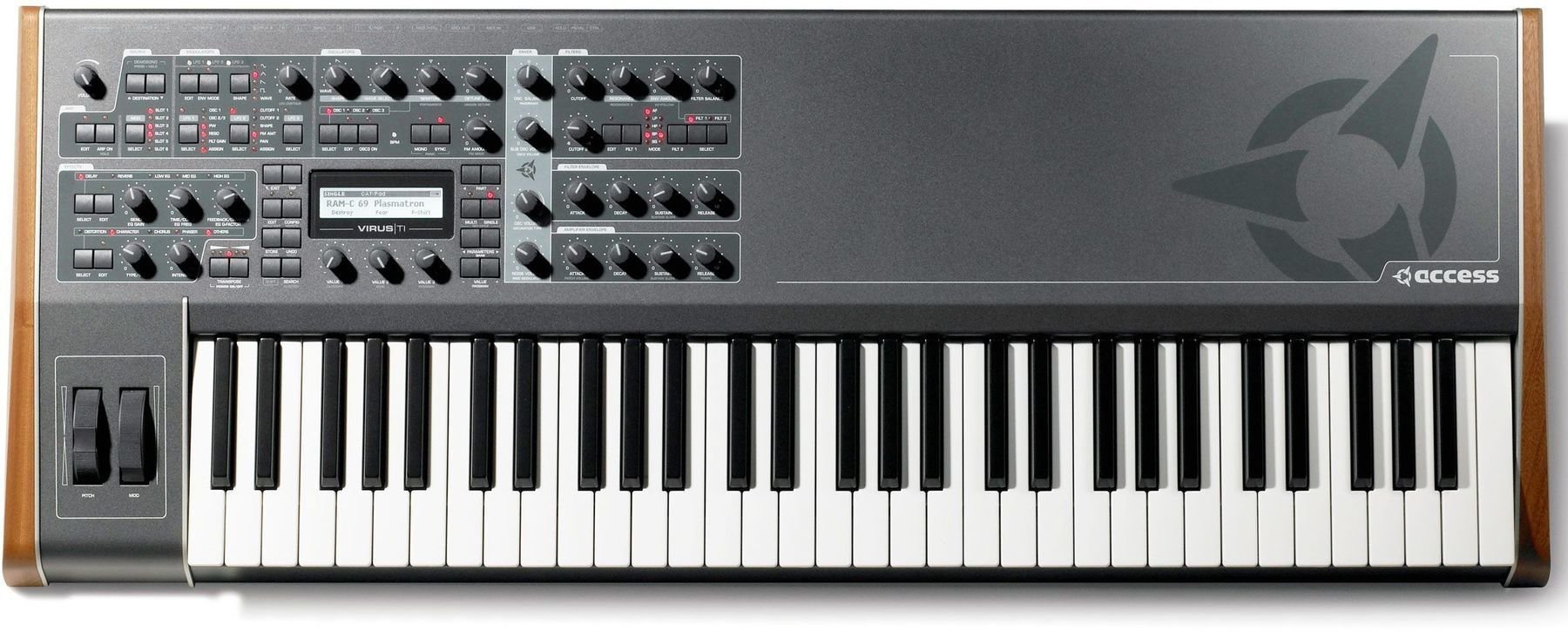
- Manufacturer: Access Music GmbH, Germany
- Year: 2005
- Production years: 2005–2009 for the original TI Keyboard generation, before the TI2 revision replaced it
- Synthesis type: DSP-based virtual analog with HyperSaw, wavetable, graintable, formant, FM, sync, sub-oscillator, and noise generation
- Category: 61-key digital performance synthesizer / keyboard synthesizer
- Polyphony: Variable; roughly 20 to 90 voices depending on patch complexity
- Period price signal: Documented late-2000s U.S. retail pricing around $2,560; current values are determined mainly by the used market
- Oscillators: 3 main oscillators plus sub-oscillator and noise source; extensive waveform and oscillator-mode options
- Filter: Dual multi-mode filter architecture with multiple routing options and analog-style models
- LFOs: 3 LFOs with extensive waveform selection
- Envelopes: 2 fast ADSTR envelopes
- Modulation system: 6-slot modulation matrix, each slot offering 1 source and 3 destinations
- Sequencer / arpeggiator: No onboard note sequencer; programmable 32-step arpeggiator with per-patch storage
- Effects: Deep integrated effects architecture including delay, reverb, chorus, flanger, phaser, EQ, distortion variants, ring modulation, vocoder, and more
- Memory: 512 RAM patches plus 3328 ROM sounds in the documented TI architecture
- Keyboard: 61 keys with velocity and aftertouch
- Inputs / outputs: 6 balanced outputs, stereo headphone output, S/PDIF digital I/O, balanced audio inputs, pedal inputs
- MIDI / USB: MIDI In/Out/Thru plus USB integration for audio/MIDI and plug-in control workflows
- Display: 128 x 32 backlit LCD
- Dimensions / weight: 99.5 cm x 37 cm x 11.5 cm; about 13.9 kg
- Power: 100–240V AC, 50–60 Hz, maximum continuous power around 30W
Strengths
- A genuinely expansive sound engine: The TI Keyboard is not limited to classic subtractive emulation. Its combination of virtual analog, wavetable-style behavior, HyperSaw mass, graintable textures, and complex modulation lets it cover a much broader sonic field than many of its direct rivals.
- Huge musical range within a single hardware instrument: It can move convincingly from trance and EDM staples to cinematic pads, EBM aggression, digital ambient, progressive textures, and dense pop production layers without feeling like it is leaving its comfort zone.
- Strong multitimbral value: Sixteen-part multitimbrality, multiple outputs, and integrated effects make it more than a one-sound-at-a-time performance keyboard. It can function as a serious production hub.
- Powerful arpeggiator and patch design logic: The per-patch programmable arpeggiator and the ability to store complex sound behavior directly into patches make it especially strong for rhythmically animated electronic music.
- Hands-on control surface: Compared with menu-heavy digital workstations of its time, the TI Keyboard remains relatively immediate. It offers enough direct control to make deep editing feel musical rather than administrative.
- A clear sonic identity: Many versatile synths end up feeling generic. The Virus does not. Even when it covers a wide range, it still tends to sound unmistakably like a Virus.
- Historically important hybrid concept: The Total Integration idea was not a marketing side note. It was central to the instrument’s appeal and helped define how many musicians imagined hardware could coexist with software.
Limitations
- Its signature sound is strong enough to become a fingerprint: That is a strength until it is not. Producers who want every patch to disappear into a neutral role may find the Virus character too recognizable.
- Patch complexity affects available polyphony: The TI can deliver a lot of voices, but not in a simple fixed way. Heavy oscillator modes, effects, and dense programming reduce the headline voice count quickly.
- The original Total Integration concept is more era-specific now than it was in 2005: As computer platforms changed, the plug-in side of the TI became less universally frictionless than the original vision implied.
- Large and heavy for players who do not need the keyboard: At nearly 14 kg, the keyboard version is substantial. For many studio users, the desktop model has always been the more practical choice.
- No onboard step sequencer in the modern sense: The arpeggiator is powerful, but musicians expecting a deeper integrated sequencing environment may still need external gear or software.
- Used-market ownership requires caution: As with many aging digital flagships, condition, display health, encoders, buttons, and power-related issues matter more than they do with newer, supported instruments.
Historical context
The Virus TI Keyboard arrived at a very specific moment in synthesizer history. By 2005, software instruments were no longer a novelty. They were already changing studio habits, price expectations, and ideas about what counted as a serious synthesizer. Access had built the Virus name through the late 1990s and early 2000s as one of the most respected virtual-analog lines on the market, particularly in trance, industrial, and electronic production circles. But the TI generation did not merely refresh the Virus formula. It answered a strategic question: how could a premium hardware synth remain relevant in an increasingly plug-in-centered world?
Access’s answer was not retreat, but escalation. The TI generation deepened the synthesis engine, expanded the effects structure, kept the hands-on hardware appeal, and wrapped the entire concept in a DAW-facing integration layer. In that sense, the TI Keyboard was both a continuation and a correction. It preserved the Virus sound while acknowledging that musicians no longer wanted hardware to live in isolation.
That timing mattered. Many digital synths of the era either leaned toward workstation complexity or toward simplified live performance roles. The Virus TI Keyboard instead positioned itself as a specialized electronic-music flagship: a machine for synthesis, performance, multitimbral production, and studio integration. When the TI2 revision arrived in 2009 with more processing power and a redesigned enclosure, it confirmed that the TI concept had worked. The original TI Keyboard had already defined the architecture the revised line would continue.
Legacy and significance
The Access Virus TI Keyboard matters because it represents one of the last great moments when high-end digital hardware tried to solve the software problem on its own terms. It did not pretend computers were irrelevant. It tried to absorb them into the identity of the instrument.
That makes it historically significant in two different ways. First, it was one of the most complete and convincing virtual-analog flagships ever built. Not because it perfectly reproduced every vintage synth before it, but because it established its own standard of what modern digital synthesis could be: broad, muscular, programmable, and unapologetically polished. Second, it embodied a now very recognizable chapter in music technology, when manufacturers believed the future would belong to deeply integrated hybrids rather than to software alone.
There is also a cultural dimension to its legacy. The Virus line became one of the defining sounds of a certain electronic mainstream, especially in styles where brightness, scale, control, and movement mattered more than analog purism. The TI Keyboard did not broaden access by becoming cheap or stripped down. It broadened access by making an elite sound-design platform more comprehensive, more integrated, and more musically versatile than many of its peers.
For that reason, the TI Keyboard is not remembered just as a successful product. It is remembered as a worldview: that a digital synth could be luxurious, central, and future-facing, rather than merely practical.
Artists, users, and curiosities
Access’s own Virus artist ecosystem tells an important part of the story. The official Hall of Fame associated the Virus line with artists and producers across electronic, pop, industrial, and film music, including Trentemøller, BT, Depeche Mode, Linkin Park, Paul van Dyk, Armin van Buuren, Deadmau5, Jean-Michel Jarre, and Hans Zimmer. That breadth matters because it shows the Virus was never only a trance machine, even if trance helped cement its image.
One useful distinction is that the Virus name often traveled as a family rather than as a single exact model. In other words, many public artist associations refer to the broader Virus line rather than to the TI Keyboard specifically. Even so, that still helps explain the TI Keyboard’s place in culture: it inherited a reputation that had already become global, then translated that reputation into a more studio-integrated flagship format.
A memorable curiosity is the role of sound designer Howard Scarr in the Virus ecosystem. His programming tutorials and sound banks became part of the instrument’s intellectual afterlife, helping users treat the Virus not just as a preset machine, but as a serious platform for learning synthesis. That matters because the TI Keyboard’s reputation was built not only on what it shipped with, but on how deeply users could grow into it.
Another curiosity is that the phrase “Total Integration,” which sounded almost futuristic in 2005, now reads like a time capsule from a period when hardware makers believed the best response to software was not imitation, but partnership. In retrospect, that ambition is one of the most fascinating things about the TI Keyboard.
Market value
- Current market position: The Virus TI Keyboard sits firmly in digital-classic territory. It is no longer judged only as a used workhorse, but also as a historically important flagship from the last great virtual-analog hardware wave.
- New price signal: There is no meaningful mainstream new-market position for the original TI Keyboard now; the instrument is fundamentally a used-market purchase.
- Used market signal: Prices vary widely by condition, originality, included accessories, and region. Real-world asking prices often land in the low-to-upper four-figure range in euros or dollars rather than bargain territory.
- Availability: It is findable, but not ubiquitous. Desktop TI units appear more regularly than the keyboard version, and clean keyboard examples tend to draw strong interest.
- Buyer notes: Confirm the exact version, operating condition, display behavior, encoder/button health, power supply situation, and whether the seller has tested USB integration or only standard MIDI operation.
- Support ecosystem: Official manuals, downloads, installers, compatibility information, and repair-contact resources remain available online, which still helps ownership.
- Ease of finding one: Moderate. It is not impossible to source, but strong examples are less common than many mass-market digital synths.
- Long-term position: The model appears stable to firm rather than overlooked. It has moved beyond “old digital synth” status and is increasingly treated as a serious legacy instrument.
Conclusion
The Access Virus TI Keyboard was not simply a bigger Virus with a USB port. It was one of the clearest flagship statements of the mid-2000s synthesis world: powerful digital hardware, deep sound design, multitimbral seriousness, and a bold attempt to fuse the keyboard instrument with the DAW era. Its importance lies not only in its features, but in the confidence of its design. It assumed that musicians still wanted a real machine at the center of their work, provided that machine could speak fluently with software. That confidence is exactly why the Virus TI Keyboard still matters.