

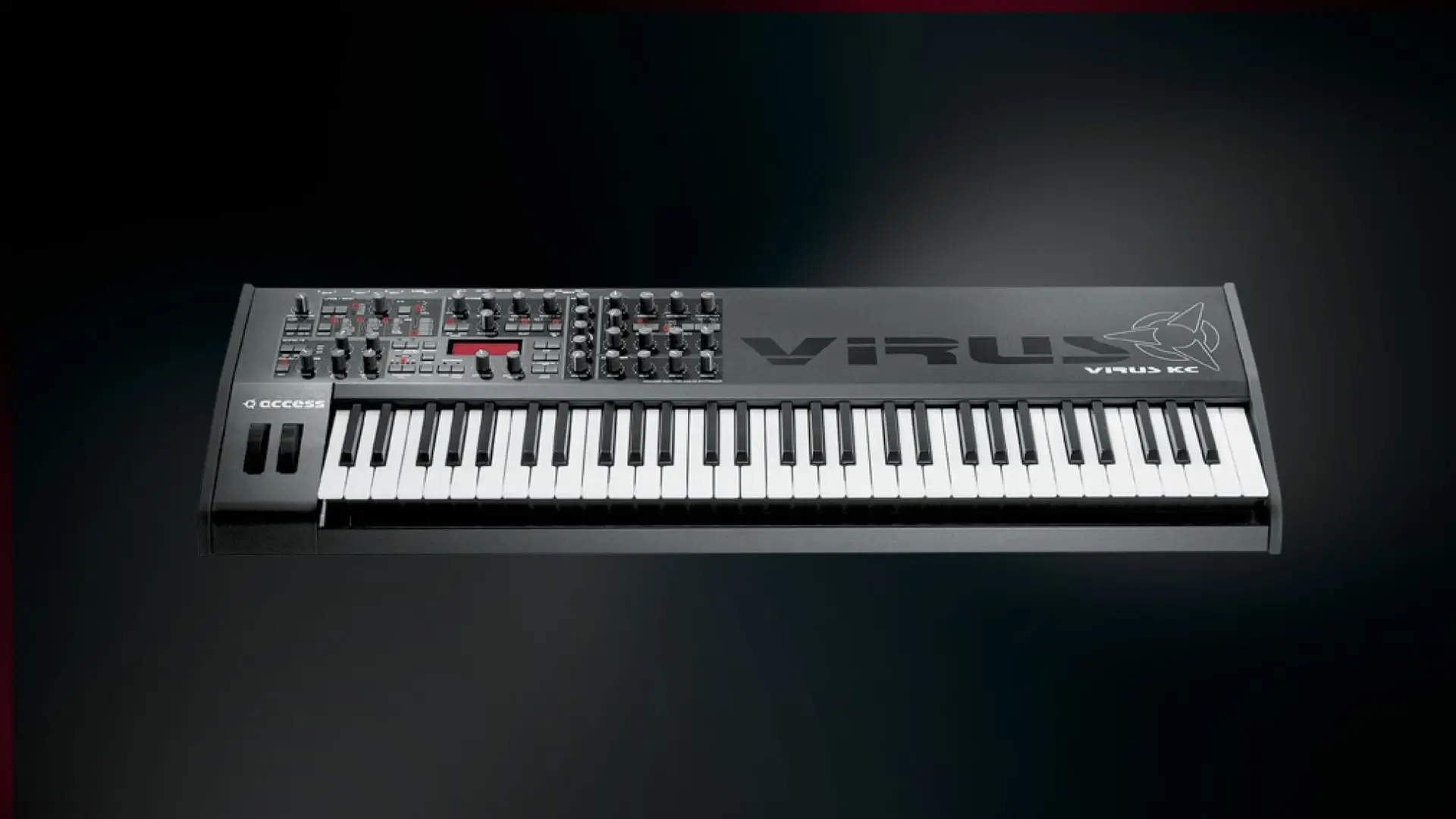
The Access Virus KC is the 61-key keyboard version of the Virus C, introduced in 2002 as a DSP-based virtual-analog synthesizer with 32 voices, 16-part multitimbrality, deep modulation, onboard effects, and a performance-oriented semi-weighted keyboard with velocity and aftertouch. It matters because it turned the Virus C engine into a full-size stage and studio instrument: not merely a desktop sound module with keys attached, but a hands-on digital polysynth designed to make the Virus language playable, immediate, and physically commanding.
Table of Contents
Access Virus KC sound and character
The Access Virus KC occupies a distinct place in early-2000s virtual analog: polished but forceful, digital but not sterile, flexible without losing a recognizable personality. Its tone is not built around the instability of voltage-controlled analog circuits. Instead, its character comes from density, modulation depth, filter routing, oscillator variation, effects integration, and the way those elements can be stacked into animated, high-impact sounds.
In practice, the Access Virus KC is especially strong at wide pads, trance-style leads, synthetic basses, rhythmic arpeggiated patterns, aggressive digital textures, and hybrid sounds that sit somewhere between analog imitation and deliberately modern synthesis. The three main oscillators, sub-oscillator, spectral waves, FM options, oscillator sync, dual multimode filters, and large effects section give it a broad vocabulary. It can be smooth and atmospheric, but it can also become sharp, metallic, saturated, or rhythmically complex very quickly.
The instrument’s strength is not that it perfectly replaces a vintage analog polysynth. Its strength is that it translates analog-style architecture into a digital performance system with far more internal routing, recall, multitimbral control, and effects processing than most classic analog instruments could offer. That is why the Access Virus KC feels historically tied to the electronic production culture of its era: it is a synthesizer designed for layered arrangements, tempo-synced movement, and studio-ready sound without requiring a large external effects chain.
Features and architecture
- Manufacturer: Access Music.
- Year: 2002.
- Production years: documented as introduced/produced in 2002; the exact final production year is not stated here because it could not be confidently verified from the reviewed sources.
- Synthesis type: DSP-based virtual analog and subtractive synthesis with FM, spectral waveforms, oscillator sync, dual filters, modulation matrix, vocoder, and onboard effects.
- Category: 61-key digital virtual-analog performance synthesizer keyboard.
- Polyphony: 32 voices, with 16-part multitimbral capability. Voice count may decrease when more demanding oscillator configurations are used.
- Original price and current market price: original KC MSRP was not included because it could not be confidently verified. Current used-market pricing is variable and depends strongly on condition, region, and availability.
- Oscillators: three main oscillators plus one sub-oscillator per voice; sawtooth, variable pulse, sine, triangle, additional spectral waveforms, oscillator sync, and FM options.
- Filter: two independent resonant multimode filters with low-pass, high-pass, band-pass, and band-reject modes; serial and parallel configurations; up to six-pole / 36 dB operation depending on routing.
- LFOs: three LFOs with 68 shapes, loop or envelope-style behavior, and MIDI clock sync.
- Envelopes: two ADSTR envelopes.
- Modulation system: modulation matrix with six source slots and nine destination slots; two assignable soft knobs; MIDI tempo sync for time-based parameters.
- Sequencer / arpeggiator: 16 independent arpeggiators with multiple patterns, real-time parameter access, swing, and note-length control.
- Effects: 98 simultaneous DSP effects, including reverb, 3-band EQ, phaser, distortion/saturation/Lo-Fi processing, chorus/flanger, delay, 32-band vocoder, ring modulation, and Analog Boost.
- Memory: 1024 programs, structured as 256 user programs, 768 ROM programs, and 128 multi programs.
- Keyboard: 61 semi-weighted keys with velocity and aftertouch.
- Performance controls: pitch bend wheel, modulation wheel, two jacks for switch or expression pedals, 32 knobs, 35 buttons, and 69 LEDs.
- Inputs / outputs: six individual outputs and two audio inputs for processing external signals through the synth engine, filters, envelopes, effects, vocoder, FM, and ring modulation.
- MIDI / USB: complete MIDI control via CC, poly pressure, and SysEx; operating-system updates via MIDI. USB is not listed among the verified KC specifications.
- Display: front-panel display information is not specified in the verified product specifications used here; the control surface is documented with 69 LEDs.
- Dimensions / weight: 975 x 351 x 112 mm; 13 kg, or 16.5 kg with packaging.
- Power: internal power supply.
Strengths
- The KC gives the Virus C engine a serious performance format. The 61-key semi-weighted keyboard, velocity, aftertouch, wheels, pedal inputs, and master-keyboard functions make it more playable than the desktop module and more expansive than the compact Indigo-style formats.
- Its architecture is unusually complete for a virtual-analog keyboard of its era. Three oscillators plus sub, dual filters, FM, spectral waves, multitimbrality, arpeggiators, a modulation matrix, and a large effects section make it capable of handling entire electronic arrangements rather than only single lead or pad duties.
- The sound engine rewards movement. Tempo-synced LFOs, arpeggiators, delays, modulation destinations, and effect parameters allow patches to evolve rhythmically, which makes the Access Virus KC particularly effective for electronic genres built around pulse, repetition, and gradual transformation.
- The onboard effects are central to the instrument rather than decorative. Reverb, delay, phaser, chorus/flanger, EQ, distortion, vocoder, and ring modulation help define the finished character of a patch inside the synth itself.
- The interface remains a major part of its appeal. With 32 knobs, 35 buttons, soft knobs, and extensive front-panel feedback, the Access Virus KC keeps a deep digital instrument from becoming purely menu-driven.
- Its 16-part multitimbrality gives it strong studio value. The Access Virus KC can function as a multi-part sound source for layered MIDI arrangements, which was especially important in the hardware-centered production environments of the early 2000s.
Limitations
- The 32-voice ceiling is generous for its period but not unlimited. Complex patches, layered parts, heavy unison, and multi-part arrangements can consume voices quickly.
- It does not offer the later Total Integration workflow of the Virus TI generation. The Access Virus KC belongs to the MIDI/SysEx era, not the USB plug-in integration era.
- It is physically substantial. At 13 kg and nearly a meter wide, it is much less convenient than a desktop Virus C or a compact keyboard such as the Indigo 2.
- The original KC price and exact end of production are not confidently established in the reviewed sources. That makes historical pricing and long-term market interpretation less precise than with better-documented mass-market instruments.
- Used-condition risk matters. The Access Virus KC is now a two-decade-old digital keyboard, so buyers need to evaluate keybed condition, aftertouch response, display behavior, knobs, buttons, outputs, and general service history.
- It is not an analog polysynth. Players looking for voltage-controlled drift, analog oscillator behavior, or vintage component irregularity may find the Access Virus KC too precise or too produced.
Historical context
The Virus C appeared in 2002 as the successor to the Virus B line, increasing polyphony from 24 to 32 voices while expanding the modulation matrix, effects, program memory, front-panel control, and overall production capacity of the platform. The KC translated that generation into a full-size keyboard instrument.
That timing matters. By the early 2000s, software instruments were becoming more important, but hardware virtual-analog synthesizers still occupied a central role in electronic studios. The Virus line did not compete by pretending to be only a vintage analog substitute. It competed by becoming a complete production synthesizer: multitimbral, programmable, effects-heavy, MIDI-controllable, and sonically associated with dense modern electronic music.
The Access Virus KC sits between two important Virus identities. On one side, it belongs to the pre-TI era, when the Virus was still fundamentally a self-contained hardware instrument. On the other side, it anticipates the later idea that a Virus could act as the center of a hybrid studio. It does not have the computer integration of the TI line, but it already shows the ambition: one instrument, many parts, deep control, finished sound.