

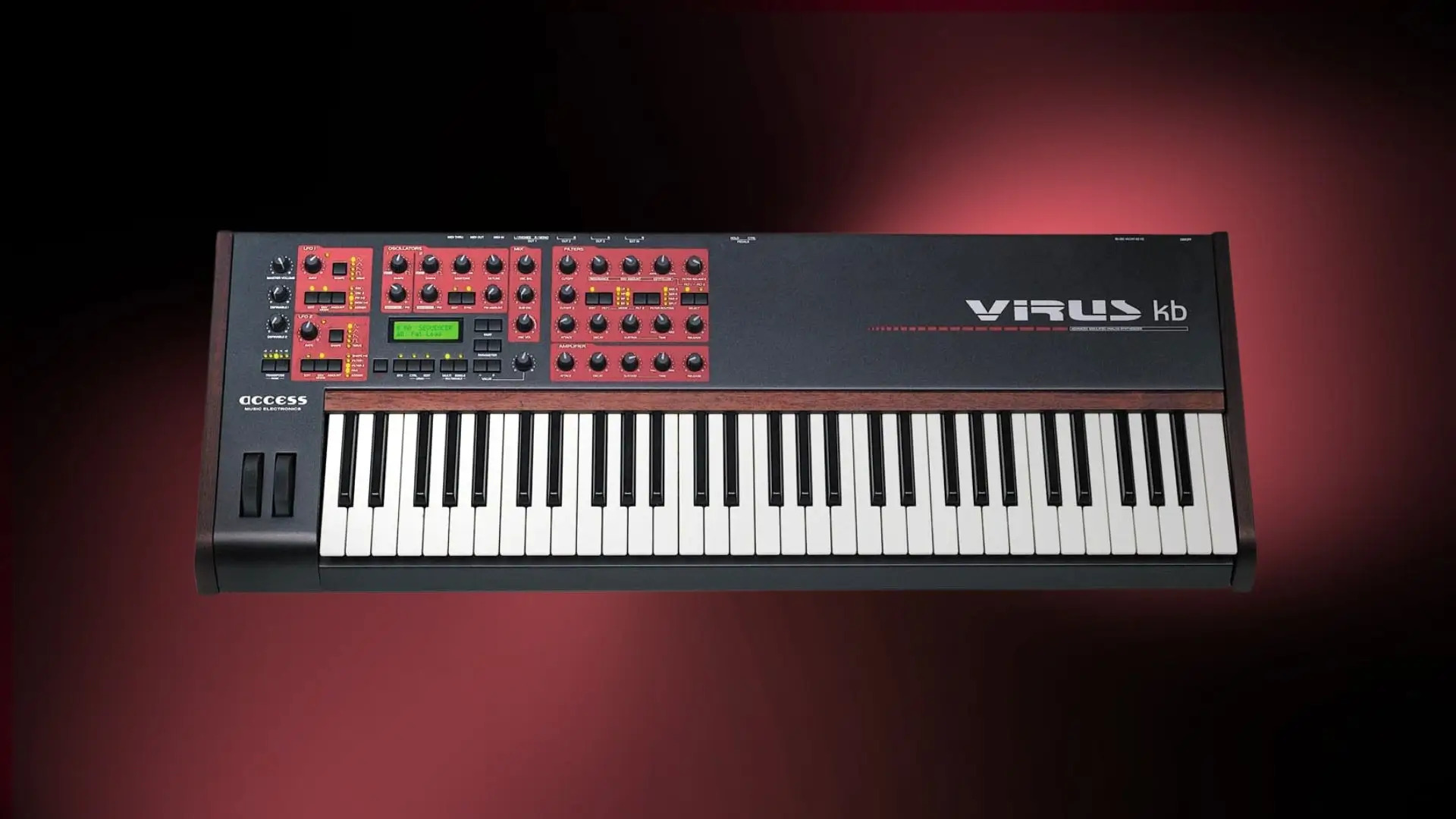
The Access Virus kb is the 61-key keyboard version of the Virus b, a German digital virtual-analog synthesizer from the turn of the millennium that placed the Virus sound engine inside a full performance instrument. Access’s own brochure describes the kb as the keyboard version of the Virus b, with a 61-key aftertouch-equipped keyboard, 24 voices, 16-part multitimbrality, three main oscillators plus a sub-oscillator per voice, dual multimode filters, extensive DSP effects, MIDI control, and six analog outputs. It matters because it did not simply add keys to a module; it turned one of the defining late-1990s virtual-analog engines into a self-contained stage and studio instrument.
Table of Contents
Access Virus kb sound and character
The Access Virus kb has the sound identity associated with the early Virus line: dark, dense, slightly polished, and unmistakably digital in the best sense of that word. It is a virtual-analog synth, but its character does not come only from imitating analog subtractive circuits. Its personality comes from the combination of subtractive architecture, spectral waveforms, oscillator FM, ring modulation, saturation, flexible filtering, and a large DSP effects section.
In practice, it is strongest when it is allowed to behave like a late-1990s digital performance polysynth rather than a museum-grade analog clone. It excels at wide pads, trance and techno leads, metallic digital sweeps, resonant basses, synthetic percussion, vocoder textures, rhythmic arpeggios, and layered electronic parts. The dual filters can move from familiar low-pass shaping into more complex serial and parallel routings, while the distortion, analog boost, phaser, chorus/flanger, delay, reverb, and vocoder help push the sound beyond a dry oscillator-filter-amplifier architecture.
Its tone is not fragile or delicate by default. It tends toward saturated, compact, mix-ready density. That is part of its cultural identity: the Virus line became associated with electronic production because it could generate finished-sounding timbres inside the Access Virus kb, not merely raw tones waiting for a studio chain.
Features and architecture
- Manufacturer: Access Music Electronics GmbH.
- Year: Access’s brochure describes the Access Virus kb as first introduced in 1998; major product databases commonly list the Access Virus kb/Virus B production era as 1999–2002.
- Production years: generally listed as 1999–2002.
- Synthesis type: digital virtual analog / subtractive synthesis, with spectral waves, FM, ring modulation, and extensive DSP processing.
- Category: 61-key digital polysynth / virtual-analog performance synthesizer.
- Polyphony: 24 voices, with the important caveat that heavy use of the third oscillator can reduce available polyphony.
- Multitimbrality: 16-part multitimbral operation.
- Original price: not included here because a reliable launch MSRP could not be verified from the accessible sources.
- Current market price: scattered and condition-dependent; recent and archived signals range from lower European local listings to ended Reverb listings around the low four-figure US-dollar/euro range.
- Oscillators: three main oscillators plus one sub-oscillator per voice; sawtooth, variable pulse, sine, triangle, and additional spectral waves; oscillator FM and ring modulation are part of the sound design vocabulary.
- Filter: two fully independent multimode filters with serial and parallel routings; low-pass, high-pass, band-pass, and band-reject modes; up to six poles / 36 dB per voice.
- LFOs: three LFOs with 68 shapes, envelope operating mode, and MIDI-clock synchronization.
- Envelopes: two ADSTR envelopes.
- Modulation system: complex modulation matrix with more than 110 destinations, plus MIDI parameter control and Access’s Adaptive Control Smoothing.
- Sequencer / arpeggiator: no conventional onboard sequencer; 16 independent arpeggiators with patterns, real-time control, swing factor, note length, and MIDI-clock synchronization.
- Effects: up to 82 simultaneous DSP effects, including reverb, retro phaser, saturation/distortion/LoFi effects, chorus/flanger, voice saturation/distortion, groove delay, 32-band vocoder, ring modulator, and analog boost.
- Memory: Access’s 2000 brochure lists 512 sounds, divided as 256 RAM, 256 ROM, and 128 multis; later database references list expanded program counts, so memory should be treated as OS/version-dependent.
- Keyboard: 61 light-weighted keys with aftertouch, plus assignable wheels.
- Inputs / outputs: two analog inputs, six analog outputs, and two multipurpose pedal connectors.
- MIDI / USB: MIDI In, Out, and Thru; USB is not part of the verified kb specification.
- Display: front-panel display with knob-and-button editing architecture; no modern high-resolution graphical interface.
- Dimensions / weight: 993 mm × 360 mm × 115 mm; 13 kg.
- Power: internal power supply.
Strengths
- The Access Virus kb gives the Virus b engine a proper keyboard identity, which makes it more immediate as a performance instrument than the desktop module.
- Its 61-key aftertouch-equipped format makes it better suited to pads, evolving filter movements, expressive leads, and split/layer performance than compact virtual-analog keyboards of the same era.
- The sound engine is unusually broad for its period: subtractive synthesis, spectral waves, FM, ring modulation, dual filters, modulation, vocoder, and effects all live inside one integrated architecture.
- The six analog outputs make the Access Virus kb more flexible in studio routing than a simple stereo-output keyboard.
- The effects are central to the Access Virus kb’s identity rather than decorative extras; they help explain why Virus patches often sound complete before external processing.
- The 16-part multitimbral structure makes it viable as a central electronic production instrument, especially for MIDI-based hardware setups.
- The arpeggiator system gives the kb a strong rhythmic identity, which fits the late-1990s and early-2000s dance-music context in which the Virus became important.
- The keyboard version preserves the seriousness of the Virus b while making it less dependent on an external controller.
Limitations
- Its 24-voice polyphony can shrink in demanding patches, especially when the third oscillator and effects-heavy sounds are used aggressively.
- It has no modern USB audio/MIDI integration, so it belongs to a MIDI-and-audio-cable workflow rather than a contemporary plug-in-style studio environment.
- The interface is hands-on by late-1990s standards, but deeper programming still involves menu navigation and a small display.
- It is a large 61-key instrument, which makes it less convenient than a desktop Virus B for small studios or mobile setups.
- Current availability is inconsistent; clean examples are not always easy to find, and shipping a 13 kg vintage keyboard adds risk and cost.
- Memory, OS condition, battery condition, encoders, outputs, inputs, keys, aftertouch, wheels, and display health matter more than they would on a newer instrument.
- It does not have the later Virus TI features such as USB-based integration, HyperSaw, wavetable oscillators, or the larger TI-era sound library.
- It can be overvalued when sellers treat every Virus keyboard as automatically collectible, even though condition and service history vary widely.
Historical context
The Access Virus kb belongs to the moment when virtual analog synthesis stopped feeling like a compromise and became a serious electronic-music language of its own. The original Virus line emerged after the mid-1990s virtual-analog wave, but the Virus b and kb refined the concept into something broader, darker, and more production-oriented. The kb did not introduce a new synthesis category; its importance was more practical and cultural. It made the Virus b into a keyboard instrument at a time when hardware performance, MIDI sequencing, and dance-music production were still deeply connected.
This timing matters. By the late 1990s and early 2000s, electronic musicians needed instruments that could do more than recreate analog leads and basses. They needed multitimbral parts, effects, MIDI sync, arpeggiators, patch memory, complex modulation, external audio processing, and sounds that could sit inside dense arrangements. The Access Virus kb answered that environment directly. It was not a nostalgic analog revival instrument. It was a digital polysynth built for a studio culture in which the Access Virus kb was expected to be sound source, effects processor, performance controller, and production tool.
Within Access’s own history, the kb sits between the earlier Virus A era and the more elaborate Virus C and TI generations. It is less expansive than the later TI models, but that also gives it a specific appeal: it captures the Virus identity before the line became more computer-integrated and feature-heavy.