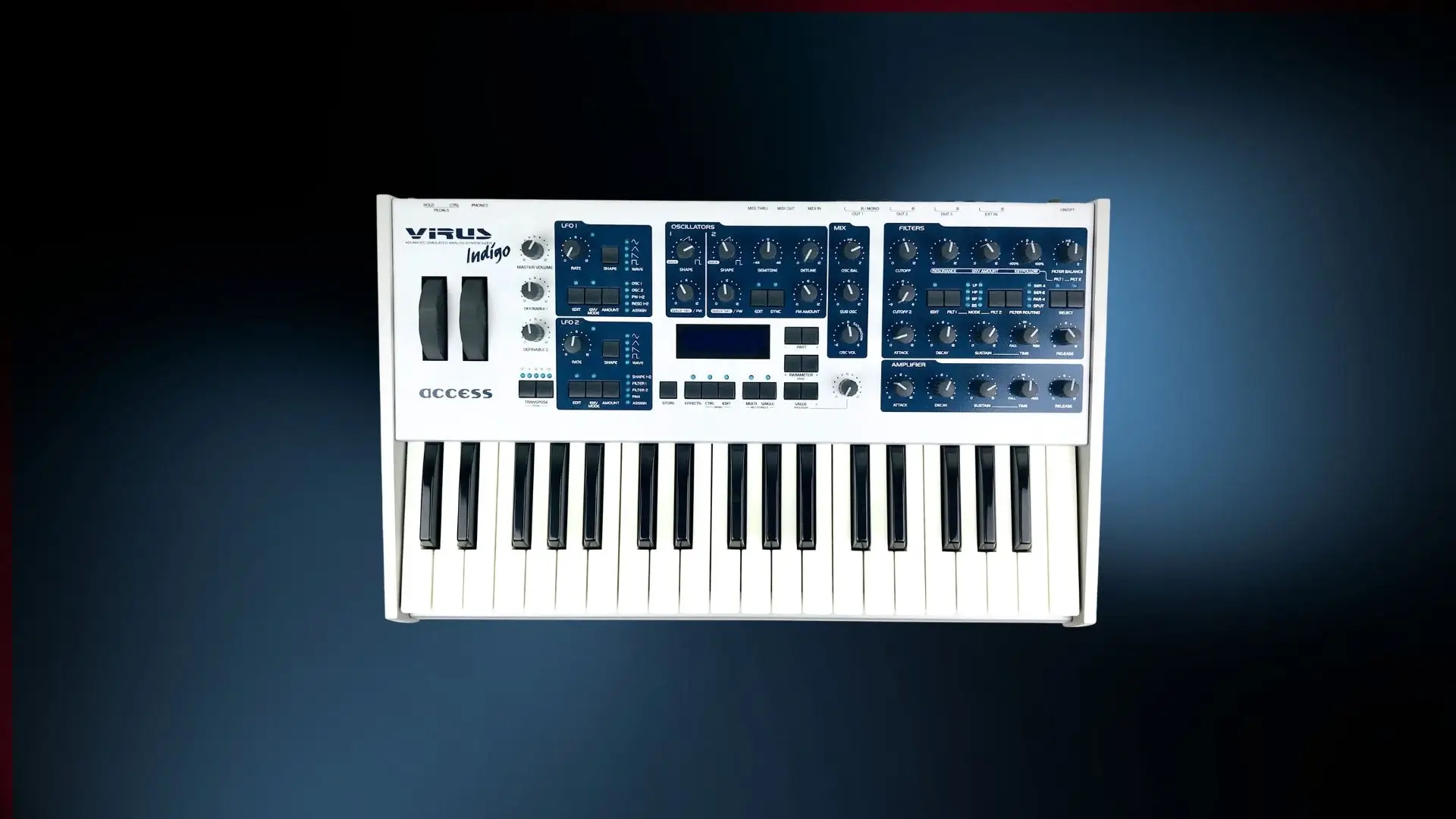
The Access Virus Indigo matters because it made the Virus identity more physically approachable. The full Virus story is often told through engines and generations: A, B, C, TI, TI2. But instruments also become historically meaningful through form factor. The Access Virus Indigo turned the Virus B from a powerful sound engine into a compact object of performance culture: small enough for a tight studio, serious enough for stage use, and distinctive enough to become visually memorable.
Its legacy is also tied to the broader moment when digital synthesizers stopped apologizing for not being analog. The Indigo did not need to be a clone of a Minimoog, Prophet, or Jupiter. Its value was in building an electronic vocabulary that belonged to turn-of-the-century production: hard sync lines, animated pads, synthetic basses, trance leads, vocoder textures, tempo-locked motion, and layered multitimbral programming. In retrospect, that sound is not merely “digital”; it is a specific historical accent.
The instrument also shows why the Virus line had such staying power. Access did not build a one-trick virtual analog. It built an ecosystem of related instruments that could function as sound module, keyboard, compact performance board, plug-in concept, and later software-integrated hardware. The Access Virus Indigo is one of the clearest examples of that strategy: not the largest Virus, not the most advanced Virus, but one of the most coherent in terms of size, function, and musical purpose.
The Virus family is widely associated with electronic producers, dance music, industrial, synth-pop, film scoring, and hybrid rock/electronic production. For the specific Indigo hardware, one notable documented studio association appears in reporting on Linkin Park’s A Thousand Suns sessions, where bass parts were tracked using a combination of GForce soft synths and hardware instruments including a Roland Juno-106, Access Virus Indigo, and Virus TI Polar. That kind of use is telling: the Access Virus Indigo was not only a trance lead machine, but also a practical studio color for hybrid productions where bass, synth, and processed textures blur together.
A useful curiosity is that “Access Virus Indigo” also became the name of a Pro Tools TDM plug-in version of the Access instrument. The software guide describes it as a real-time TDM plug-in version of Access Music’s Virus Indigo synthesizer, with standard and expanded voice-count versions for Pro Tools HD systems. Even more interestingly, the guide explains that owners of the hardware Virus could use it as a control surface for the plug-in. That makes the Access Virus Indigo part of a transitional moment in music technology: hardware synthesizer, digital signal processing, DAW integration, and tactile control all meeting before the later Virus TI concept made “total integration” the official headline.
The other curiosity is visual. The Access Virus Indigo’s compact 37-key body and blue-grey styling gave the Virus line a recognizable small-format keyboard identity years before the Virus TI Polar carried the idea into the TI era. In that sense, the Access Virus Indigo was not only a reduced Virus B; it was a design prototype for the idea that a serious flagship-derived engine could live in a compact keyboard without feeling like an entry-level compromise.
- Current market position: Discontinued compact Virus keyboard with cult appeal, especially attractive to buyers who want the Virus B sound in a portable key-equipped format.
- New price signal: There is no normal new-market price because the original Access Virus Indigo has long been out of production.
- Used market signal: Used references commonly sit around the high hundreds to roughly $1,200, though actual prices vary heavily by region, condition, accessories, and whether the listing is for Indigo 1, Indigo 2, or a limited variant.
- Availability: Not impossible to find, but not abundant. Listings appear intermittently rather than continuously in every market.
- Buyer notes: Confirm whether the unit is the original Access Virus Indigo or Indigo 2, because the original is Virus B-based while the Indigo 2 is Virus C-based.
- Buyer notes: Check LCD readability, button and encoder response, keyboard condition, aftertouch response, audio outputs, MIDI ports, power supply, and internal battery status.
- Support ecosystem: Access still hosts manuals and downloads for Virus generations, and third-party editor/librarian tools also exist, but the buyer should treat the instrument as legacy hardware rather than a currently developed platform.
- Ease of ownership: Easier than many obscure vintage digitals because the Virus community is still active and the architecture is well documented, but harder than buying a current synth with warranty and factory support.
- Price behavior: The Indigo appears more stable-to-rising than forgotten. Its value is supported by the broader Virus reputation, the end of Virus production, and continued demand for hands-on digital hardware with a recognizable sound.
- Collectibility: Collectible, but not purely decorative. Its strongest value remains practical: it is still a serious multitimbral digital synthesizer with keys, effects, and a historically specific sound.
The Access Virus Indigo represents a precise moment in synthesizer history: the point where virtual analog had matured, electronic production was becoming increasingly DAW-aware, and musicians still wanted hardware that felt immediate, portable, and complete. It is not the most advanced Virus and not the most expansive keyboard in the family. Its importance is more focused than that.
The Access Virus Indigo took the Virus B engine and gave it a compact performance body, creating an instrument that captured the sound and workflow of early-2000s digital synthesis without reducing it to a module or a preset box. Its lasting appeal is exactly that balance: compact size, serious architecture, unmistakable Virus character, and a place in the cultural memory of electronic hardware before software fully took over the studio.