

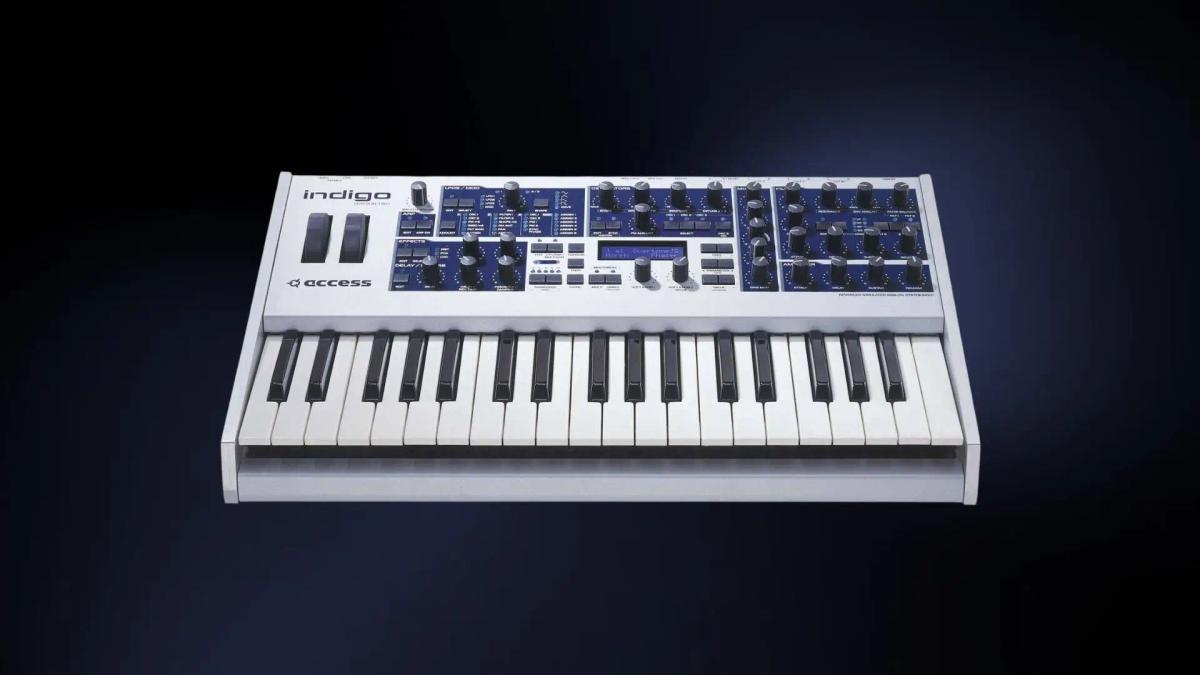
The Access Virus Indigo 2 is a 37-key digital virtual-analog synthesizer introduced in 2002 as the compact keyboard version of the Virus C engine. It brought the mature pre-TI Virus architecture into a portable, performance-oriented format, combining 32-voice polyphony, 16-part multitimbrality, a deep modulation system, extensive onboard effects, and a distinctive silver-and-blue stage presence. Its importance lies not in being the largest or most technologically final Virus, but in how completely it condensed the early-2000s Access sound into a compact instrument built for electronic musicians who wanted hardware immediacy without surrendering studio depth.
Table of Contents
Access Virus Indigo 2 sound and character
The Access Virus Indigo 2 belongs to the classic pre-TI Virus family: digital, polished, slightly dark, flexible, and unmistakably shaped by the early-2000s virtual-analog moment. It does not behave like a vintage analog polysynth, and judging it by that standard misses the point. Its character comes from a DSP engine designed to move quickly between subtractive synthesis, spectral waveforms, FM-style interactions, filter routing, saturation, effects, and tempo-synced modulation.
In practice, it excels at wide pads, tight basses, aggressive leads, trance plucks, moving arpeggios, metallic textures, synthetic strings, evolving atmospheres, and processed external signals. The Access Virus Indigo 2’s two multimode filters, multiple oscillator options, 3 LFOs, modulation matrix, and integrated effects make it especially strong at sounds that are neither purely analog emulation nor purely digital abstraction. It can be smooth and spacious, but it can also become hard-edged, nasal, compressed, and rhythmically animated.
The Access Virus Indigo 2’s sound is also inseparable from workflow. A patch can move from a basic sawtooth tone to a syncopated, effected, tempo-locked performance sound without requiring external processors. That was a major part of the Virus appeal: it was not merely an oscillator-and-filter synth, but a complete electronic production voice inside a hardware instrument.
Features and architecture
- Manufacturer: Access Music, Germany.
- Year: 2002.
- Production years: exact production end date not confidently verified in the sources checked; the model belongs to the Virus C era and predates the later Virus TI line.
- Synthesis type: digital virtual analog / subtractive synthesis, with additional spectral waves, FM options, ring modulation, external-input processing, and extensive DSP effects.
- Category: compact keyboard digital synthesizer / virtual-analog polysynth.
- Polyphony: up to 32 voices, depending on patch complexity.
- Multitimbrality: 16-part multitimbral.
- Original price signal: Sound On Sound listed the Access Virus Indigo 2 at £1199 including VAT in its 2002 review context.
- Current market price signal: recent used-market signals cluster around roughly $1,500 to $1,650 for standard units, with limited or special editions sometimes appearing higher.
- Oscillators: 3 main oscillators plus sub-oscillator per voice; sawtooth, variable pulse, sine, triangle, and additional spectral waves.
- Filter: 2 multimode filters, selectable as low-pass, high-pass, band-pass, or band-reject, with serial and parallel routing configurations up to 6 poles / 36 dB.
- LFOs: 3 LFOs with 68 LFO shapes, including loop or envelope-style modes and MIDI clock sync.
- Envelopes: 2 ADSTR envelopes.
- Modulation system: modulation matrix with 6 source slots and 9 destination slots.
- Sequencer / arpeggiator: no conventional onboard sequencer; includes 16 independent arpeggiators with pattern control, swing, note length, and real-time modulation access.
- Effects: onboard DSP effects including reverb, delay, chorus/flanger, phaser, distortion/saturation/lo-fi processing, ring modulator, 3-band EQ, Analog Boost, surround capabilities, and a 32-band vocoder.
- Memory: 1,024 programs, consisting of 256 user programs, 768 ROM programs, and 128 multi programs.
- Keyboard: 37-note velocity- and aftertouch-capable keyboard.
- Performance controls: pitch bend wheel, modulation wheel, 2 assignable soft knobs, master-keyboard functions, and 2 pedal inputs for switch or expression pedals.
- Inputs / outputs: 6 individual audio outputs and 2 audio inputs for processing external signals through the Access Virus Indigo 2 engine, filters, effects, vocoder, FM, and ring modulation.
- MIDI / USB: MIDI control and OS updates via MIDI; no USB integration like the later Virus TI generation.
- Display: bright LCD with the Indigo line’s distinctive blue visual language.
- Controls: 32 knobs, 35 buttons, and 69 blue LEDs.
- Dimensions / weight: 542 x 352 x 110 mm; 9 kg.
- Power: standard AC power connection; exact internal power specification not confidently verified from primary sources checked.
Strengths
- It gives the compact Indigo format the more advanced Virus C engine, making it a more capable instrument than the earlier Indigo based on the Virus B generation.
- The 32-voice, 16-part multitimbral architecture makes it unusually complete for a compact keyboard synth of its period.
- Its 37-key format is genuinely useful for players who want a self-contained performance instrument rather than a desktop module.
- The aftertouch-capable keyboard gives it a more expressive role than the original Indigo, which was criticized for lacking aftertouch.
- The modulation system, arpeggiators, tempo sync, and effects make it strong for complete electronic parts rather than only raw synth tones.
- The dual-filter architecture gives it more structural flexibility than simpler virtual-analog synths with a single conventional filter path.
- The onboard effects are not decorative; they are central to the Virus identity and help define the Access Virus Indigo 2’s finished, record-ready character.
- Its external-input processing turns it into a sound-design processor as well as a synthesizer.
- The physical design is memorable: aluminum side panels, blue LEDs, compact body, and a clear early-2000s performance aesthetic.
- It remains attractive because it captures the pre-TI Virus sound without the software-integration dependency that later became a point of debate for some TI users.
Limitations
- The 37-key range is compact and playable, but limiting for two-handed performance, splits, or broader harmonic work.
- There is no USB audio/MIDI integration, which makes it less convenient in modern DAW-based studios than the later Virus TI models.
- The Access Virus Indigo 2 is deep enough that some important functions require menu navigation, despite the generous front-panel controls.
- Polyphony can decrease depending on oscillator use, unison, effects, and patch complexity.
- The arpeggiator system is extensive, but the Access Virus Indigo 2 is not a full workstation or groovebox and should not be treated as one.
- Used units are now old enough that buyers must pay attention to encoders, buttons, outputs, display condition, battery/RAM behavior, and general service history.
- The used-market price can feel high when compared with modern software instruments or newer digital polysynths.
- Its sound is strongly associated with a specific late-1990s and early-2000s electronic vocabulary, which is a strength in the right context but can be too recognizable if used without restraint.
- Exact production-year boundaries are not clearly documented in the checked sources, which makes market dating less clean than for some Japanese or American synth lines.
- The later TI series added deeper DAW integration, USB, newer oscillator models, and higher variable polyphony, so the Access Virus Indigo 2 is not the final technical statement of the Virus line.
Historical context
The Access Virus Indigo 2 appeared at a moment when virtual analog had already moved past novelty and was becoming a professional language of electronic production. By 2002, musicians were no longer merely asking whether digital instruments could imitate analog synths. They were using DSP-based instruments as their own category: stable, programmable, multitimbral, effects-heavy, and ready for club-oriented production.
Access Music was founded in 1997, and the original Virus established the company as one of the important names in the virtual-analog market. The brand’s own history emphasizes that the Virus was not designed simply to clone a specific vintage synth. That matters because the Access Virus Indigo 2 reflects this philosophy clearly. It does not try to be a Minimoog, Prophet, Jupiter, or Oberheim in miniature. It is a Virus: a synth whose identity comes from a flexible digital oscillator section, elaborate modulation, dual filters, effects, and a deliberately modern sonic finish.
The Access Virus Indigo 2 also corrected an important practical issue in the first Indigo. The original Indigo gave players a compact three-octave Virus keyboard, but the Access Virus Indigo 2 added the Virus C engine and aftertouch, making the form factor more mature as a real performance instrument. In that sense, it was not just a cosmetic update. It was the point where the Indigo idea became technically serious enough to stand beside the larger Virus C keyboard versions rather than feeling like a reduced edition.